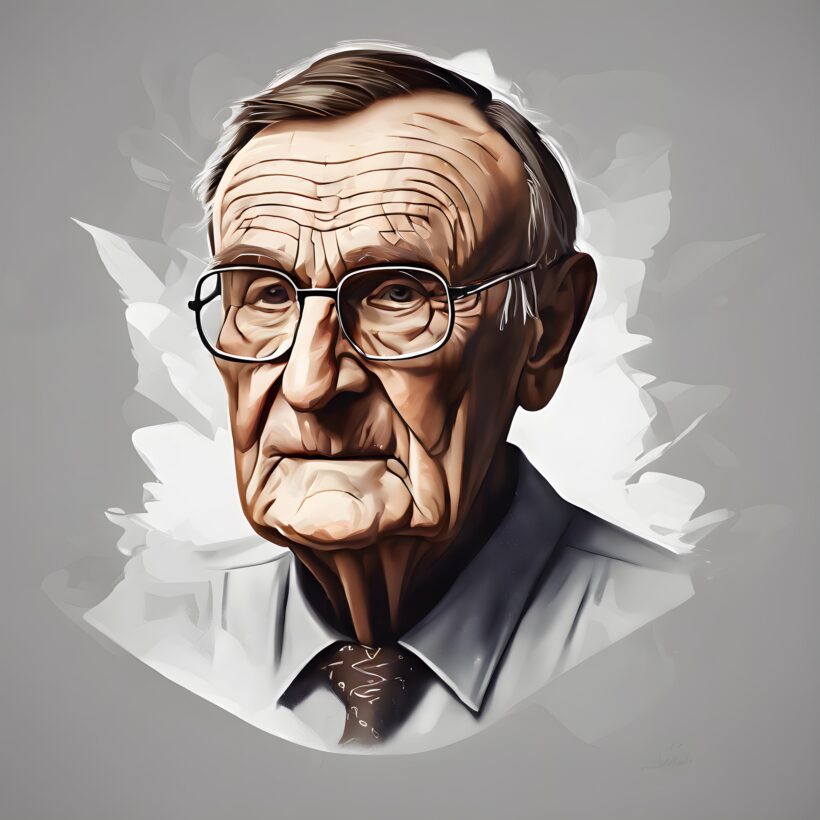

Ingvar Kamprad was a Swedish retail visionary whose name is forever synonymous with affordable, well-designed furniture. As the founder of IKEA, he turned a mail-order business run out of a Swedish farmhouse into one of the most recognized retail brands on earth. Kamprad’s genius lay in democratizing design — making stylish, functional home furnishings accessible to ordinary families around the world rather than reserving them for the wealthy. Though he passed away on January 27, 2018, at age 91, his legacy lives on through IKEA’s more than 460 stores across 62 countries. At the time of his death, Kamprad’s net worth was estimated at approximately $58.7 billion, a fortune built over seven decades of building, expanding, and relentlessly refining the company that bears his initials.
Early Life & Background
Ingvar Feodor Kamprad was born on March 30, 1926, on the family farm of Elmtaryd in Agunnaryd, a small rural parish in the Smaland region of southern Sweden. He was raised in modest circumstances, and from a remarkably young age he showed an extraordinary aptitude for commerce. At just five years old, Kamprad began buying boxes of matches in bulk from Stockholm and reselling them individually to neighbors at a small profit. By his early teens, he was selling fish, Christmas tree decorations, pencils, and pens to local buyers through informal market networks. Kamprad struggled with dyslexia throughout his life, a challenge he later credited with shaping his deep preference for clear, simple systems and direct communication — a philosophy that would come to define IKEA’s entire operational culture. When he excelled in school, his father rewarded him with a small sum of money. Kamprad used every penny of it to start a business.
Career & Rise to Success
Kamprad founded IKEA in 1943 at the age of 17. The name was an acronym combining his initials (I.K.) with Elmtaryd (E), his family farm, and Agunnaryd (A), his home parish. The early business sold small household items by mail-order catalog, distributed across rural Sweden via local milk delivery routes. By 1948, Kamprad had added furniture to the catalog. The transformative insight came in the late 1950s when an IKEA employee, trying to load a dining table into a car for delivery, removed the legs to make it fit. The flat-pack concept was born — by shipping furniture as disassembled components, IKEA dramatically reduced transportation costs and passed the savings directly to customers. The first IKEA showroom opened in Almhult, Sweden, in 1958. International expansion followed steadily: Norway in 1963, Denmark in 1969, Switzerland in 1973, Germany in 1974, and Australia in 1975. In 1976, Kamprad relocated IKEA’s operations to Switzerland, partly for tax reasons, and the company’s complex holding structure — spread across Dutch foundations and Swiss entities — kept its finances famously difficult to parse. He returned to live permanently in Sweden in 2014.
Major Achievements
Kamprad transformed the global furniture industry from the ground up. What had been a category dominated by expensive, made-to-order, and inaccessible products became a mass-market staple available to virtually everyone. The IKEA model — showrooms where customers experience fully assembled rooms, paired with flat-pack warehouse sections where they collect their own purchases — was a retail innovation that inspired countless imitators and permanently shifted consumer expectations. By the time of Kamprad’s death, IKEA Group operated more than 460 stores in over 62 countries, employed more than 220,000 people, and generated annual revenues exceeding 44 billion euros. The brand became a cultural institution: IKEA’s food offerings — the Swedish meatballs, the legendary low-cost hot dogs — are beloved globally, and the company’s design aesthetic has shaped interior design trends for two generations. Forbes repeatedly listed Kamprad among the wealthiest people in the world, and at certain points in the early 2000s estimated him to be the single richest individual on earth.
Income Sources & Business Ventures
IKEA’s ownership structure is deliberately complex and unlike any conventional corporation. The retail operations are held by INGKA Group (formerly IKEA Group), which is owned by the Stichting INGKA Foundation, a Dutch charitable foundation. The IKEA brand, concept, and trademark are licensed separately by Inter IKEA Group, controlled through the Interogo Foundation. Kamprad and his family controlled these interlocking structures, which generated revenue from global furniture retail, IKEA’s in-store food operations (IKEA Food), IKEA’s commercial real estate holdings (IKEA Centres), and franchise licensing fees. The foundation architecture meant that profits were largely reinvested in the business rather than distributed as dividends — a key factor in IKEA’s ability to maintain consistently low prices while funding its aggressive global expansion over seven decades.
Assets & Lifestyle
Despite sitting atop one of the world’s greatest fortunes, Ingvar Kamprad was famous for his almost theatrical frugality. He drove a 1993 Volvo 240 well into the 2000s — one of the oldest vehicles in his Swiss village. He flew economy class on commercial flights when traveling for business. He bought his clothes at flea markets, reportedly reused his own tea bags, and encouraged IKEA managers to write on both sides of every sheet of paper. Wasting resources is a mortal sin at IKEA, he often said. He ate at IKEA’s own in-store restaurants to set a personal example for staff. Kamprad owned homes in Switzerland and, after returning to Sweden in 2014, maintained residences in the Skane region. His lifestyle was a direct, lived expression of the same value philosophy that built IKEA: maximum quality and utility at the lowest possible cost.
Philanthropy & Giving Back
Kamprad’s philanthropic efforts were channeled primarily through the Kamprad Family Foundation (Familjen Kamprads Stiftelse), which supports research in science, education, and environmental sustainability across Sweden and beyond. The foundation has funded university research programs and supported local communities in the Smaland region where Kamprad was raised. IKEA itself has made significant sustainability commitments over the decades, including ambitious targets for sourcing sustainable cotton and certified wood from responsibly managed forests. Kamprad’s personal charitable giving was modest by the standards of his peers, and analysts have noted that IKEA’s foundation ownership structure served simultaneously as a vehicle for reinvestment and as an estate-planning tool that kept the business intact across generations.
Ingvar Kamprad’s Net Worth in 2025
Ingvar Kamprad passed away on January 27, 2018, at his home in Agunnaryd, Sweden, at the age of 91. At the time of his death, Forbes estimated his net worth at approximately $58.7 billion, making him one of the wealthiest individuals in modern history. Because IKEA is held through a complex web of foundations and private entities rather than publicly traded stock, precise valuations were always difficult to establish — some estimates placed his wealth significantly higher when the full value of the INGKA Foundation’s assets was accounted for. The Stichting INGKA Foundation, which controls IKEA’s retail operations, is among the richest foundations in the world. In 2025, IKEA continues to thrive under the stewardship of his heirs and professional management, with the brand and combined business structure estimated to be worth 67 billion euros or more — a testament to the extraordinary durability of the enterprise Kamprad built from a Swedish farmhouse.
Conclusion
Ingvar Kamprad’s legacy is etched into the homes of hundreds of millions of families worldwide. He proved that good design did not have to be expensive, that simplicity could be revolutionary, and that a business built on genuine value for customers could also generate extraordinary and enduring wealth. His frugal, purposeful approach to both work and life became an almost mythological part of the IKEA brand story — a founder who lived the values he preached. Though he is gone, the company he built in a Swedish farmhouse continues to grow and furnish the lives of new generations across every continent.
References


 Ross Stretch