Most people assume they are effective communicators because they can speak clearly and organize their thoughts. But effective communication is not just about what you say — it is about what sticks. Research on learning and memory has consistently shown that visual communication dramatically outperforms spoken word alone when it comes to retention. Understanding the science of memory retention and the role of dual-coding theory can transform how you present ideas, pitch products, teach concepts, and lead teams — making the difference between a message that lands and one that evaporates.
The Science of How We Remember
Memory is not a passive recording — it is an active construction. Every time you learn something, your brain encodes it by forming connections between neurons. The more pathways that connect to a piece of information, the more likely you are to recall it later. This is why repetition works, why emotion boosts memory, and why multi-sensory experiences are far more memorable than single-channel ones.
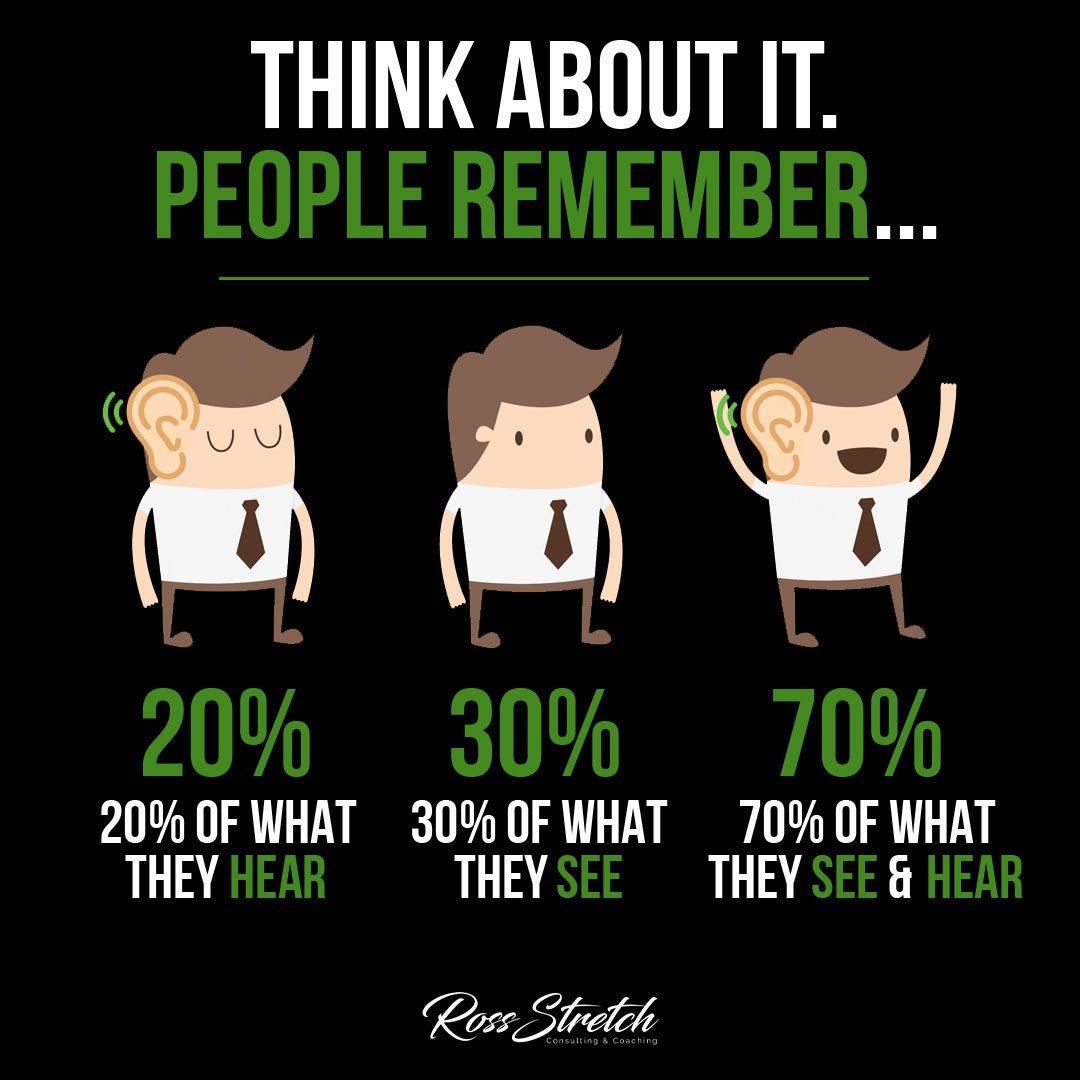
Studies on recall rates show a consistent pattern: people typically retain only about 20% of what they hear in spoken form alone. When information is presented visually — through images, charts, diagrams, or video — retention climbs to approximately 30%. But when auditory and visual elements are combined effectively, retention can reach 70% or higher. This dramatic difference is not a quirk — it is a feature of how the human brain is built to process and store information.
Why Auditory Communication Alone Falls Short
Sound is powerful. The right tone of voice, a compelling story, a well-timed pause — these engage the brain’s emotional centers and can make information feel meaningful. But spoken words are linear and ephemeral. Once a sentence is delivered, it disappears from the air. The listener must hold it in working memory while processing what comes next, and working memory has a notoriously limited capacity.
This is why long lectures can be exhausting and why important verbal instructions so often fail to stick. The listener’s brain is doing significant work just to keep up with the flow of speech, and there is little bandwidth left for deeper processing and long-term encoding. Verbal communication is necessary, but it is rarely sufficient for complex ideas or messages you need people to act on later.
The Influence of Visual Stimuli on the Brain
The human brain processes visual information at remarkable speed. About 30% of the brain’s cortex is involved in visual processing, compared to roughly 8% for touch and 3% for hearing. We are, by neurological design, visual creatures. Images, color, shape, and spatial arrangement are processed more rapidly and encoded more durably than abstract verbal content.
This is why infographics communicate statistics more effectively than bullet points, why a well-designed chart makes data immediately understandable, and why a photograph can convey emotion that a paragraph of text cannot match. Visual elements are not decoration — they are cognitive shortcuts that reduce the mental effort required to process information while simultaneously strengthening memory encoding. When you add a relevant visual to a verbal message, you are not just making it prettier. You are making it easier to understand and harder to forget.
Dual-Coding Theory: Why Combined Stimuli Are So Powerful
Dual-coding theory, developed by cognitive psychologist Allan Paivio, proposes that people learn and remember more effectively when information is encoded through two channels simultaneously — visual and verbal. Each channel processes information independently, but when both are activated together, the learner creates two separate but linked mental representations of the same content. The result is richer, more resilient memory that is easier to retrieve from multiple angles.
In practice, this means that a speaker who describes a process while showing a diagram of it will be understood and remembered far better than a speaker who uses words alone. A teacher who uses annotated slides engages students more deeply than one who lectures without visual support. A marketer who pairs compelling copy with strong imagery creates more memorable brand experiences. The principle is consistent across domains: combining sound and image is not just a nice enhancement — it is a fundamentally superior mode of communication.
How to Harness Visual Communication in Practice
Understanding the science is useful; applying it is where the real advantage is realized. Whether you are creating marketing materials, delivering a presentation, writing a blog post, or running a team meeting, integrating visual elements strategically will increase comprehension and retention every time. The key is to treat visuals as primary, not supplementary.
Start with your most important messages. What do you most need your audience to remember? Build a visual anchor for each of those key points — a chart, a photograph, a diagram, a bold typographic statement. Use color intentionally, since color increases brand recognition significantly and directs attention to what matters most. Structure your presentations so that visuals lead and words support, not the reverse. Apply the rule of one — one key idea per slide or visual — to prevent cognitive overload.
- Use infographics to present data and statistics that would otherwise feel abstract or dense
- Incorporate short videos to demonstrate processes, tell stories, or showcase social proof
- Apply consistent visual branding — colors, fonts, and layout — to build recognition over time
- Add visual hierarchy to written content through headers, pull quotes, and strategic use of bold text
- Pair every complex concept with a visual metaphor that makes it immediately accessible
Visual Storytelling: The Highest Form of the Practice
The most powerful application of visual communication is storytelling. When narrative structure — beginning, conflict, resolution — is combined with compelling imagery, it creates an experience that engages both the analytical and emotional parts of the brain simultaneously. This is why documentary films move people to action, why brand videos outperform product spec sheets, and why the most memorable speeches use powerful visual language and imagery.
If you want your message remembered a week, a month, or a year after delivery, it needs to be a story told with both words and images. That is true whether you are a marketer building a campaign, an entrepreneur pitching investors, or a manager trying to inspire a team. People remember how you made them feel, and nothing creates feeling more efficiently than the combination of visual and auditory storytelling working together.
Conclusion
The gap between information that is delivered and information that is remembered is enormous — and visual communication is the bridge. By understanding how the brain encodes memory through multiple sensory channels and applying the principles of dual-coding theory, you can dramatically increase the impact of every message you send. Whether you are building a business, a brand, or a body of knowledge, invest in communication that people can see, hear, and feel. That is what gets remembered — and remembered messages are the ones that change behavior.
Resources


 Ross Stretch