In today’s competitive professional landscape, raw effort alone rarely separates high performers from everyone else. The most successful people have learned to combine disciplined effort with intelligent systems — working both smarter and harder. This is not a contradiction. It is a philosophy. Working harder without a system burns you out. Working smarter without effort produces nothing. Together, they compound into results that neither approach achieves on its own.
The strategies below are not abstract motivational advice. They are practical, tested principles used by high-output entrepreneurs, executives, and professionals who consistently outperform their peers. If you are serious about building a career or business that reflects your ambitions, these habits are worth owning completely.
Plan Intentionally and Eliminate the Unnecessary
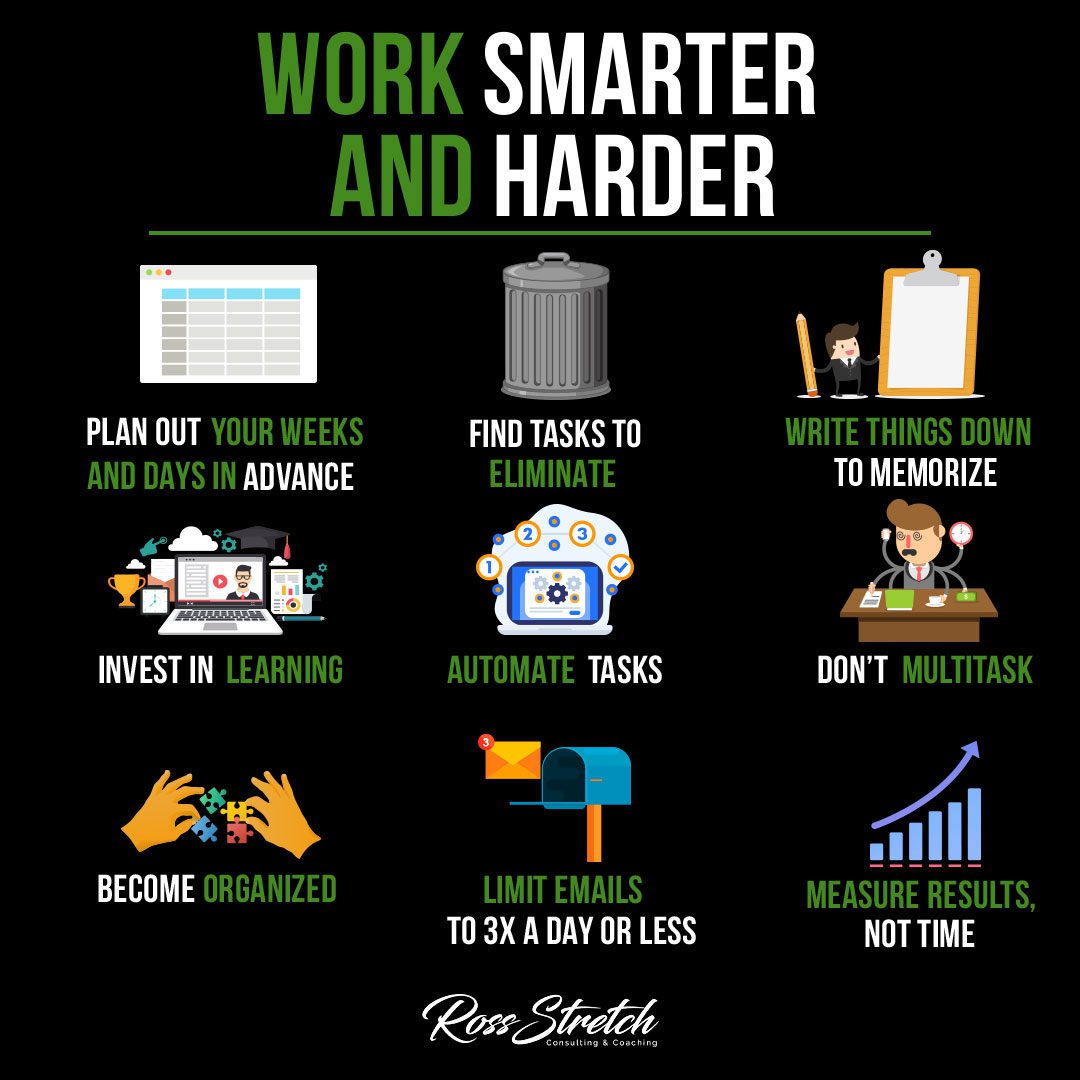
Effective planning is one of the highest-leverage activities available to any professional. Spending 15 to 20 minutes at the end of each week mapping out the following week — key priorities, deadlines, and deep work blocks — creates clarity that carries into every task you touch. Without that map, you default to reacting. You fill your day with motion instead of progress.
A useful planning method is time blocking: assigning specific calendar slots to specific categories of work. Reserve your peak cognitive hours — typically the first two to three hours of your workday — for your most demanding priorities. Schedule communication, admin, and low-stakes decisions for later in the day when mental energy naturally dips. This protects your best thinking for the work that actually moves the needle.
Equally important is deciding what not to do. Audit your task list regularly and ask whether each item genuinely requires your involvement. Many professionals carry tasks that could be delegated, automated, or dropped entirely. Every hour spent on low-value work is an hour not spent on high-impact activity. Ruthless prioritization is not laziness — it is discipline.
Capture Everything and Invest in Learning
The human brain is exceptional at generating ideas and poor at storing them reliably. When you rely on memory alone, you spend mental energy tracking tasks, commitments, and details that a simple note-taking system could handle for free. Writing things down — whether in a notebook, a task manager, or a voice memo — offloads that cognitive burden and lets you focus fully on the work in front of you.
This principle extends beyond task management. Capturing insights from books, conversations, meetings, and experiences creates a personal knowledge base you can draw on for years. High performers treat information as a resource to be organized and retrieved, not just consumed and forgotten. A simple tagging or folder system in a notes app like Notion or Obsidian can transform how much you retain and apply from what you read and learn.
Committing to continuous learning is non-negotiable for anyone serious about long-term success. Markets shift, industries evolve, and the skills that made you competitive three years ago may be table stakes today. Allocate dedicated time each week — even 30 to 60 minutes — to reading, online courses, or conversations with people operating at a level above yours. The compounding effect of consistent learning over months and years is dramatic.
Leverage Automation and Control Your Inbox
Automation is one of the most underused productivity tools available to professionals at every level. Repetitive tasks — report generation, social media scheduling, invoice reminders, data entry, file organization — can often be handled by tools that cost less per month than a single lunch. Before you spend another hour on a routine process, ask whether a tool like Zapier, Make, or a built-in software automation could handle it instead.
The goal of automation is not to eliminate work but to redirect your attention toward decisions and output that require your specific judgment and creativity. Once you identify and automate even two or three recurring tasks, you reclaim hours each week that compound into significant additional capacity over a year.
Email is one of the most persistent productivity drains in modern work. The average professional checks email dozens of times per day, each check fragmenting focus and resetting cognitive momentum. A more effective approach: designate two or three fixed times each day to process email, and close the inbox entirely between those windows. Use filters, folders, and labels to triage what arrives so that urgent messages surface quickly and newsletters or low-priority threads do not compete for your attention during critical work periods.
Focus Deeply and Build an Organized Environment
Multitasking is a productivity myth that research has consistently dismantled. When you switch between tasks, your brain incurs a switching cost — a brief but meaningful period of recalibration before it can engage fully with the new task. Frequent task-switching compounds these costs into significant lost productivity across a workday. The solution is single-tasking: give one task your complete attention until it reaches a natural stopping point, then move to the next.
Building a practice of deep work — sustained, focused sessions on cognitively demanding tasks without interruption — is one of the most powerful competitive advantages you can develop. Cal Newport, who coined the term, argues that the ability to focus without distraction is becoming increasingly rare and increasingly valuable. Treat your deep work sessions as non-negotiable appointments with your most important priorities.
Your physical and digital environment directly shapes your ability to focus. A cluttered desk competes for your attention. A disorganized file system adds friction to every task. A clean, structured workspace — whether physical or digital — reduces the micro-decisions and small frustrations that collectively drain energy throughout the day. Build organizational systems that require minimal maintenance and make the right action the easiest action.
Measure Results, Not Hours
Time is a poor proxy for value. An hour of distracted, low-priority work produces far less than 30 minutes of focused effort on the right task. Yet most professionals — and most organizations — still default to measuring productivity in hours logged rather than outcomes delivered. Shifting your own scorecard from time spent to results achieved is a meaningful mindset change that clarifies priorities and raises the quality of your decisions about what to work on.
Set specific, measurable goals for each week and each project. At the end of the week, assess whether you hit them — and if not, identify what got in the way. This regular feedback loop builds self-awareness about where your time actually goes versus where you intend it to go. Over time, it tightens the gap between intention and execution, which is where most productivity improvement lives.
Tracking results also builds intrinsic motivation. Progress is a powerful driver of engagement, and when you can see clearly that your effort is moving the metrics that matter, it reinforces the habits and systems that produced those results. Start simple: define two or three key outcomes for the week, measure them honestly, and iterate.
Conclusion
Working smarter and harder is not about doing more — it is about doing the right things, in the right order, with the right systems behind you. Planning ahead, eliminating waste, capturing information, automating repetition, protecting focus, and measuring outcomes are not exotic techniques. They are the unglamorous foundations of sustained high performance.
The professionals who build meaningful careers and businesses are not those who grind blindly — they are those who design intelligent systems and then show up with real effort to work within them. Start with one or two of these strategies, implement them fully, and build from there. Consistency with the fundamentals compounds into extraordinary results.
Resources

 Ross Stretch