Opening a local café is one of the most rewarding entrepreneurial ventures you can pursue — but it is also one of the most competitive. The difference between cafés that thrive and those that close within the first year often comes down to preparation and market intelligence. One of the most underutilized sources of that intelligence is already available for free: competitor reviews on Google Maps. By systematically analyzing what local customers love and hate about existing cafés, you can design a customer experience that addresses proven pain points before you pour a single cup of coffee.
Why This Matters
The café and restaurant industry has one of the highest failure rates in business — approximately 60% of new restaurants close within the first year, and 80% fail within five years, according to research from Ohio State University. Most of these failures share a common thread: the owners did not deeply understand their local market before opening. They assumed what customers wanted rather than discovering what they actually needed and would pay for consistently.
Google Maps reviews represent thousands of data points collected from real customers in your specific geographic market, available at no cost. They reveal exactly what frustrates local café-goers and what creates loyalty. This is competitive intelligence that marketing agencies charge thousands of dollars to collect. Using it strategically before you open gives you a decisive advantage that most competitors simply never develop — and it takes nothing more than time and focused attention.
Step-by-Step: Learning from Competitor Reviews to Open a Winning Café
Step 1: Identify and Map Your Competition
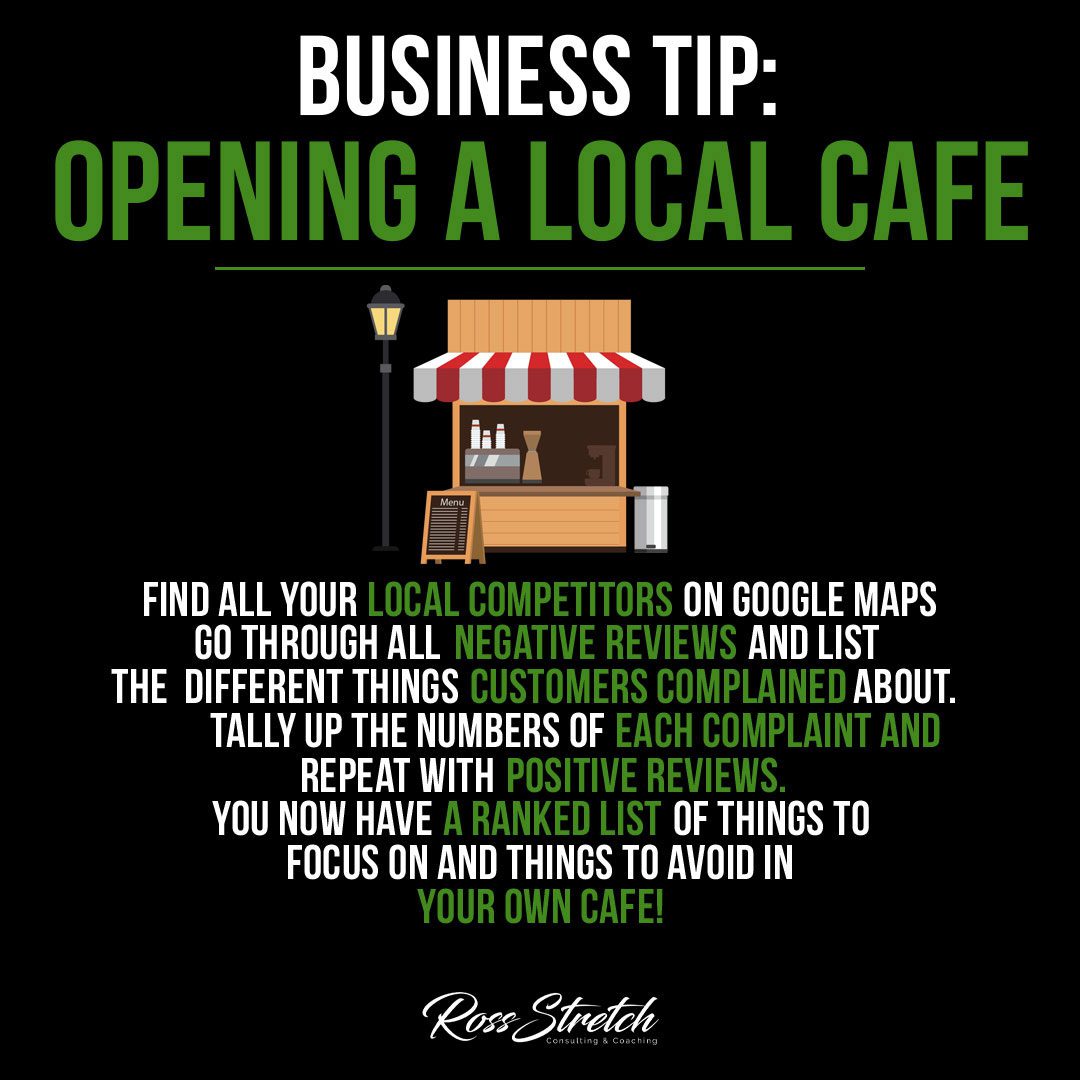
Before you can learn from competitors, you need to know exactly who they are. Open Google Maps and search for “café” or “coffee shop” within a 2-3 mile radius of your intended location. Create a simple spreadsheet listing every competitor, their star rating, and their total review count. Prioritize competitors with at least 100 reviews — they provide enough data to identify reliable patterns rather than statistical noise. Also note hours, price range, and specialty focus to understand the full landscape you are entering.
- Use Google Sheets or Notion to organize your findings with columns for business name, rating, review count, main complaints, and key strengths — this becomes your competitive intelligence database.
- Visit each competitor’s Google Maps listing directly and note their busiest review periods, which often reveal when customer expectations are highest and service quality is most tested.
Step 2: Analyze Competitors’ Negative Reviews
Filter each competitor’s listing to show one and two-star reviews and read through a minimum of 50 negative reviews per competitor. Your goal is to identify recurring complaints — themes that appear across multiple reviewers. Common issues include slow service, inconsistent coffee quality, unfriendly staff, limited seating, poor WiFi, lack of parking, or items frequently unavailable. Each repeated complaint represents a market pain point your café can solve from day one.
- Create a tally sheet with common complaint categories. Every time you encounter a complaint type, mark it. After reviewing all competitors, you will have a ranked list of the most significant frustrations in your local market.
- Pay special attention to complaints that appear across multiple different cafés — these represent systemic market gaps, not just one business’s individual failures, and signal your highest-value differentiation opportunities.
Step 3: Study Competitors’ Positive Reviews
Filter for five-star reviews and read at least 50 positive reviews per competitor. Identify what specific elements customers celebrate most enthusiastically. Do reviewers mention a particular barista by name? Praise the atmosphere for remote work? Rave about a signature menu item? These details reveal what your target market values deeply — the standards you must meet or surpass to build genuine loyalty in your community.
- Note which positive aspects appear consistently across multiple cafés in your area — these represent baseline expectations that you must meet just to be considered competitive in the local market.
- Look for positive aspects mentioned at only one or two competitors — these rare differentiators signal opportunities to stand out by delivering something the market values but rarely experiences consistently.
Step 4: Create a Ranked Priority List for Your Café
With your data collected, build a two-column priority list: Problems to Solve (ranked by frequency of complaints) and Strengths to Incorporate (ranked by how often they are praised). This list becomes your operating blueprint. The most frequently cited complaints become your highest-priority design and operational decisions — problems you eliminate before they can appear in your own reviews.
- For each item on your Problems to Solve list, write a concrete operational solution. If slow service appears frequently, plan your staffing ratios and training protocols from day one rather than discovering this problem in your own negative reviews six months after opening.
- Focus first on eliminating the top three complaints before optimizing anything else. Preventing dissatisfaction has a stronger impact on customer retention than adding new features or menu items.
Step 5: Design Your Café Experience Around the Data
Translate your research into concrete decisions about your café’s operations, physical design, menu, and staff culture. If WiFi complaints are frequent among competitors, invest in enterprise-grade internet before you open. If a particular competitor earns consistent praise for atmosphere, visit in person to understand precisely what they have done — then adapt those elements to your own vision. Build your staff training program around the service failures you identified in competitor reviews rather than waiting for your own customers to surface these issues.
- Visit your top three competitors as a paying customer before you open. Experience what your research revealed firsthand — observe how staff handles rush periods, how complaints are addressed, and what the overall energy of each space feels like at different times of day.
- Create a written customer experience standard — a clear description of the experience every customer will have regardless of which staff member is working. Post it where your team can see it daily and return to it in every training session.
Common Mistakes to Avoid
- Ignoring three-star reviews: Mid-range reviews often contain the most nuanced, actionable feedback — customers with mixed experiences describe exactly what worked and what did not, giving you a detailed roadmap for improvement.
- Copying rather than improving: The goal is not to replicate what competitors do well — it is to do it measurably better while solving the problems they have left unaddressed. Derivative businesses rarely dominate their local markets.
- Underestimating consistency: Many cafés receive complaints not about uniformly bad experiences, but inconsistent ones. A customer who has one transcendent visit and one disappointing one will not return. Train your team so quality does not vary by shift or day of the week.
- Treating this as a one-time task: Competitive intelligence is not gathered once before opening. Set up Google Alerts for key competitors and review their new reviews monthly to stay ahead of emerging trends and shifting customer expectations in your market.
Conclusion
Opening a local café that succeeds long-term requires more than passion for great coffee — it demands disciplined market research and a customer-first operating philosophy built from real data. The strategy outlined here costs nothing but time, yet it provides the insight that most café owners only gain after their first year of painful and expensive mistakes. Use your competitors’ reviews as a free MBA in local market dynamics and consumer psychology.
The cafés that build lasting businesses are rarely the most creative — they are the most responsive. They pay attention to what customers are actually telling them and design their operations around that feedback before problems have a chance to define their reputation. Start your analysis today, and by the time your doors open, you will already know exactly what your customers want — and exactly how to deliver it consistently.
Resources


 Ross Stretch