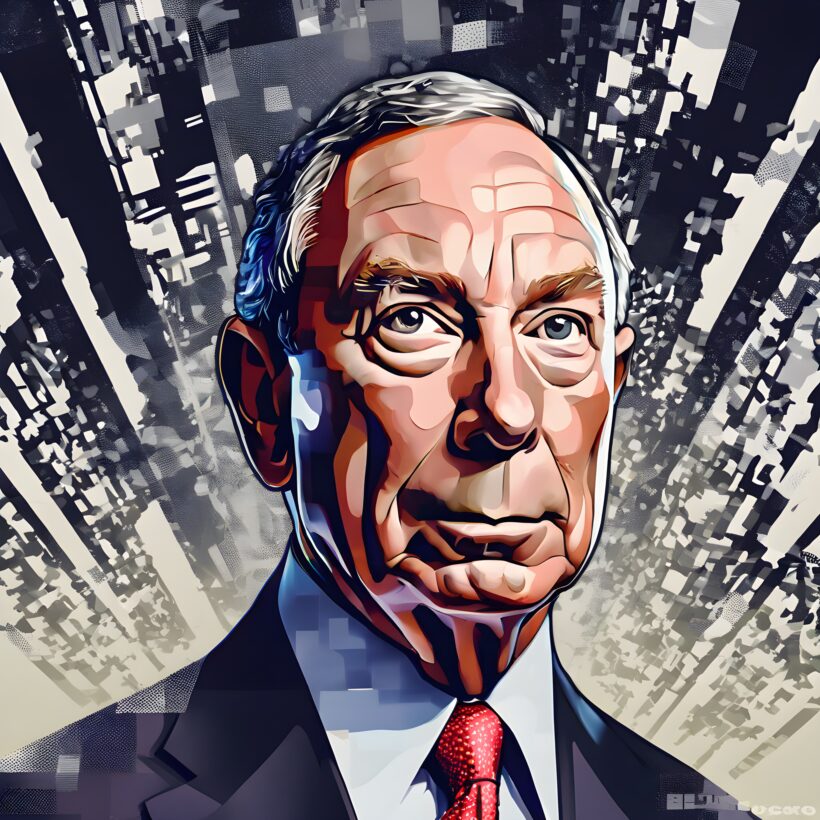

Michael Bloomberg is a rare figure who has achieved towering success in three distinct domains — finance, government, and philanthropy. As the founder of Bloomberg LP and a three-term Mayor of New York City, he has left an indelible mark on global financial markets, urban policy, and charitable giving. As of 2025, his net worth is estimated at approximately $105 billion, making him one of the ten wealthiest individuals in the world and one of the most prolific philanthropists in modern history.
Early Life & Background
Michael Rubens Bloomberg was born on February 14, 1942, in Brighton, Massachusetts, and grew up in a middle-class Jewish family in Medford, a Boston suburb. His father worked as a bookkeeper for a dairy company, and the family lived modestly. Bloomberg showed strong academic aptitude early, excelling in science and mathematics. He earned a Bachelor of Science in electrical engineering from Johns Hopkins University in 1964 — working his way through school as a parking lot attendant — and went on to earn an MBA from Harvard Business School in 1966. The combination of engineering discipline and business training proved uniquely powerful for what would follow.
Career & Rise to Success
Bloomberg joined Salomon Brothers, one of Wall Street’s most storied investment banks, immediately after Harvard. He spent 15 years there, rising from a bond trader to become head of equity trading and, eventually, head of systems development — a combination that proved uniquely suited to what would come next. In 1981, Salomon Brothers was acquired by Phibro Corporation, and Bloomberg, who had reached general partner status, was laid off with a $10 million severance package. Rather than join another firm, he used that money to found Innovative Market Systems — later renamed Bloomberg LP — in a small Manhattan office in 1981. His first product was the Bloomberg Terminal, a proprietary computer system that gave traders access to real-time bond pricing and analytics they had never had before. The concept was revolutionary: Merrill Lynch became Bloomberg’s anchor client, investing $30 million in exchange for 30% of the company (a stake later repurchased). The terminal became the industry standard almost immediately, and Bloomberg LP expanded into news services (Bloomberg News), financial television (Bloomberg TV), radio, and digital media. Today, the company serves more than 325,000 subscribers across 150 countries, with annual revenues exceeding $12 billion. Bloomberg then entered public life, serving as Mayor of New York City from January 2002 to December 2013 across three terms — an unprecedented run enabled by a charter change allowing a third term.
Major Achievements
Bloomberg LP’s growth from a two-person startup to a company employing more than 22,000 people across 176 offices worldwide is among the great entrepreneurial stories of the late 20th century. The Bloomberg Terminal alone processes approximately 5 billion pieces of market data per day and is so embedded in global financial infrastructure that it is effectively irreplaceable for institutional traders and analysts. As Mayor of New York, Bloomberg implemented landmark public health measures including a ban on smoking in bars and restaurants, mandatory calorie labeling on restaurant menus, and restrictions on trans fats — policies subsequently adopted by cities and countries worldwide. He oversaw significant drops in New York City crime rates, major urban development projects, and the creation of new technology and innovation campuses. He briefly ran for U.S. President in the 2020 Democratic primary, spending more than $1 billion of his own money before withdrawing from the race after Super Tuesday.
Income Sources & Business Ventures
Bloomberg’s wealth derives almost entirely from his ownership of Bloomberg LP, of which he holds approximately 88% — a dominant stake in a company generating over $12 billion in annual revenue. The Bloomberg Terminal subscription, priced at approximately $27,000 per year per user, drives the bulk of that revenue and has proven extraordinarily resilient across financial market cycles. Additional revenue streams include Bloomberg News digital subscriptions, Bloomberg Intelligence research, enterprise analytics products, and advertising across Bloomberg TV and digital properties. Despite having stepped back from day-to-day management during his mayoral terms, Bloomberg remains deeply involved in the company’s strategic direction and product development.
Assets & Lifestyle
Bloomberg is known for a functional rather than flashy lifestyle — a deliberate choice for someone who has repeatedly stated his intention to die having given away most of his wealth. He owns a townhouse on the Upper East Side of Manhattan, valued at over $30 million, as well as properties in London, Bermuda, and other locations. He travels by private jet for business and philanthropic purposes. Despite his enormous wealth, he is not associated with the super-yacht or private island acquisitions that characterize some of his billionaire peers. His primary luxury is his access to information and influence — resources he deploys relentlessly across his charitable and civic activities.
Philanthropy & Giving Back
Bloomberg is one of the most generous individual philanthropists alive. Through Bloomberg Philanthropies, he has donated more than $17 billion cumulatively as of 2025, placing him among the largest individual donors in modern history. His giving is organized around five areas: arts, education, environment, government innovation, and public health. He has committed hundreds of millions of dollars to fighting climate change, including major funding for the Sierra Club’s Beyond Coal campaign, which has helped accelerate the retirement of coal power plants across the United States. He donated $1.8 billion to Johns Hopkins University in 2018 — the largest gift in the institution’s history — specifically to support financial aid and access for lower-income students. He funds Everytown for Gun Safety, one of the most significant anti-gun-violence organizations in the country. He signed the Giving Pledge in 2010 and has consistently exceeded its commitments year after year.
Michael Bloomberg’s Net Worth in 2025
As of 2025, Michael Bloomberg’s net worth is estimated at approximately $105 billion, according to Forbes. His wealth has grown substantially in recent years as Bloomberg LP has benefited from surging demand for real-time financial data, rising subscription pricing power, and the explosion of algorithmic and quantitative trading that depends on the company’s data infrastructure. Even after donating more than $17 billion to charitable causes, Bloomberg’s fortune has continued to expand — a testament to the exceptional revenue-generating power of the Bloomberg Terminal’s near-monopoly position in financial data. His net worth places him firmly among the world’s top ten wealthiest individuals.
Conclusion
Michael Bloomberg’s life is a study in compounding achievement — each chapter building purposefully on the last. From bond trader to financial data pioneer, from New York City mayor to global philanthropist, Bloomberg has consistently deployed his wealth and influence toward measurable outcomes. His net worth reflects not just the commercial success of the Bloomberg Terminal, but decades of strategic reinvestment in his company, in public service, and in the causes he believes will define the 21st century. His story is a powerful reminder that great wealth, when paired with genuine conviction and rigorous accountability, can be a meaningful force for good in the world.
References


 Ross Stretch