Most people don’t spend much time thinking seriously about regret until they’re far enough along in life that the options have narrowed. But the research on end-of-life reflections tells a consistent story: the biggest regrets aren’t dramatic failures or catastrophic decisions — they’re the things people never attempted. Palliative care nurse Bronnie Ware spent years documenting the thoughts of patients in their final weeks and found striking patterns in what they wished they had done differently. The themes weren’t exotic. They were ordinary missed opportunities that compounded quietly over decades.
For anyone between 25 and 45, this data is more than philosophical — it’s strategic. The choices made in this window of life are among the most consequential a person will make. Career direction, financial habits, entrepreneurial bets, health investments, and the relationships you nurture or neglect all compound over the next 30 to 40 years. Understanding the most common life regrets isn’t about inducing anxiety. It’s about using the accumulated wisdom of those who came before you to make better decisions while the options are still wide open.
Not Taking the Entrepreneurial Leap
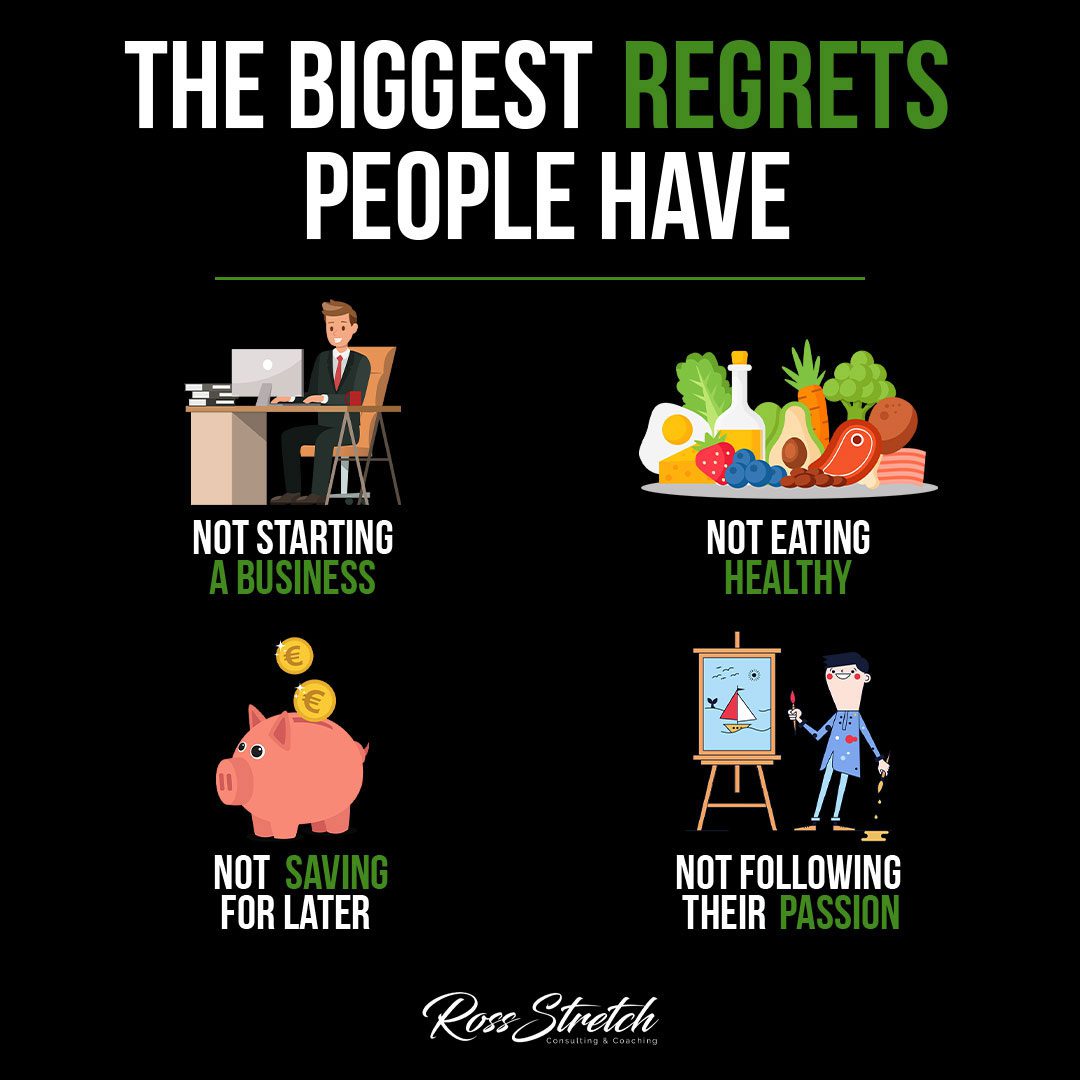
Across nearly every survey on regret, not starting a business — or not pursuing an entrepreneurial idea with serious effort — ranks near the top. The pattern is remarkably consistent: someone spends years working for someone else’s vision while their own idea sits in a notebook or the back of their mind, slowly losing its urgency. Fear of failure, lack of startup capital, and the comfort of a predictable paycheck are the most commonly cited reasons for inaction.
What makes this regret particularly sharp in hindsight is that failure, viewed from a distance, doesn’t look nearly as catastrophic as it did beforehand. Most entrepreneurs who tried and failed don’t regret the attempt — they regret waiting so long to make it. A first business venture rarely succeeds on its own terms, but it generates experience, networks, and self-knowledge that no career path working for others can replicate in the same way.
If you have an idea worth exploring, the most useful thing you can do today is run a low-cost validation experiment. Talk to potential customers, build a simple landing page, and test a small advertising campaign. The goal isn’t to be fully ready — it’s to start generating real-world feedback before the years of hesitation accumulate into a permanent missed window.
Neglecting Health Until the Bill Came Due
Health is a slow-moving variable, which makes it easy to deprioritize when you’re busy and functional. The consequences of poor nutrition, chronic stress, sedentary work, and inadequate sleep tend to appear years or decades after the habits are entrenched — which is exactly why so many people in their 50s and 60s look back at their 30s and wish they had treated their body as a long-term investment rather than a machine to be depleted in service of productivity.
The financial parallel is precise. Just as compound interest works in your favor when you invest early, the compounding effects of lifestyle choices accumulate invisibly over time. A decade of convenience food, sedentary hours, and abbreviated sleep doesn’t announce itself with a single dramatic event — it presents as gradual energy decline, cognitive fog, and eventually chronic conditions that are expensive, time-consuming, and difficult to reverse.
The interventions that matter most aren’t complicated or expensive: consistent physical activity, whole-food nutrition, 7-8 hours of quality sleep, and regular medical screenings. These aren’t optimization-level habits for elite performers — they’re the baseline for functioning well across a long career and life. The earlier they become non-negotiable, the less ground you’ll need to claw back at 50 or 60.
Failing to Build Financial Habits Early
This regret almost always comes down to lost time rather than missing knowledge or opportunity. The math of early investing is well-documented and not particularly complex — but understanding it intellectually and acting on it consistently are two different things. A person who invests $400 per month starting at 25 will build dramatically more wealth by 65 than someone who invests $800 per month starting at 40, even though the later investor contributes more total capital over their saving years.
Lifestyle inflation is the primary culprit. As income rises across a career, spending typically rises in lockstep — leaving savings rates flat or declining even as earnings grow substantially. The professionals who avoid this regret are those who automate savings before lifestyle expectations expand, treat retirement contributions like a fixed non-negotiable expense, and resist the pressure to match peer spending patterns as their careers advance.
You don’t need an exceptional income to build meaningful financial security. You need consistent behavior over time. A steady savings rate on a modest income, started early and sustained through discipline, outperforms an irregular savings pattern on a high income that begins late. The math is unambiguous — and the regret of understanding it too late is one of the most financially painful experiences a person can have.
Never Seriously Pursuing What You Actually Cared About
Settling is comfortable in the short term. Choosing the safer job, the more practical degree, the career with clearer benchmarks — these decisions feel responsible at 24 and increasingly hollow at 44. The most common version of this regret isn’t a dramatic fantasy about a completely different life. It’s quieter than that: “I wish I had at least found out if I could have made it work.”
The conversation around passion and career tends to be oversimplified in both directions. Pure “follow your passion” advice ignores the real requirements of building marketable skills and financial stability. But defaulting entirely to what’s safe and sensible, without ever testing an authentic interest, produces a specific kind of dissatisfaction that accumulates year over year. The people who report the least regret in this area are those who found a way to pursue meaningful work — even if it required a longer runway, lower early income, or a significant career pivot in their mid-30s.
If you haven’t yet identified what genuinely engages you, experimentation is the only reliable method. Side projects, part-time work in adjacent fields, and deliberate skill-building in areas of real interest will generate far more useful information than introspection alone. Clarity rarely arrives before action — it comes from doing.
Letting the Most Important Relationships Drift
Relationship regrets carry among the highest emotional weight because they’re often irreversible. A missed investment opportunity can eventually be replaced. A decade of distance from a parent who has since passed, or a marriage that eroded quietly from inattention, cannot. The most common version of this regret isn’t dramatic — it’s the slow drift of relationships that mattered deeply, happening gradually while everyone was busy with the urgent things.
Harvard’s 80-year Study of Adult Development, the longest-running study of adult life ever conducted, found that the quality of close relationships is the single strongest predictor of long-term health, happiness, and cognitive resilience in aging. Not income, career achievement, or fitness — the depth of human connection. The people who report the most life satisfaction consistently name their investment in relationships as among the most important choices they made.
This doesn’t require a wholesale lifestyle restructuring. It requires treating relationships with the same intentionality you apply to work and finances. Scheduled calls, consistent visits, genuine presence during conversations rather than divided attention. The cumulative effect of small, consistent investments in the people who matter most is significant — and the regret of not making those investments is one of the most commonly reported of all.
Conclusion
The biggest regrets people carry tend to be quiet omissions rather than dramatic failures — businesses never started, health neglected until the damage was done, money not saved during the years when time made the greatest difference, authentic ambitions abandoned for the path of least resistance, and relationships allowed to thin out while attention went elsewhere. These aren’t unusual patterns. They’re the default outcomes when people navigate life reactively instead of intentionally.
The value of understanding what people most commonly wish they had done differently is practical, not sentimental. You still have the window. The decisions that determine which regrets you carry — or don’t — are being made right now, in the ordinary choices of an ordinary week. Use the information available to you and act accordingly.
Resources

 Ross Stretch