
Running a small business is one of the most rewarding endeavors you can undertake — and one of the most unforgiving. Most early-stage failures trace back to a handful of predictable, avoidable errors. By understanding the most common small business mistakes — from poor business planning to neglecting your online presence — you can sidestep the traps that derail too many entrepreneurs before they gain real traction.
Why This Matters
The numbers tell a sobering story. According to the U.S. Small Business Administration, roughly 20 percent of small businesses fail within their first year, and nearly half do not survive past five years. The reasons behind these failures are rarely unique — most owners repeat the same patterns of missteps, often without recognizing the problem until real damage has already been done. Understanding these patterns is the single most practical advantage any new or struggling business owner can have.
Avoiding these pitfalls does not require a business degree or a large budget. It requires awareness, honesty about your current approach, and a willingness to course-correct before small problems become expensive ones. Whether you are launching your first venture or trying to stabilize an existing business, addressing these six common errors can fundamentally change your long-term outcome.
How to Avoid These 6 Small Business Mistakes
Step 1: Stop Running Without a Plan
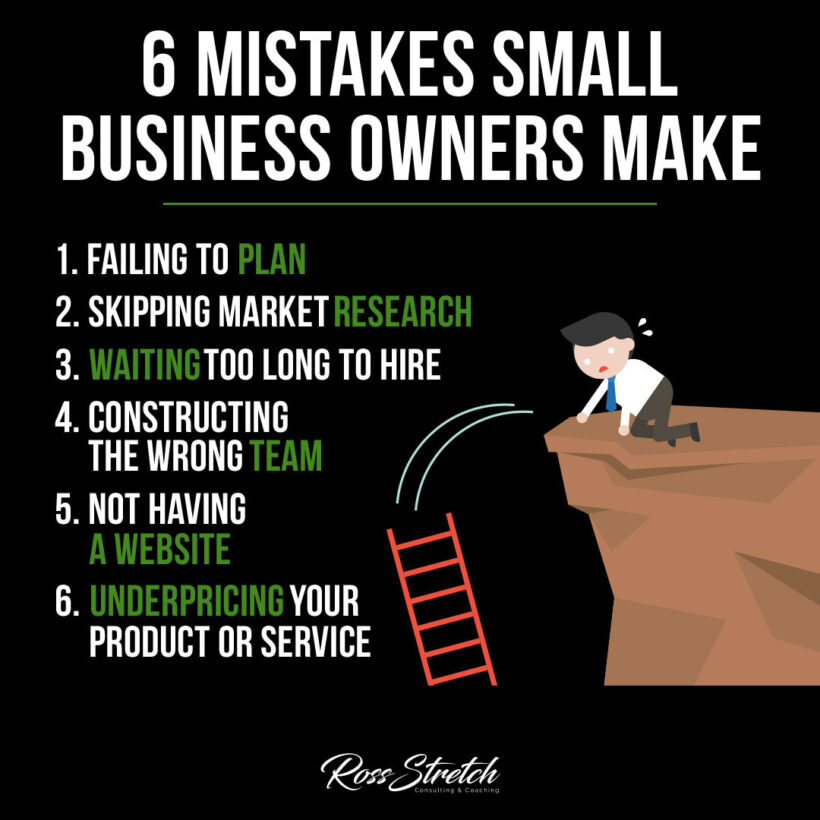
Enthusiasm gets a business started, but a written plan is what keeps it going. Many new owners skip formal planning because it feels like extra work — but without a documented roadmap that includes goals, target audience, marketing approach, and financial projections, you end up reacting to problems instead of preventing them. A business plan does not need to be 40 pages long. Even a one-page plan forces the kind of clarity that leads to better daily decisions.
- Write out your business goals for the next 12 months in specific, measurable terms.
- Define your target customer in as much detail as possible — demographics, needs, buying habits.
- Include a basic financial section covering your break-even point and first-year revenue targets.
- Avoid treating the plan as finished — revisit and update it at least once per quarter.
Step 2: Do the Market Research First
Skipping market research is one of the fastest ways to build a business no one actually needs. Before launching — or when reassessing an existing product or service — spend time studying your competitors, understanding what your customers truly want, and identifying where real gaps exist in the market. This research does not have to be expensive. Online surveys, competitor review analysis, and conversations with potential customers reveal more than most paid research reports ever could.
- Use free tools like Google Trends, Reddit communities, and industry forums to gauge real demand.
- Interview at least 10 potential customers before committing to a new product or service direction.
- Study your three closest competitors — their negative reviews tell you exactly what customers want more of.
- Avoid assuming your personal preference reflects what the broader market is willing to pay for.
Step 3: Hire Before You Burn Out
The instinct to handle everything yourself is understandable — it saves money in the short term. But trying to manage operations, sales, accounting, customer service, and delivery on your own is a fast track to burnout and stalled growth. When you are spending 60 hours a week just keeping the lights on, you have no bandwidth to actually improve the business. Recognize the signs early: if you are consistently behind, making errors from fatigue, or turning down work you could handle with one more person, it is time to bring in help.
- Start with part-time help or freelancers to test which tasks can be successfully delegated.
- Hire for the role that is costing you the most time — not the role you find most interesting.
- Track your hours by task for one month to identify exactly where your time is actually going.
- Avoid waiting until a crisis forces the decision; hire from a position of stability when possible.
Step 4: Build the Right Team, Not Just Any Team
Hiring too fast is nearly as costly as hiring too late. Bringing on people who lack the right skills or who do not share your business values can create internal conflict, erode your workplace culture, and waste enormous amounts of time on managing and replacing staff. A small team of the right people consistently outperforms a larger team of mismatched ones. Take the hiring process seriously even when you are under pressure to fill a role quickly.
- Write a clear job description that outlines both the specific skills required and the values you are hiring for.
- Ask candidates for concrete examples from their past work rather than hypothetical answers.
- Check references thoroughly and ask specifically how the candidate handled setbacks or difficult situations.
- Avoid hiring based on availability alone — a warm body in the wrong role creates more problems than the vacancy does.
Step 5: Build a Website Before You Think You Need One
In today’s environment, a business without a website is effectively invisible to a large portion of its potential customers. Most consumers search online before making a purchase decision or choosing a service provider — if you do not appear in those searches, a competitor does. A simple, well-organized website builds credibility, makes it easy for customers to contact you, and works for your business around the clock without any additional effort from you.
- Start with a simple site that clearly lists your services, location, contact information, and customer reviews.
- Use a platform like WordPress, Squarespace, or Wix to build a professional presence without large upfront costs.
- Create a Google Business Profile to appear in local search results immediately, even before your website is polished.
- Avoid launching a site and leaving it static — keep your hours, contact details, and services current at minimum.
Step 6: Price Your Products and Services Correctly
Underpricing is one of the most common and most damaging mistakes new business owners make. The logic seems sound — lower prices will attract more customers — but in practice it erodes your margins, attracts clients who are difficult to retain, and signals lower quality to buyers who associate price with value. Your pricing needs to cover your real costs, reflect the value you deliver, and allow for a sustainable profit margin. Research what competitors charge, calculate your actual cost of delivery, and price accordingly without apology.
- Calculate your true cost of delivering a product or service — including your time — before setting any price.
- Research competitor pricing to understand the range your market supports.
- Review your prices at least once per year to account for rising costs and the growing value of your experience.
- Avoid using discounting as your default sales tactic — it trains customers to wait for the next sale rather than paying full price.
Common Mistakes to Avoid
- Mixing personal and business finances — open a dedicated business bank account from day one to keep your accounting clean and protect yourself legally.
- Ignoring customer feedback — negative reviews and complaints are free market research; treat them as data to act on, not attacks to ignore.
- Over-expanding too quickly — adding locations, products, or staff before your core operation is stable tends to amplify existing problems rather than solve them.
- Neglecting tax planning — set aside a percentage of every payment you receive for taxes and never let tax season arrive as a surprise.
- Relying on a single revenue stream — if one client or one product makes up more than half your revenue, that concentration is a serious risk worth actively reducing.
Conclusion
Small business ownership involves a steep learning curve, and some mistakes are inevitable. But the six errors covered here are not inevitable — they are patterns that repeat precisely because most owners do not recognize them early enough. By building a real plan, conducting market research, hiring at the right time, assembling the right team, establishing an online presence, and pricing with confidence, you give your business a foundation that most of your competitors will never have.
Start with the one area on this list where you know you are weakest and build from there. If you want outside perspective as you grow, consider connecting with a free business mentor through SCORE or exploring the resources available at your nearest Small Business Administration office. Getting experienced input early costs nothing and frequently saves months of expensive trial and error.
Resources
- Small Business Administration — Business Guide — Step-by-step guidance on planning, launching, and managing a small business in the United States.
- SCORE — Free Business Mentoring — Connects small business owners with experienced volunteer mentors at no cost, in person and online.
- Entrepreneur — Starting a Business — Practical, regularly updated articles covering every stage of building and growing a business.
- NFIB — Small Business Resources — Research, tools, and advocacy resources specifically built for small business owners.


 Ross Stretch