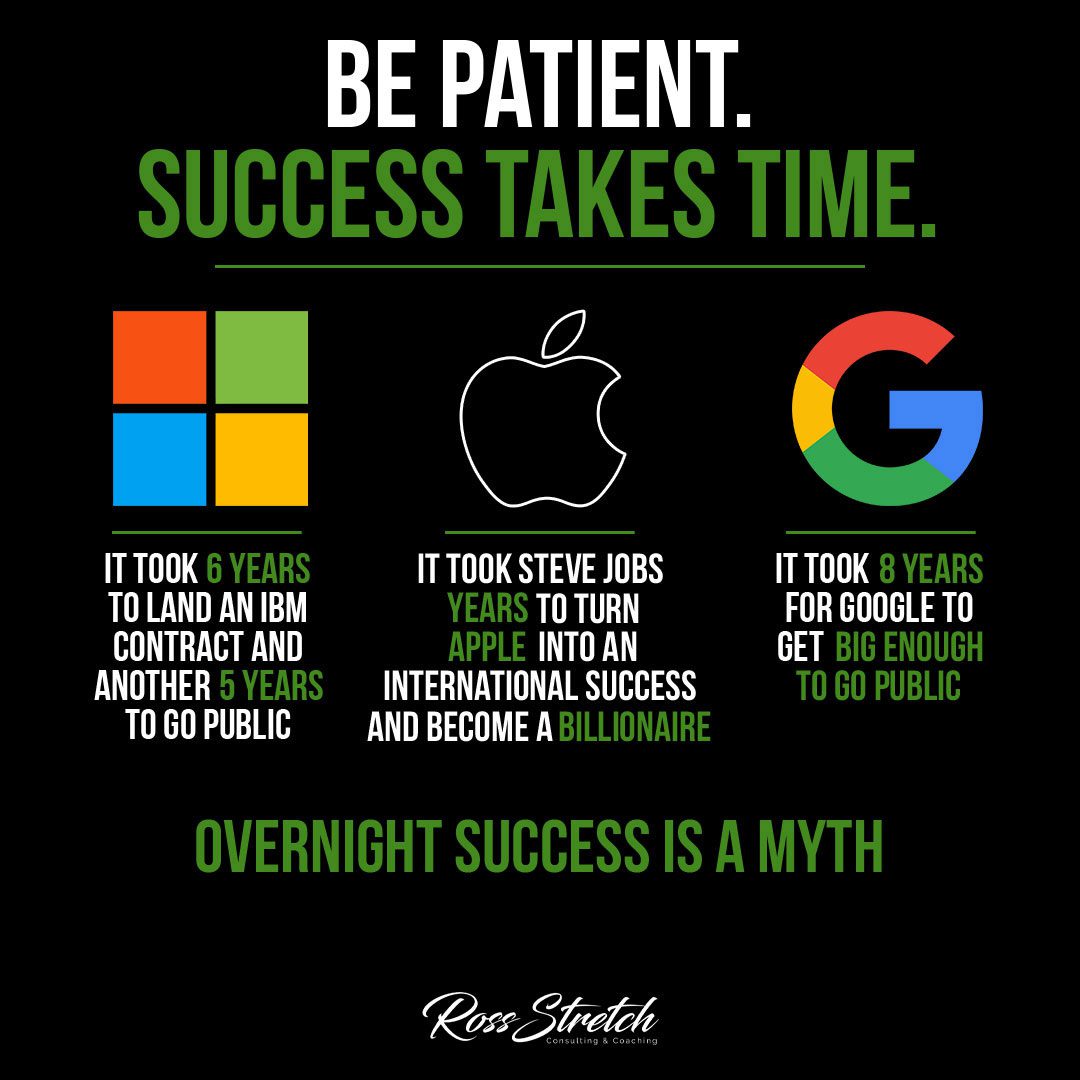
The companies we most admire were not built in a weekend. Microsoft, Apple, and Google — three of the most valuable enterprises ever created — each required years of grinding, failing, pivoting, and waiting before they became the defining institutions of the technology age. If there is one quality that connects their founders, it is patience: the disciplined ability to stay the course when results are slow, critics are loud, and quitting feels reasonable.
For ambitious professionals building careers, businesses, or investment portfolios, the lesson from these three companies is both humbling and energizing. Real success is not measured in months — it is measured in years. Understanding why patience is a competitive advantage changes how you approach every setback and every slow stretch.
Microsoft: Six Years to IBM, Five More to Go Public
Bill Gates and Paul Allen founded Microsoft in 1975. For the next six years, the company operated as a small software firm writing code for early personal computers. The breakthrough came in 1981 when Microsoft secured a contract with IBM to supply the operating system for the IBM PC — a deal that fundamentally changed the company’s trajectory. That contract did not happen because Gates was lucky. It happened because he had spent years building expertise, relationships, and credibility in a market most people did not yet fully understand.
Even after the IBM contract, Microsoft was not an overnight sensation. The company continued growing, iterating, and expanding its product line for another five years before going public in 1986. The IPO made Gates a billionaire at 30 — but it was eleven years of consistent work that made the IPO possible. The patience required to operate in relative obscurity while building something real is a discipline that most people abandon far too soon.
Apple: Steve Jobs and the Long Road Back
Apple’s story contains one of the most dramatic patience arcs in business history. Steve Jobs co-founded Apple in 1976 and by 1984 had launched the Macintosh — a revolutionary product. But by 1985, internal conflict led to Jobs being pushed out of the company he built. For the next twelve years, he ran NeXT and Pixar, learning disciplines — operational rigor, storytelling, design systems — that he could not have acquired while running Apple at the pace it demanded.
When Apple acquired NeXT in 1997 and Jobs returned as CEO, the company was weeks away from bankruptcy. What followed was one of the most remarkable corporate turnarounds in modern history: the iMac, iPod, iTunes, iPhone, and iPad all emerged from a team led by a founder who had spent over a decade being refined by adversity. The patience Jobs demonstrated — staying productive and purposeful through exile rather than retreating — was the foundation of everything that came after. Apple’s multi-trillion-dollar valuation is inseparable from the years Jobs spent rebuilding himself outside the company.
Google: Eight Years from Dorm Room to IPO
Larry Page and Sergey Brin started Google as a research project at Stanford in 1996. The company was incorporated in 1998, and for the next six years it focused almost exclusively on building the best search engine in the world — resisting the temptation to prematurely monetize or diversify. Google turned down multiple acquisition offers during this period, famously including an early offer from Excite when the company was still in its infancy. That patience paid off when Google went public in August 2004, raising nearly two billion dollars.
The discipline to stay focused on product quality rather than chasing early exits is what separated Google from the dozens of search engines that preceded it. The founders understood that compounding quality — like compounding interest — requires time to produce exponential results. Eight years of focused development created a product so dominant that the company’s name became a verb in everyday language.
Why Patience Is a Competitive Advantage
In an era of viral launches, rapid funding rounds, and overnight success stories that dominate social media, patience has become genuinely rare — and therefore genuinely valuable. The professionals and entrepreneurs who master it operate with a structural edge over peers who abandon promising efforts after the first sign of difficulty.
- Long-term vision separates strategy from reaction. Patience allows you to make decisions based on where you are going, not just where you are today.
- Continuous learning compounds over time. Skills, judgment, and relationships all improve with sustained effort — but only if you stay in the game long enough to accumulate them.
- Resilience through setbacks is only possible when you are not expecting immediate results. Patience removes the fragility that comes from tying your identity to short-term outcomes.
- Deeper relationships are built by people who show up consistently over years, not by those chasing quick wins. The most valuable professional connections take time to develop and cannot be rushed.
How to Cultivate Patience in Your Own Journey
Understanding that patience is valuable is one thing. Practicing it when results are slow and doubt is loud is another. The founders of Microsoft, Apple, and Google were not passively waiting — they were actively building, learning, and iterating during every seemingly quiet period. That distinction matters. Patience is not the absence of action; it is the ability to act consistently without demanding immediate validation.
Measure your progress in the right units. If your goal is a ten-year outcome, weekly metrics will mislead you constantly. Track leading indicators — skills acquired, relationships deepened, systems improved — rather than fixating on results that take years to materialize. Build a support network of people with similarly long time horizons. Patience is far easier to sustain when you are surrounded by others who are also playing the long game.
Finally, document the process. Gates, Jobs, and Brin did not know they were building legendary companies during the early years — they were solving problems and improving products. Keeping a record of what you are building, learning, and deciding creates the through-line that makes a long journey feel coherent rather than chaotic. The patience that produces great outcomes is not passive endurance. It is active, deliberate, and informed by a clear sense of where you are headed.
Conclusion
Microsoft took eleven years to reach its IPO. Apple’s greatest chapter began twelve years after its founding. Google spent eight years building before going public. These timelines are not obstacles to celebrate in hindsight — they are the mechanism by which great companies are built. The ambition to build something significant is common. The patience to see it through is rare. Cultivate that patience deliberately, measure it honestly, and trust that sustained effort compounds in ways that short-term thinking never can.
Resources

 Ross Stretch