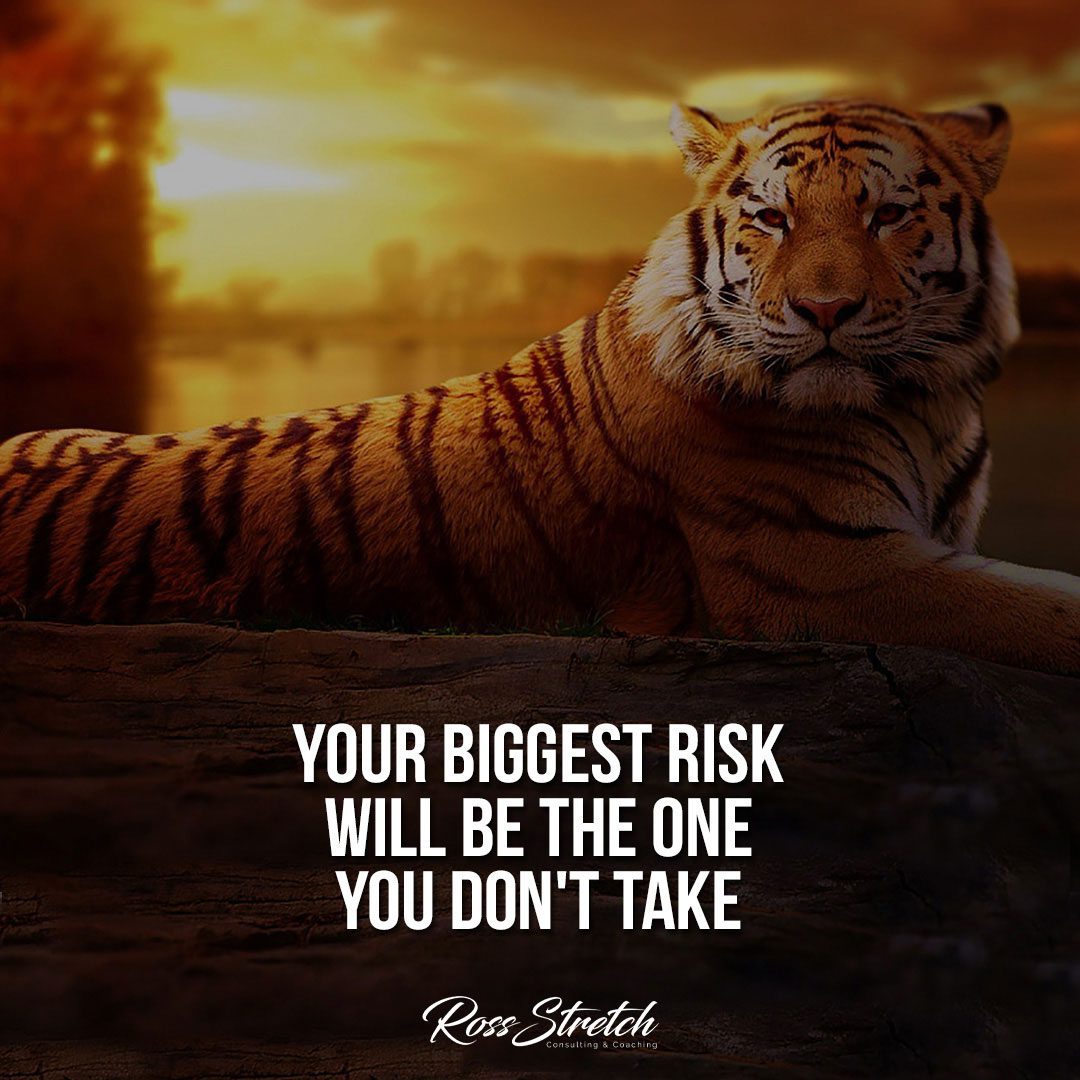
The biggest risk most people ever take isn’t a bold move into the unknown — it’s the quiet decision to stay safe. Every year spent in a comfortable but unfulfilling job, every business idea left unexecuted, every investment passed on because it felt uncertain: these are risks too. They’re just risks with delayed consequences, which makes them easier to rationalize in the moment. The principle that your biggest risk is the one you don’t take isn’t a cliché — it’s a description of how opportunity cost actually works in a human life.
This article is for ambitious professionals who know they’re capable of more and are wrestling with the fear and uncertainty that comes with acting on that knowledge. It covers the psychology of risk avoidance, how to evaluate risk intelligently, and how to build the courage to act when acting matters most.
Why Playing It Safe Is Its Own Kind of Risk
Humans are wired to weight losses more heavily than equivalent gains — a cognitive bias called loss aversion, identified by psychologists Daniel Kahneman and Amos Tversky. This means that the prospect of losing what you have feels more threatening than the prospect of gaining something better feels attractive. The result is a systematic bias toward inaction, toward preserving the status quo even when the status quo isn’t working.
But inaction has costs that loss aversion makes invisible. The entrepreneur who doesn’t launch their business doesn’t just fail to gain — they spend years in a career that doesn’t fit, accumulating resentment and losing time they can’t recover. The investor who avoids market exposure doesn’t just avoid losses — they surrender decades of compounding returns to inflation and low-yield savings. Opportunity cost is real, even when it’s not visible on a balance sheet.
Understanding this bias doesn’t eliminate it, but it does give you a framework for questioning your default responses. When you feel the pull toward playing it safe, ask yourself: what is the actual cost of not taking this risk? Sometimes safety is the right choice. Often it isn’t.
Breaking Free from the Comfort Zone
Your comfort zone isn’t a fixed address — it’s a range of experience that expands or contracts based on what you practice. Every time you act in spite of discomfort, your comfort zone grows. Every time you avoid discomfort, it shrinks. Over time, the cumulative effect of either pattern becomes dramatic.
The most effective approach to expanding your comfort zone isn’t a single dramatic leap — it’s a series of progressive challenges. Start with risks that are uncomfortable but not catastrophic. Cold-pitching a potential client. Publishing your first piece of public writing. Having a direct conversation you’ve been avoiding. Each successful act of courage builds what researchers call self-efficacy — the belief that you can handle what comes next.
The goal isn’t to become someone who never feels fear. It’s to become someone who acts despite it. That’s a learnable skill, and it compounds in the same way that any other repeated behavior does.
Taking Calculated Risks: Balancing Courage and Caution
Risk tolerance isn’t a binary. Between recklessness and paralysis lies the territory where most successful decisions live: the calculated risk. A calculated risk is one where you’ve assessed the downside carefully, determined that it’s survivable, and concluded that the potential upside justifies the exposure.
Nassim Nicholas Taleb’s framework from “Antifragile” is useful here: look for situations where the downside is capped and the upside is uncapped, or at least asymmetric. Starting a side business while employed, for example, caps your downside (you keep your salary if it fails) while leaving the upside open. That’s a different risk profile from quitting your job on day one with no runway — both are risks, but they’re not equally intelligent ones.
Before taking a significant risk, run a simple pre-mortem: imagine it’s one year from now and this decision led to the worst-case outcome. What specifically happened, and can you recover from it? If the answer is yes, the risk is likely worth taking. If the worst case would be genuinely catastrophic, either reduce your exposure or wait until you can structure it differently.
Overcoming Fear with Action
Fear of failure is the most common reason ambitious people don’t take the risks they know they should. But the neuroscience of fear reveals something important: fear is not a signal to stop. It’s a signal that something matters. The presence of fear means you’ve identified something worth pursuing — something that would genuinely impact your life if it worked.
The most effective antidote to fear is action, not reassurance. Waiting until you feel confident before taking a risk is a trap — confidence is built through action, not before it. The first step is nearly always the hardest. Once you’ve started, momentum replaces paralysis, and the fear that loomed so large beforehand tends to shrink to its actual proportions.
Practical tools that help include setting a deadline (indefinite decisions stay indefinitely deferred), seeking evidence from people who’ve taken similar risks (their experience expands your sense of what’s possible), and defining your next smallest action (what’s one concrete thing you could do in the next 48 hours to move forward?).
Learning from Failure When It Comes
Taking risks means accepting that some of them won’t pan out. That’s not a flaw in the strategy — it’s a feature of engaging with uncertainty. The question is what you do with failure when it arrives. People who take intelligent risks and learn from failures consistently outperform those who avoid risk entirely, because their error-correction cycles are faster and their skills compound through experience rather than theory.
After a setback, resist the urge to either catastrophize or dismiss. Instead, run a structured review: what did I expect to happen, what actually happened, and what does that gap tell me about my assumptions or execution? This kind of deliberate post-mortem turns every failure into a competitive advantage — information your competitors who played it safe never collected.
The Regret You Avoid by Acting Now
Harvard psychologist Daniel Gilbert’s research on affective forecasting found that people consistently overestimate how bad they’ll feel about failures and underestimate how much they’ll regret inaction. In other words, the sting of a failed attempt fades faster than the nagging weight of a path not taken. Regret over inaction tends to be more persistent and more painful than regret over action, even when the action didn’t go as planned.
Jeff Bezos used a version of this insight when deciding to leave a stable Wall Street job to start Amazon. He imagined himself at 80 looking back on his life and asked which he would regret more — trying and failing, or never trying at all. The answer was clear enough that he took the leap. That same thought experiment is available to you right now.
Conclusion
The risks you don’t take have consequences just as real as the ones you do. Playing it safe isn’t neutral — it’s a choice with a cost. The most successful professionals and entrepreneurs aren’t reckless; they’re calibrated. They’ve learned to distinguish fear that signals genuine danger from fear that signals discomfort and opportunity. They take calculated risks, learn from outcomes, and keep moving. That willingness to embrace the unknown is what separates a life of possibility from one of regret. The leap you’ve been considering? It’s worth taking.
Resources


 Ross Stretch