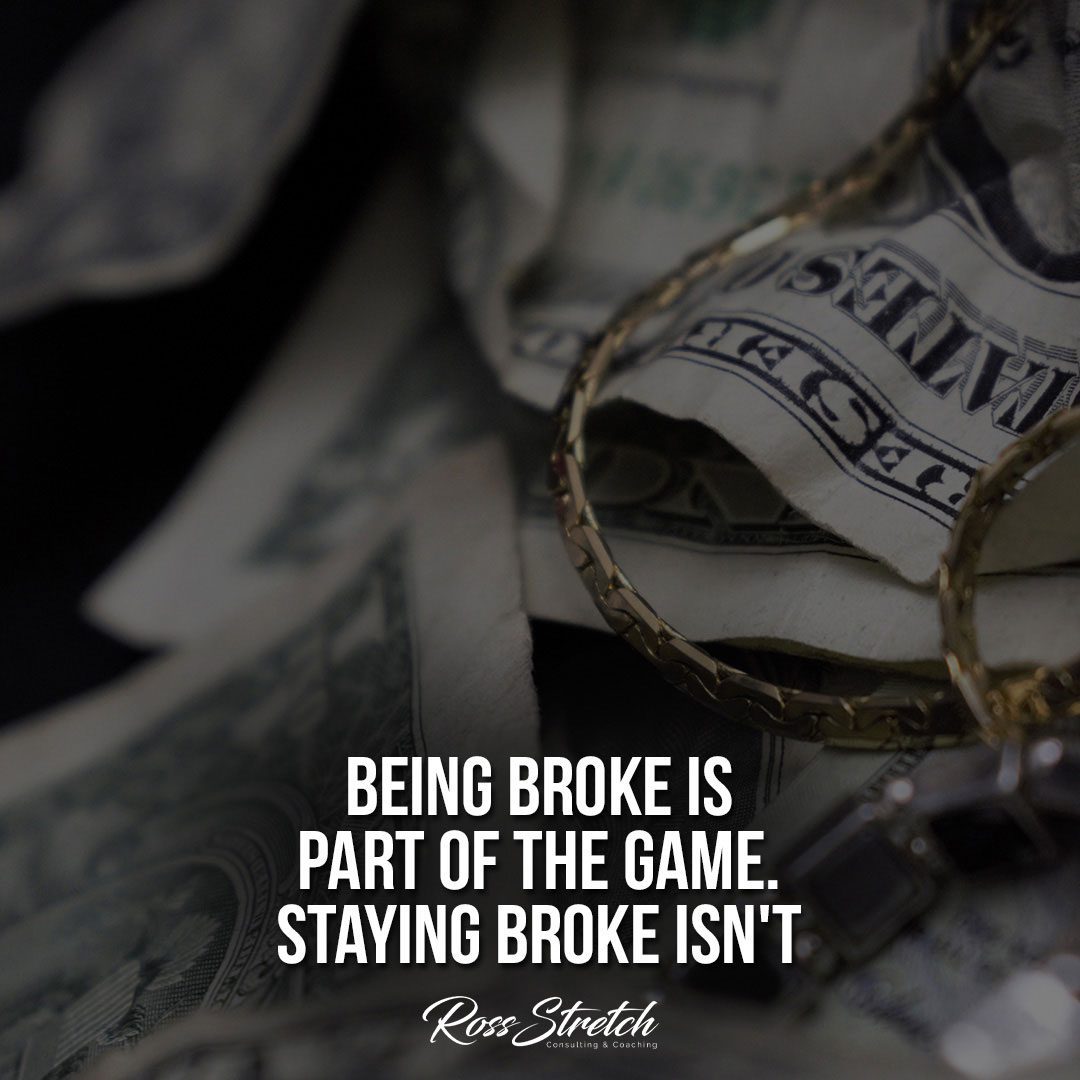
Most people who eventually achieve financial stability were broke at some point. Broke in their twenties while building a career. Broke launching a business that didn’t pan out. Broke after a job loss, a divorce, or a health crisis that wiped out savings they’d worked years to accumulate. Being broke is not a character flaw — it’s a common stage in the financial journey that millions of people move through every year. What separates those who build lasting financial security from those who remain stuck is not luck or a high income — it’s the decision to treat financial struggle as a temporary condition requiring a specific response, rather than a permanent identity requiring only endurance.
Being Broke Is a Starting Point, Not a Destination
There is an important distinction between experiencing financial hardship and being defined by it. Many people who grew up watching their parents struggle with money carry an unconscious belief that financial struggle is simply what their life looks like — and that belief shapes every financial decision they make. It creates a scarcity mindset that avoids risk, refuses to invest, and confuses short-term survival tactics with long-term strategy. The result is a life that stays financially static not because of circumstance, but because of an unexamined belief.
The truth is that being broke is typically a symptom, not a sentence. It reflects a specific set of circumstances — income level, expenses, debt load, and financial knowledge — that can be changed. Not all at once, and not without effort, but changed nonetheless. People from every background, income level, and starting point have built financial security. The common thread is not inheritance or opportunity — it’s a mindset shift that reframes broke as “not yet” rather than “never.”
If you’re currently in a difficult financial position, the most important thing you can do is resist the urge to normalize it. Accepting where you are is not the same as accepting that it will always be this way. Take stock of the situation clearly — debts, income, expenses, spending patterns — and treat it as data that reveals what needs to change, not as evidence of what you deserve.
Learning From Financial Mistakes Without Staying Stuck in Them
Financial mistakes are not the problem. Everyone makes them — overspending in lean years, taking on debt at high interest rates, avoiding investing because it feels complicated, or trusting the wrong financial advice at the wrong time. The problem is repeating the same mistakes without examining why they happened. People who grow financially develop the habit of conducting honest post-mortems on their financial choices: what led to this outcome, what could have been done differently, and what system needs to change so the same mistake doesn’t repeat.
Two of the most common and most costly financial patterns are lifestyle inflation and passive avoidance. Lifestyle inflation means spending more as you earn more without a corresponding increase in savings — a trap that keeps people income-dependent regardless of how much they earn. Passive avoidance means not looking at account balances, credit card statements, or investment performance because the numbers feel overwhelming. Both behaviors are understandable, both are very common, and both have compounding consequences that make financial recovery harder over time.
The goal is not to eliminate financial mistakes — that’s neither realistic nor necessary. The goal is to fail forward: to extract the lesson from each setback and use it to make slightly better decisions in the next cycle. Over time, slightly better decisions compound into dramatically better financial outcomes. The learning itself becomes the asset.
Why Staying Broke Is Often a Pattern — and How to Break It
Chronic financial struggle — when the primary barrier is not catastrophic circumstances but habitual patterns — is often maintained by a collection of deeply ingrained habits, beliefs, and systems that were formed under difficult conditions and never updated. This is not a character flaw. It is not laziness or incompetence. It is the natural result of operating on financial autopilot in an environment where no one taught you a better system.
Common patterns that perpetuate financial stagnation include spending driven by emotional needs rather than actual budget capacity, avoiding financial education because money feels like a painful topic, and the absence of any written financial plan — which leaves every financial decision to be made impulsively in the moment. Breaking these patterns doesn’t require a windfall or a dramatic life change. It requires identifying the specific pattern, understanding what triggers it, and replacing the response with a more constructive habit, consistently applied.
Practical starting points: a written monthly budget even if income is irregular, automatic transfers to savings even if the amount starts at fifty dollars a month, and a scheduled block of time each week to review finances the same way you’d review any other important project. These are small actions, but they shift the relationship with money from reactive to intentional — and that shift changes everything given enough time.
Building Financial Resilience: Preparing for the Setbacks That Will Come
Financial resilience is the ability to absorb unexpected shocks — a job loss, a medical emergency, a major car repair — without going into crisis. It is built through three primary mechanisms: an emergency fund, manageable debt levels, and diversified income sources. None of these develop overnight, but each one represents a layer of protection that makes the next setback far less devastating than the last one was.
An emergency fund with three to six months of living expenses is the single most impactful financial tool available to someone rebuilding their finances. It sounds like an enormous amount when you’re starting from nothing, but the first $1,000 is the most important milestone — it handles the majority of common financial emergencies and breaks the cycle of reaching for high-interest credit every time something unexpected happens. Start there, then build toward three months, then six.
Managing debt is equally critical. High-interest consumer debt — particularly revolving credit card balances — acts as a financial drain that makes every other financial goal harder to achieve. The debt avalanche method — paying minimum balances on all debts while directing every extra dollar toward the highest-interest balance — minimizes total interest paid and accelerates the payoff timeline. Creating a plan and executing it at a steady pace reduces both the financial and psychological weight of debt simultaneously.
The Mindset Shift That Makes Financial Growth Possible
The most important change that precedes financial growth is rarely a change in income — it’s a change in perspective. Specifically, it’s moving from a fixed view of financial reality — “this is just my situation” — to a growth view — “this is my current situation, and it is changeable.” That shift doesn’t make the math easier or the work lighter, but it determines whether you’ll stay in the work long enough to see results. Without it, every setback is a confirmation of failure rather than a data point informing the next attempt.
Financial growth compounds in the same way that interest does: slowly at first, then accelerating as the base grows. The early months of a budget, a savings habit, or a debt payoff plan rarely feel rewarding. Progress is incremental and easy to dismiss. The temptation to abandon the plan because it’s not working fast enough is the test that separates those who build wealth from those who repeatedly restart the process from zero. Staying in the work long enough for compounding to work in your favor is the actual strategy — one that requires no special knowledge, only consistency.
Conclusion
Being broke is a chapter, not the whole story. Nearly every person who has achieved meaningful financial stability passed through periods of scarcity, debt, and uncertainty. What changed was not their circumstances — at least not immediately — but their decision to engage deliberately with their financial reality rather than endure it passively. Learn from the mistakes, build the habits, create the systems, and give the process enough time to compound. Financial growth is available to anyone willing to treat their money with the same seriousness and consistency they bring to the rest of their work. The journey from broke to financially stable starts with refusing to treat broke as a permanent address.
Resources


 Ross Stretch