The personal finance internet is saturated with advice about multiple income streams, passive income portfolios, and side hustles stacked on top of side hustles. Much of that advice is legitimate — but it skips a crucial first step. Before you diversify, you need to master one. Building wealth on a shaky foundation is not diversification; it is chaos with extra steps. The most reliable path to financial independence starts with a single, stable, growing income source — and the discipline to strengthen it before moving on.
Why One Income Source First
There is a counterintuitive truth in personal finance: trying to do too many things at once often results in doing none of them well. Entrepreneurs who launch three businesses simultaneously frequently see all three underperform. Employees who moonlight on five different side projects often burn out before any of them take off. Attention is finite. Capital is finite. In the early stages of building financial security, spreading both too thin is one of the most reliable ways to stall progress.
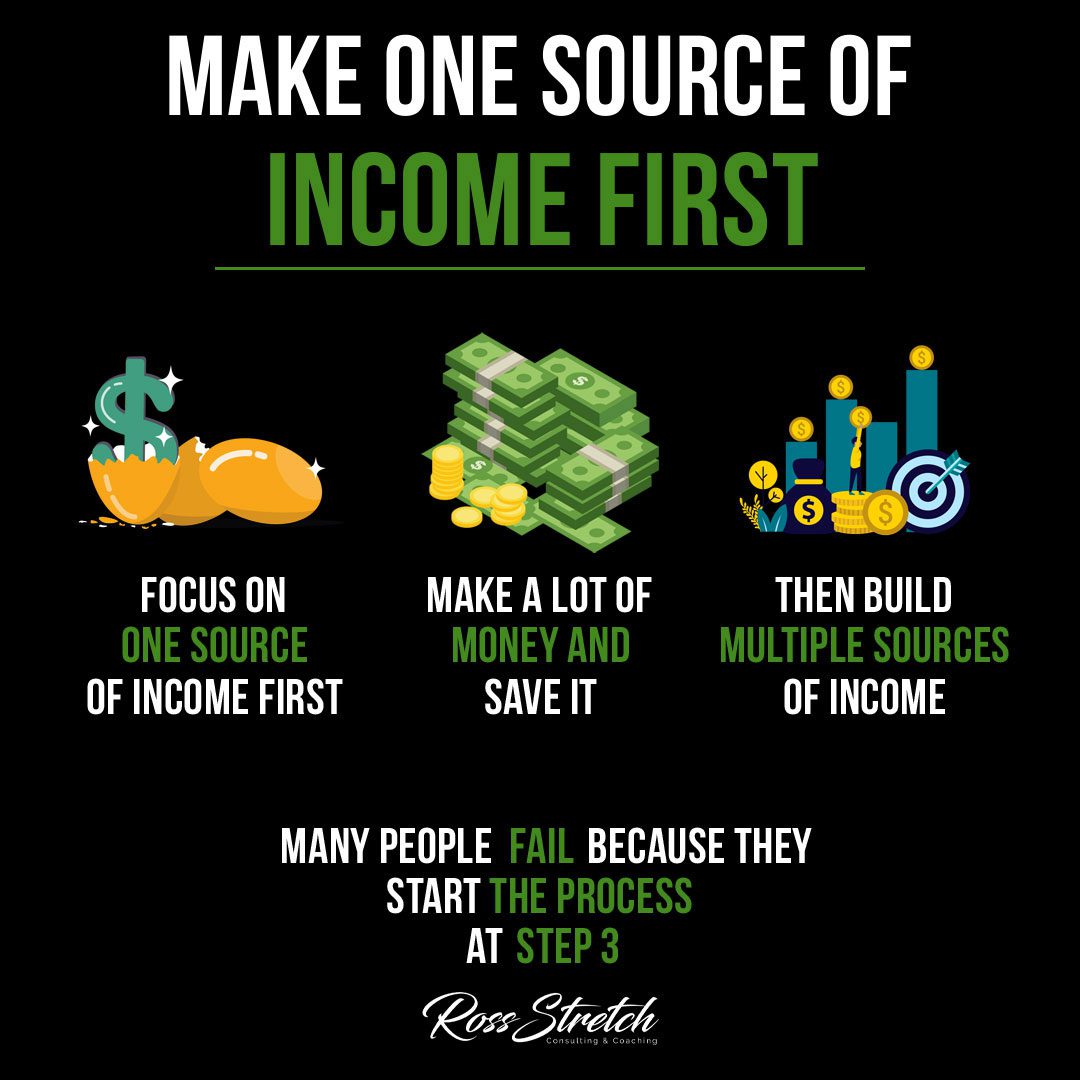
Focusing on one income source first forces you to go deep rather than wide. It means developing genuine expertise in your field, building real relationships with clients or customers, and refining your process until it runs efficiently. Whether your primary income comes from employment, a freelance practice, a small business, or a skilled trade, the goal in the first phase is the same: make it reliable, make it grow, and make it sustainable enough to generate surplus you can deploy elsewhere.
This is how most self-made wealthy individuals actually built their first base of capital. They did not start with a diversified portfolio — they started with a business, a skill, or a career that they drove hard until it produced real cash flow. The diversification came later, funded by profits from that first engine.
Strategies for Strengthening Your Primary Income
Once you have committed to one income source, the objective is to maximize it. This means investing in the skills, tools, and relationships that make you more valuable in your chosen domain. If you are employed, it might mean pursuing certifications, taking on high-visibility projects, or building expertise in a niche that commands a premium salary. If you are self-employed or running a business, it means tightening your offer, improving your marketing, and delivering enough value that clients refer others.
Efficiency matters enormously at this stage. Every hour and dollar you spend should be evaluated against its return to your primary income. Streamlining your workflow, systemizing repetitive tasks, and eliminating low-return activities all contribute to a stronger baseline income without requiring more hours. The goal is to earn more from the same or less effort — creating the surplus that funds the next phase.
- Identify the 20% of your activities generating 80% of your income and protect that time fiercely.
- Raise your rates or negotiate salary increases when your value clearly justifies it — most people wait too long.
- Build systems and processes that make your income more predictable and less dependent on constant hustle.
The Critical Role of Saving
A strong primary income means nothing if it all flows out the door each month. Saving is the bridge between earning and building — it is how you accumulate the capital needed to eventually create a second income stream, invest in assets, or survive the inevitable setbacks that come with any entrepreneurial path.
The general guidance of saving 20% of your income is a reasonable target, but the more important principle is consistency. Automate your savings so the money moves before you have a chance to spend it. High-yield savings accounts, tax-advantaged retirement accounts like an RRSP or 401(k), and simple index fund contributions all work — the key is that money leaves your spending account reliably every pay period.
Building a cash reserve covering three to six months of living expenses should be your first savings priority. This emergency fund is not an investment — it is insurance. It is what allows you to take calculated risks later, weather a slow period in your business, or pivot your career without financial panic forcing a bad decision. Without it, even a single unexpected expense can derail months of financial progress.
When to Expand to Multiple Income Streams
The right time to add a second income stream is not when you spot an exciting opportunity — it is when your primary income is stable, your savings rate is consistent, and you have surplus capital and time you can allocate without jeopardizing the foundation you have built. This is a higher bar than most people set, and that is precisely the point.
Common second income streams worth considering include dividend-paying stocks or ETFs, rental properties, a small online business or product, or royalties from creative work. Each has a different risk profile, capital requirement, and time demand. The one that makes sense for you depends on your existing skills, your available capital, and how much additional time you can realistically commit without degrading your primary income.
The key distinction is that a second income stream should be funded by the excess of your primary income — not by debt, not by raiding your emergency fund, and not at the expense of your core business or career. Treat each new income source like a new investment: start small, validate the model, and scale only when the returns justify it.
The Danger of Skipping Steps
The most common wealth-building mistake is attempting to diversify before the foundation is solid. Social media makes this worse — the feeds are full of people showcasing their passive income portfolios, rental property empires, and automated online businesses, all apparently built overnight. The reality is almost always different: what looks effortless from the outside is usually the result of years of focused work on a primary income source that generated the capital to fund everything else.
When people skip the foundation-building phase and jump straight into multiple simultaneous ventures, the typical result is financial overextension. Credit cards get used to fund ventures that are not yet profitable. Time gets stretched so thin that the primary income suffers. And without an emergency fund, any disruption — a slow month, an unexpected expense, a failed product launch — creates a cascade of financial stress that can take years to recover from.
Conclusion: The Methodical Path Is the Fastest Path
Financial freedom is built sequentially, not simultaneously. Master one income source. Save aggressively from it. Build your cash reserve. Then — and only then — begin layering additional streams with the surplus capital and time your strengthened foundation provides. It is a slower start than highlight reels suggest, but far more reliable. The methodical approach is not the cautious approach or the boring approach — it is the approach that actually works.
Resources


 Ross Stretch