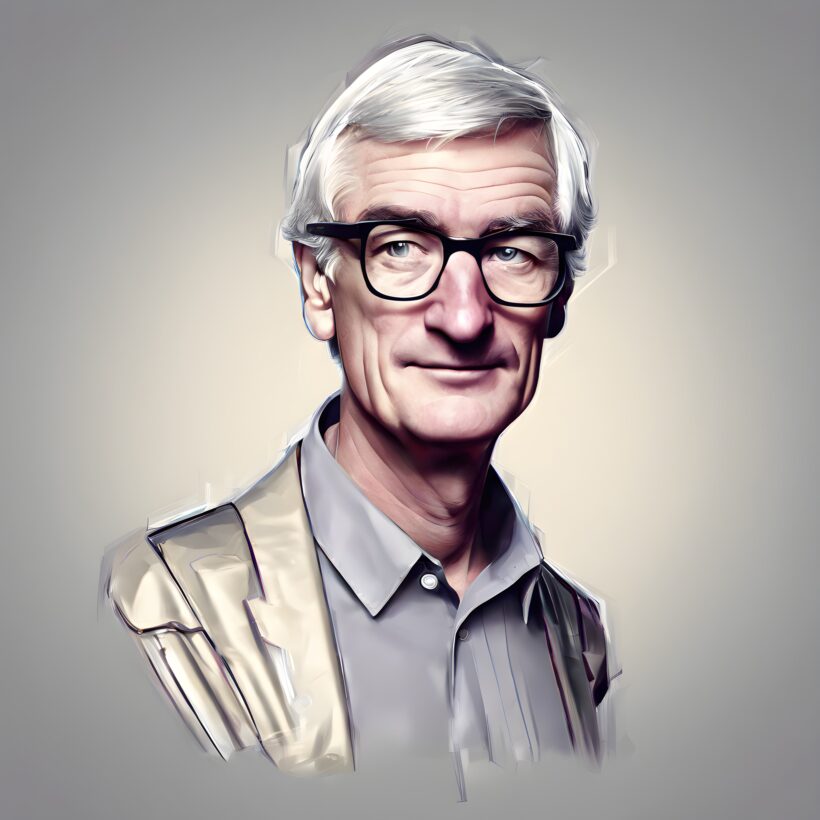

James Dyson is the British inventor, engineer, and industrialist who turned a frustration with a clogging vacuum cleaner bag into one of the most successful consumer technology companies in the world. The founder and sole owner of Dyson Ltd., he spent five years and built 5,127 prototypes before producing a bagless vacuum that would eventually outsell every competitor on the British market. His relentless commitment to engineering-first design has expanded Dyson into bladeless fans, air purifiers, hand dryers, hair styling tools, noise-canceling headphones, and beyond. As of 2025, his net worth is estimated at approximately $10.7 billion by Forbes, while the Sunday Times Rich List has placed his fortune even higher at £20.8 billion (approximately $26 billion), reflecting differing methodologies for valuing his privately held company. Either way, Dyson stands as one of Britain’s wealthiest individuals and one of the most commercially successful inventors of the modern era.
Early Life & Background
James Dyson was born on May 2, 1947, in Cromer, Norfolk, England. His father, Alec Dyson, was a classics teacher at Gresham’s School in nearby Holt — the same school James attended on a scholarship. Alec died of cancer when James was just nine years old, an early loss that Dyson has credited with shaping his self-reliance and determination. He briefly attended the Byam Shaw School of Art in London before transferring to the Royal College of Art, where he studied furniture and interior design alongside engineering. At the RCA, he caught the attention of inventor Jeremy Fry, who hired him to help design and market the Rotork Sea Truck, a high-speed flat-bottomed marine vessel. Working with Fry on a real engineering product — managing suppliers, solving manufacturing problems, navigating commercial realities — gave Dyson the practical business education that his formal training alone could not provide. It also confirmed his belief that design and engineering were not separate disciplines but a single integrated practice.
Career & Rise to Success
In 1974, Dyson invented the Ballbarrow — a wheelbarrow that replaced the traditional front wheel with a large plastic ball, making it easier to maneuver across soft ground and uneven terrain. The product sold well, but disputes with his business partners led to his departure from the company, an early lesson in the importance of protecting intellectual property and maintaining control of one’s own ventures. In 1978, frustrated by the way his Hoover vacuum cleaner progressively lost suction as its bag filled with dust, Dyson began investigating industrial cyclone technology — a system that used centrifugal force rather than filters to separate particles from airflow. He adapted what he observed into a domestic vacuum concept and began building prototypes. The process took more than five years and exactly 5,127 prototypes before he had a design he was satisfied with. British manufacturers and retailers refused to license or stock the product, so Dyson licensed the technology to a Japanese manufacturer, launching the G-Force vacuum in Japan in 1986. He used the licensing royalties to fund his own UK manufacturing operation, launching Dyson Ltd. in 1991 and releasing the DC01 — the first Dyson vacuum sold in Britain — in 1993. Within two years it had become the best-selling vacuum cleaner in the United Kingdom.
Major Achievements
The story of 5,127 prototypes has become one of the most quoted examples of perseverance in entrepreneurship literature worldwide, taught in business schools and cited in motivational contexts by leaders across industries. Beyond the vacuum cleaner, Dyson’s engineering team produced a series of genuinely innovative products: the Dyson Airblade hand dryer (2006), which used a focused sheet of high-velocity air rather than heat; the Air Multiplier bladeless fan (2009), which used aerodynamic principles to amplify surrounding air without exposed blades; the Supersonic hair dryer (2016), which placed the motor in the handle rather than the head to reduce weight and noise; and the Airwrap multi-styler (2018). Dyson is one of the largest patent filers in the United Kingdom and invests approximately ten percent of annual revenue into research and development. He was appointed Commander of the Order of the British Empire (CBE) in 1999 and knighted as Sir James Dyson in 2006. The Sunday Times Rich List has placed him among Britain’s top five wealthiest individuals for more than a decade.
Income Sources & Business Ventures
Dyson Ltd. is a wholly private company owned by James Dyson and his family through a trust structure, meaning no public shareholders or external investors have a claim on its profits. The company sells products in more than 80 countries, with particularly strong positions in the United Kingdom, North America, China, and across Southeast Asia. Annual revenues have exceeded £5 billion in recent years, with vacuum cleaners and hair care products representing the largest volume segments. Dyson invested several hundred million dollars in an electric vehicle project before canceling it in 2019, concluding that the economics of vehicle manufacturing were incompatible with the margins he required. He has since pivoted significant R&D investment toward solid-state battery technology, home robotics, and heating and cooling systems. Dyson also holds substantial agricultural land across England, reportedly making him one of the largest private landowners in the country — an investment that has attracted political controversy given debates over agricultural subsidies.
Assets & Lifestyle
James Dyson’s property portfolio is extensive and reflects both his personal tastes and his agricultural investments. He owns Dodington Park, a stately Georgian estate in Gloucestershire, England, along with associated farmland. He owns additional properties in London and has expanded his landholdings significantly in recent years, acquiring farms across Lincolnshire, Gloucestershire, and other English counties that have made him one of the country’s largest agricultural landowners. After moving Dyson Ltd.’s headquarters to Singapore in 2019, he also purchased a large penthouse in the city-state’s Wallich Residence development, one of Singapore’s most expensive residential properties. He maintains a collection of cars and aircraft consistent with someone who has spent his career obsessing over engineering. Despite his wealth, Dyson is described by colleagues as unpretentious in manner, more comfortable discussing engineering tolerances than luxury goods.
Philanthropy & Giving Back
Dyson’s philanthropic focus is concentrated almost entirely on engineering education, reflecting his conviction that Britain’s long-term economic competitiveness depends on producing more world-class engineers. Through the James Dyson Foundation, he funds the annual James Dyson Award — an international design competition open to university students and recent graduates, which has discovered and funded hundreds of innovative products across its years of operation. In 2017, he established the Dyson Institute of Engineering and Technology in Malmesbury, Wiltshire, which offers an accredited Bachelor of Engineering degree while students work full-time as paid engineers within Dyson’s R&D division — an alternative model to conventional university education. He has donated to the Royal College of Art, the University of Cambridge, and other institutions committed to design and engineering excellence. During the COVID-19 pandemic in 2020, Dyson developed a ventilator design in response to a government request and donated the machines to international health organizations.
James Dyson’s Net Worth in 2025
As of 2025, James Dyson’s net worth is estimated at approximately $10.7 billion according to Forbes, which values his stake in the privately held Dyson Ltd. using conservative assumptions about the company’s earnings multiples and market comparables. The Sunday Times Rich List 2024 applied a higher valuation methodology and placed his fortune at £20.8 billion (approximately $26 billion), reflecting the strong revenue growth Dyson Ltd. has achieved across its global markets and its premium positioning in multiple product categories. The discrepancy between the two estimates is a function of how difficult it is to value a profitable, fast-growing private company with no public market for its shares. What is beyond dispute is that Dyson’s decision to retain 100 percent ownership of his company — resisting significant pressure over the decades to sell stakes or take it public — has proven to be one of the most financially rewarding choices ever made by a British entrepreneur.
Conclusion
James Dyson’s career is above all a story about the rewards of engineering conviction and commercial patience. The man who built 5,127 prototypes before achieving success did not do so because he was lucky or because he had unlimited resources — he did so because he refused to accept that a better solution was impossible. His journey from frustrated homeowner to global technology billionaire has inspired a generation of engineers and entrepreneurs to treat failure not as a stopping point but as data. His insistence on keeping Dyson fully private, on investing relentlessly in R&D, and on treating engineering talent as the most valuable asset a company can hold has produced a business unlike almost any other in modern manufacturing. For anyone who has ever wondered whether persistence in the face of repeated rejection can actually pay off, James Dyson’s life provides one of history’s clearest and most satisfying answers.
References


 Ross Stretch