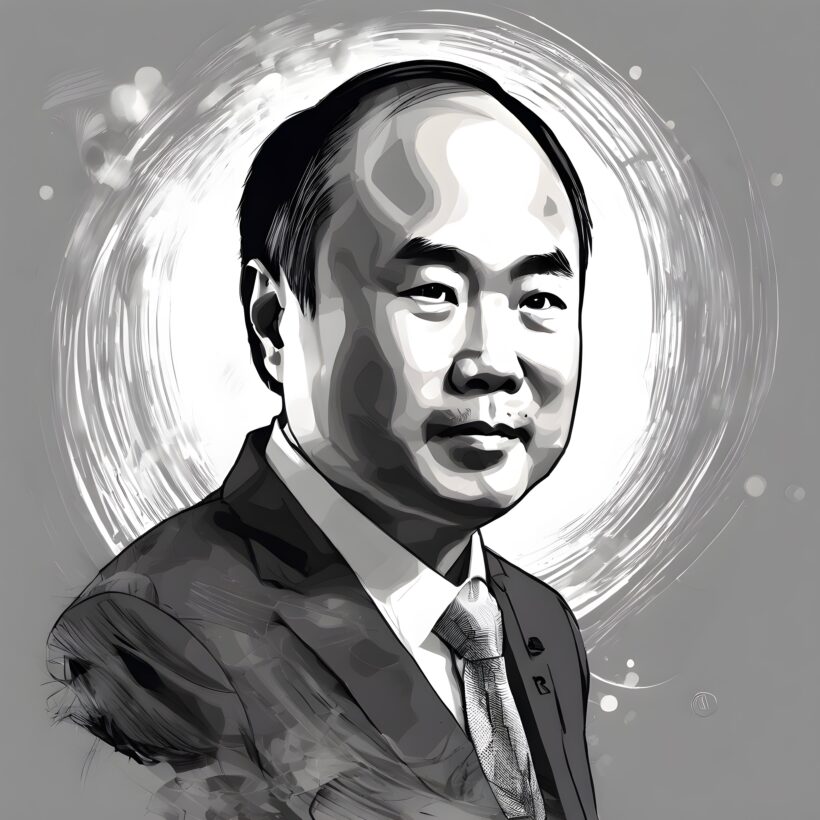

Masayoshi Son is one of the most audacious investors in the history of technology. As the founder and CEO of SoftBank Group, the Japanese telecommunications and investment conglomerate, Son has made bets that range from spectacular triumphs to spectacular failures — often at the same colossal scale. His early investment in Alibaba, made in 2000 for $20 million, grew to be worth over $130 billion at its peak, producing what many consider the single greatest venture capital return ever recorded. His creation of the SoftBank Vision Fund — a $100 billion pool of capital that rewrote the rules of startup investment globally — permanently changed how the technology industry raises and deploys money. As of 2025, Masayoshi Son’s net worth is estimated at $27.8 billion, according to Forbes, though his wealth has oscillated dramatically with the fortunes of SoftBank’s enormous portfolio.
Early Life & Background
Masayoshi Son was born on August 11, 1957, in Tosu, Saga, Japan, to a family of ethnic Koreans who had immigrated to Japan. His family used the Japanese surname Yasumoto, but Son later reclaimed his Korean family name. Growing up as a member of Japan’s Korean minority community, Son experienced discrimination that reportedly fueled a fierce ambition to prove himself on the world stage. At age 16, determined to pursue broader opportunities, he moved to California on his own, studying at Holly Names College in Oakland before transferring to the University of California, Berkeley, where he studied economics and computer science. At Berkeley, the entrepreneurial drive that would define his life was already fully apparent. He invented an electronic pocket translator — a compact device that could translate words between Japanese and English — and licensed the technology to Sharp Corporation for approximately $1 million. He also imported Japanese video games and distributed them to local arcades to fund his education, demonstrating from the start a knack for identifying arbitrage opportunities across borders.
Career & Rise to Success
Son returned to Japan in 1981 and founded SoftBank in Fukuoka. The company’s early focus was distributing PC software to Japanese computer retailers. Son reportedly made a theatrical speech to his first two employees, standing on a produce crate and declaring that within five years, SoftBank would grow into a billion-dollar company. They quit shortly after. He persisted. Through the late 1980s and early 1990s, SoftBank expanded aggressively through acquisitions and publishing deals, and in 1994 the company went public on the Tokyo Stock Exchange. Son’s instincts for transformative technology sharpened dramatically in the mid-1990s. In 1995, he invested in Yahoo and subsequently launched Yahoo Japan, which became the dominant internet portal in that country. Then in 2000, he met Jack Ma in Beijing and invested $20 million in a young e-commerce startup called Alibaba — a bet that most professional investors had passed on. That stake eventually grew to be worth more than $130 billion before SoftBank sold the bulk of its Alibaba holding between 2021 and 2023. The dot-com crash of 2000-2001 was brutal: Son’s paper wealth collapsed by an estimated $70 billion virtually overnight, setting what was at the time a record for personal wealth destruction in history. He rebuilt. In 2006, SoftBank acquired Vodafone Japan for $15 billion, transforming the company into a major telecommunications player. In 2016, SoftBank acquired ARM Holdings — the British semiconductor company whose chip architectures power virtually every smartphone on earth — for $31.4 billion, one of the largest technology acquisitions ever made.
Major Achievements
Son’s career is bookmarked by achievements of historic proportions. The Alibaba investment stands as the benchmark for venture capital returns in the modern era. In 2017, Son launched the SoftBank Vision Fund with $93 billion in committed capital — roughly half from Saudi Arabia’s Public Investment Fund and Abu Dhabi’s Mubadala — making it the largest technology investment fund ever created. The Vision Fund backed transformative companies including DoorDash, ByteDance, Grab, Coupang, Flipkart, and OYO Rooms. In September 2023, Son led ARM Holdings’ return to the public markets via a $54.5 billion IPO on the Nasdaq — the largest technology IPO of the year and a pivotal milestone in SoftBank’s financial recovery. Son has been named repeatedly to Forbes’ lists of most powerful people in technology and business, and his Vision Fund model fundamentally reshaped how venture capital operates at the global level.
Income Sources & Business Ventures
Son’s wealth flows primarily from his approximately 27% stake in SoftBank Group, which in turn holds equity positions across a vast portfolio of technology companies at various stages of growth. SoftBank’s revenue streams include SoftBank Corp (Japan’s third-largest mobile carrier by subscribers), the SoftBank Vision Fund and Vision Fund 2, a major stake in ARM Holdings, and equity positions in T-Mobile USA inherited from the Sprint merger completed in 2020. Son’s personal investments include direct equity positions managed outside SoftBank’s public structure. The company’s fortunes are tightly correlated with the performance of the global technology sector, which makes Son’s net worth among the most volatile of any billionaire — he has personally lost and gained tens of billions of dollars on paper over periods of just a few years as technology valuations have cycled through booms and corrections.
Assets & Lifestyle
Son is known for thinking and living at grand scale. He owns a notable estate in Woodside, California — the affluent enclave in the hills above Silicon Valley that houses some of the world’s wealthiest technology investors — as well as properties in Tokyo. He is married to Masami Son and has two daughters. Son’s most distinctive personal characteristic is not his real estate or his wealth, but the sheer scale of his stated ambitions: he has published a 300-year vision for SoftBank, spoken earnestly about artificial superintelligence and the technological singularity, and proposed a $9 billion solar energy super-grid spanning Asia. Known for theatrical boardroom presentations accompanied by hand-drawn sketches and sweeping historical analogies, Son is a genuinely unconventional figure even by the standards of the technology industry’s most eccentric founders.
Philanthropy & Giving Back
Son has been an active philanthropist, particularly in response to national disasters. Following the 2011 Tohoku earthquake and tsunami — Japan’s most devastating natural disaster in modern history — Son donated 10 billion yen (approximately $100 million) personally to relief efforts and pledged to donate his entire salary to reconstruction causes for the remainder of his tenure at SoftBank. He became a vocal advocate for renewable energy in the aftermath of the Fukushima nuclear disaster, proposing an Asia Super Grid to interconnect solar and wind power capacity across the region. Son also supports educational initiatives and international scholarship programs for students in Japan. In December 2016, he pledged to invest $50 billion in the United States and create 50,000 American jobs — a commitment made directly to then-President-elect Donald Trump that reflected his instinct for positioning SoftBank’s capital alongside the world’s most consequential decision-makers.
Masayoshi Son’s Net Worth in 2025
As of 2025, Masayoshi Son’s net worth is estimated at approximately $27.8 billion, according to Forbes. His wealth is primarily determined by the value of his SoftBank Group equity, which fluctuates dramatically with the performance of SoftBank’s investment portfolio and the broader technology market. Son’s fortune peaked at roughly $78 billion during the height of the dot-com boom before collapsing — then was rebuilt again over the following decade. The ARM Holdings IPO in 2023 and the artificial intelligence investment boom of 2024-2025 have been powerful positive catalysts for SoftBank’s stock price, and Son’s net worth has recovered substantially from lows reached during the 2021-2022 technology sector correction. With ARM’s chip architecture underpinning virtually every AI accelerator and mobile device on earth, Son’s long-term positioning in the AI era may prove to be his most consequential bet yet.
Conclusion
Masayoshi Son’s career is defined by a willingness to make enormous bets at precisely the moment when most investors hesitate. His successes with Alibaba, ARM Holdings, and now the AI-adjacent infrastructure of the modern technology economy prove that when his instincts are right, they are generational in their impact. His failures — most notably the WeWork debacle and other Vision Fund write-downs — have been equally spectacular and offer cautionary lessons about the dangers of capital deployed too quickly and at inflated valuations. At 67, Son remains one of the most consequential figures in global technology and finance, and the arc of his next chapter may well be shaped by the artificial intelligence revolution he has spent decades predicting and funding.
References


 Ross Stretch