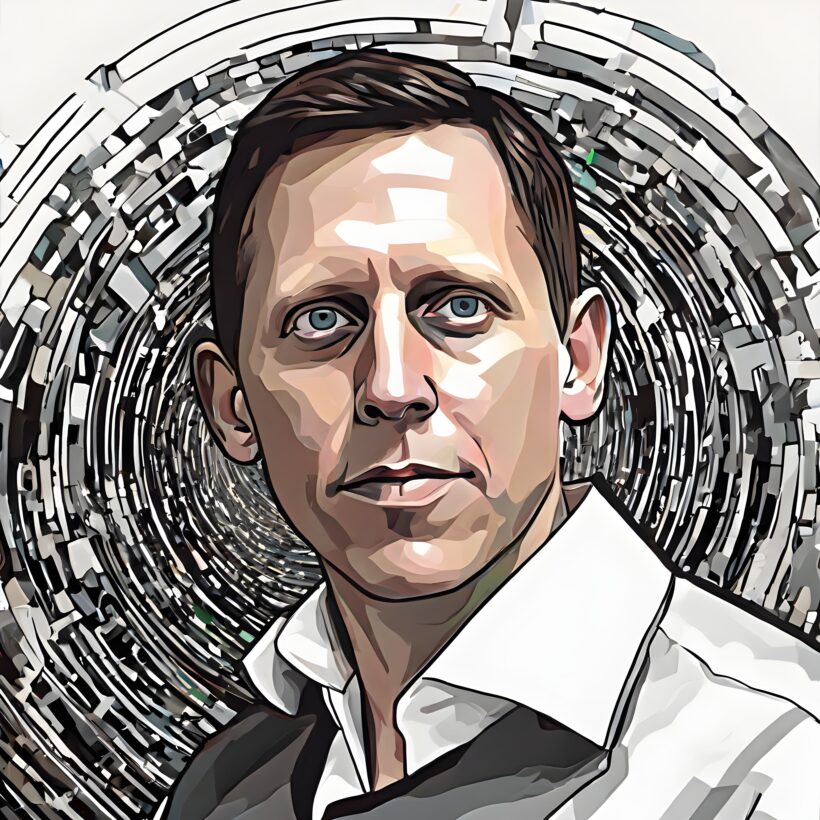

Peter Thiel is one of Silicon Valley’s most celebrated and controversial figures. As a co-founder of PayPal, the first outside investor in Facebook, and the co-founder of Palantir Technologies, Thiel has had an extraordinary run of identifying and shaping the most important technology companies of the past three decades. As of 2025, Forbes estimates Peter Thiel’s net worth at approximately $9 billion, a figure driven in large part by Palantir’s dramatic stock appreciation, his ongoing investment portfolio at Founders Fund, and decades of strategic bets made on technology before the rest of the world understood what it was looking at.
Early Life & Background
Peter Andreas Thiel was born on October 11, 1967, in Frankfurt, West Germany, to a German family that emigrated to the United States when he was one year old. His father was a chemical engineer whose work in mining took the family to various locations across the United States and South Africa before they settled in Foster City, California. These early experiences of geographic and cultural displacement contributed to a restless, globally curious intellectual temperament that has defined Thiel throughout his career.
An intellectually gifted child, Thiel became a nationally ranked chess player in his youth, reaching the top 25 players in the United States within his age group. He attended San Mateo High School and earned admission to Stanford University, where he studied philosophy and graduated in 1989. He went on to earn his Juris Doctor from Stanford Law School in 1992. After law school, Thiel clerked for Judge J. Lawrence Irving of the U.S. District Court for the Southern District of California, then worked briefly as a securities lawyer at Sullivan & Cromwell in New York City. Finding the practice of law unfulfilling, he returned to the Bay Area to pursue entrepreneurship.
Career & Rise to Success
Thiel’s first major venture was launching Confinity in December 1998 alongside Max Levchin, Luke Nosek, Ken Howery, and Yu Pan. Initially focused on security software for mobile devices, Confinity quickly pivoted to an email-based digital payments product that would become PayPal. In March 2000, Confinity merged with Elon Musk’s online banking company X.com, creating a formidable digital payments platform. Thiel served as CEO and guided the combined company through its IPO in February 2002. That July, eBay acquired PayPal for $1.5 billion, netting Thiel approximately $55 million after taxes and launching his career as a technology investor.
The “PayPal Mafia” — the group of founders and early employees who went on to found or fund companies including LinkedIn, YouTube, Tesla, SpaceX, Yelp, and Palantir — became one of Silicon Valley’s most celebrated networks, and Thiel was its central node. In 2004, he made perhaps the most consequential single investment in venture capital history: he provided $500,000 to a 20-year-old Mark Zuckerberg in exchange for approximately 10% of Facebook, becoming the social network’s first outside investor. By the time Facebook went public in 2012, his stake — which he sold over time — had returned over $1 billion, representing one of the most spectacular returns in startup investing history.
Major Achievements
Thiel’s investment track record is among the most impressive in venture capital. Through Founders Fund, which he co-founded in 2005 with PayPal colleagues Ken Howery and Luke Nosek, Thiel has backed companies that have defined the modern technology landscape, including SpaceX, Stripe, Airbnb, Lyft, and DeepMind. The fund has returned billions to investors and cemented Thiel’s reputation as one of the sharpest technology investors alive.
In 2003, Thiel co-founded Palantir Technologies with Alex Karp, Joe Lonsdale, Stephen Cohen, and Nathan Gettings. Named after the all-seeing stones in J.R.R. Tolkien’s The Lord of the Rings, Palantir builds data integration and analytics platforms initially for U.S. government intelligence agencies and later for commercial enterprises. The company went public via direct listing in September 2020 and has seen its stock surge dramatically in 2024 and 2025 as demand for AI-powered data analytics platforms accelerated sharply. Thiel is also the author of Zero to One: Notes on Startups, or How to Build the Future (2014), co-written with Blake Masters, which became an instant classic in entrepreneurship literature and has been read by millions of founders and investors worldwide.
Income Sources & Business Ventures
Thiel’s wealth today flows from several major sources. His stake in Palantir Technologies represents his largest publicly traceable holding — the company’s stock has surged dramatically as government contract expansions and commercial AI product launches have driven rapid revenue growth and investor enthusiasm. Palantir’s market capitalization crossed $100 billion in 2024, significantly boosting the value of Thiel’s retained position. Through Founders Fund, he continues to earn carried interest from successful investments in private technology companies at various stages of growth.
Thiel’s personal investment portfolio spans real estate, private equity, and a range of early-stage technology companies. His Thiel Fellowship, which provides $100,000 grants to young people under 23 who agree to leave college and pursue their entrepreneurial ideas for two years, has produced a remarkable cohort of alumni including Vitalik Buterin (co-creator of Ethereum) and Austin Russell (founder and CEO of Luminar Technologies). While the fellowship is a philanthropic endeavor, it has also given Thiel access to some of the most compelling early-stage entrepreneurs of each generation.
Assets & Lifestyle
Thiel owns significant real estate holdings, including a large oceanfront property on Maui, Hawaii, as well as homes in Los Angeles and Miami. In 2011, he became a New Zealand citizen — a decision that attracted substantial media attention and ongoing speculation about his intentions. He is known for a relatively private personal life and a small circle of close professional associates.
Thiel’s intellectual passions are well-documented and wide-ranging. He has been a major funder of longevity research, including substantial support for the SENS Research Foundation, which works to develop therapies that could extend healthy human lifespan. He has spoken publicly about his interest in parabiosis research and other cutting-edge longevity interventions. He is also a known skeptic of mainstream higher education, famously characterizing the college credential as a “bubble” similar to the housing market that collapsed in 2008 — a view he has backed with both money and advocacy through the Thiel Fellowship.
Philanthropy & Giving Back
Through the Thiel Foundation, Peter Thiel supports research and innovation across several fields including artificial intelligence, biotechnology, and longevity science. The Thiel Fellowship has become one of the most distinctive and talked-about philanthropic programs in Silicon Valley, with hundreds of fellows now running companies, conducting research, and advancing technology across every major sector. The program’s unconventional premise — that stopping out of college can be advantageous for the right person with the right idea — has sparked meaningful debate about the purpose and value of higher education.
Thiel has also donated to libertarian organizations including the Cato Institute and the Seasteading Institute, which explores the creation of autonomous floating communities outside the jurisdiction of existing governments. His philanthropic worldview is shaped by a conviction that transformative technological progress — rather than incremental policy reform — offers humanity’s best path toward solving its most pressing problems. He has been an outspoken advocate for prioritizing innovation in energy, medicine, and computing over regulatory approaches to societal challenges.
Peter Thiel’s Net Worth in 2025
As of 2025, Peter Thiel’s net worth is estimated at approximately $9 billion, according to Forbes. The bulk of that wealth is tied to his stake in Palantir Technologies, whose stock experienced dramatic appreciation through 2024 and into 2025 as the company emerged as a leading beneficiary of enterprise and government demand for AI-enabled data analytics. His continued involvement as a limited partner in Founders Fund and his personal investment portfolio further diversify and grow his wealth. He remains one of Silicon Valley’s most influential and financially powerful figures — and, by any measure, one of the most consequential technology investors in the history of the industry.
Conclusion
Peter Thiel’s career is a study in contrarian conviction. He bet on digital payments before the internet was mainstream. He invested in a college student’s social network before social media was a recognized category. He built a surveillance analytics firm for intelligence agencies at a time when such work was deeply unfashionable in Silicon Valley. He was right in each case, and the compounding effect of those early correct bets has made him a billionaire many times over. Beyond the financial scorecard, Thiel’s intellectual contributions to entrepreneurial thinking — through Zero to One, the Thiel Fellowship, and decades of provocative public discourse — have left a meaningful mark on how the next generation of founders thinks about building companies. His core insight, that the most valuable businesses are those that create genuinely new things rather than incrementally improving existing ones, remains as relevant today as when he first articulated it.
References


 Ross Stretch