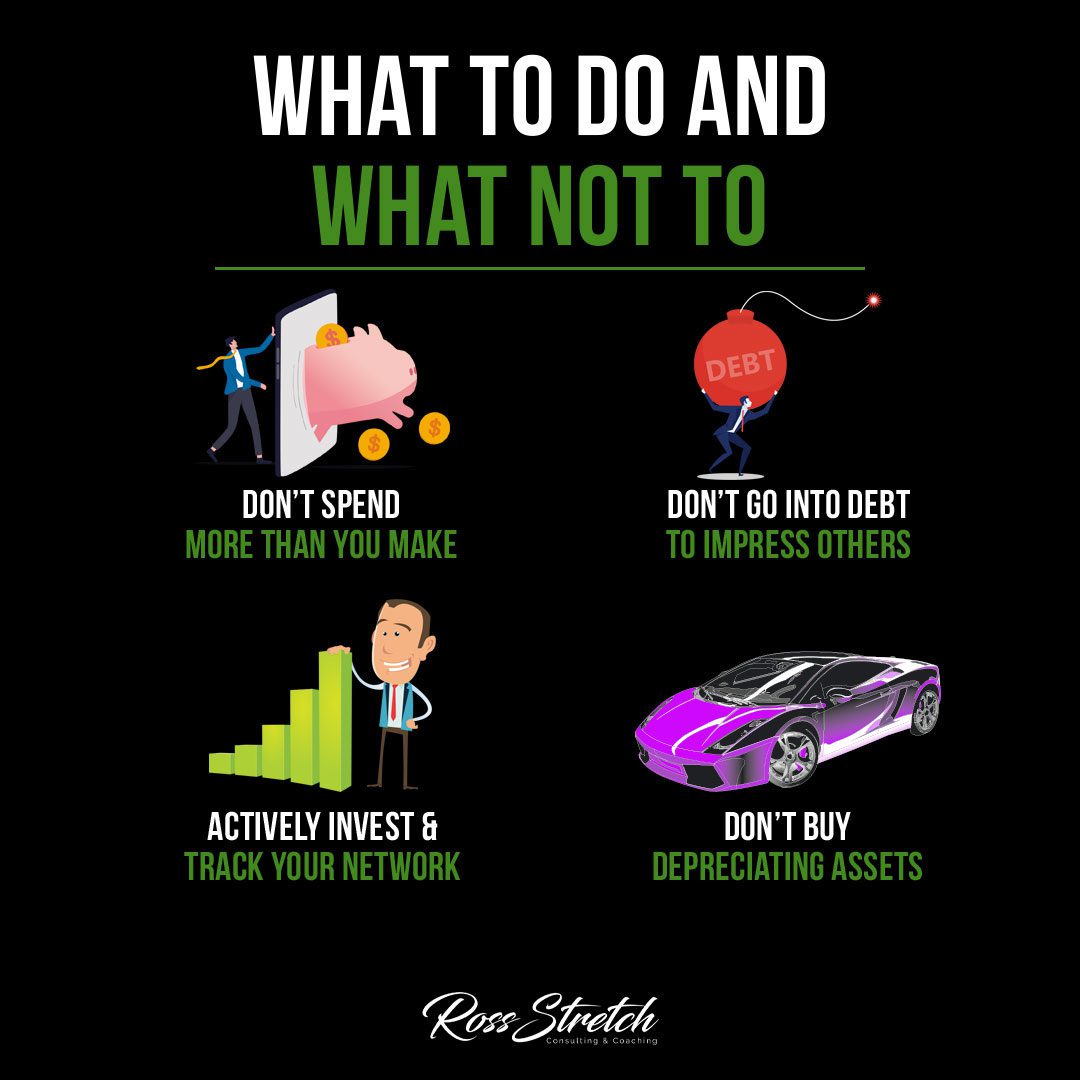
Managing personal finances well is less about earning more and more about building the right habits. The difference between financial stress and financial freedom often comes down to a few consistent decisions made every day. Living within your means, avoiding lifestyle debt, and putting money to work through strategic investing are the pillars that separate those who build lasting wealth from those who spend their best earning years treading water. Whether you are starting fresh or resetting after setbacks, understanding the core dos and don’ts of personal finance gives you a clear roadmap to follow.
\
\
\
\
Live Within Your Means: The Foundation of Financial Health
\
\
The most powerful financial principle is also the simplest: do not spend more than you earn. This rule sounds obvious, yet most people violate it through the slow accumulation of small purchases that gradually exceed their income. Credit cards, buy-now-pay-later services, and subscription creep make overspending nearly invisible until the debt becomes significant.
\
\
Creating a realistic monthly budget is the essential first step. Track every expense — not just the obvious ones like rent and groceries, but the streaming subscriptions, coffee runs, and impulse purchases that quietly drain your account. Once you can see where your money actually goes, you can make deliberate decisions about what to cut and where to redirect funds toward savings and investments. Budgeting apps like YNAB or Mint make this process measurable by automating expense categorization and flagging patterns you might otherwise miss.
\
\
A practical starting framework is the 50/30/20 rule: allocate 50% of after-tax income to needs, 30% to wants, and 20% to savings and debt repayment. Adjust those ratios as your income grows, but maintain the discipline of allocating money before spending it, not after. Small consistent actions compound into dramatically different financial outcomes over time.
\
\
\
\
Debt: Understand When It Works Against You
\
\
Not all debt is destructive. A mortgage on a home in a growing market, or a loan for education that significantly increases earning potential, can make financial sense. Consumer debt taken on to purchase things you cannot truly afford — luxury goods, vacations charged to a card, or the latest electronics — is an entirely different problem. High-interest credit card debt is one of the most expensive traps in personal finance, with rates that regularly exceed 20% annually.
\
\
One of the most corrosive financial behaviors is spending to maintain appearances. Buying a car you cannot afford to impress people, or upgrading your home before your income can support the payments, converts potential wealth into monthly obligations. True financial strength is often quiet. Those who look the wealthiest are frequently carrying significant debt, while genuinely wealthy individuals tend to live well below their means.
\
\
If you carry high-interest debt, prioritize eliminating it aggressively. The debt avalanche method — paying off the highest-interest balances first — saves the most money mathematically. The debt snowball method — clearing the smallest balances first — builds psychological momentum. Both are effective; the right one is whichever you will stick with consistently over time.
\
\
\
\
Invest Consistently to Build Real Wealth
\
\
Keeping money in a savings account feels safe, but inflation erodes its purchasing power every year. Investing is how you put your money to work, allowing it to compound over time into substantially larger sums. You do not need to be a financial expert to start. Index funds that track broad market indices like the S&P 500 offer instant diversification at very low cost. Historically, the U.S. stock market has returned an average of roughly 10% annually over the long run — enough to turn consistent, modest contributions into meaningful wealth over decades.
\
\
Contributing to tax-advantaged accounts like a 401(k) or Roth IRA amplifies those returns by reducing your tax burden now or in retirement. If your employer offers a 401(k) match, contribute at least enough to capture the full match — it is an immediate 50% to 100% return on that portion of your money, which no passive investment can reliably beat as a starting point.
\
\
Dollar-cost averaging — investing a fixed amount each month regardless of market conditions — removes the temptation to time the market. You buy more shares when prices are low and fewer when prices are high, naturally smoothing the impact of volatility over time. The most common mistake investors make is waiting for the right moment. The right moment is as early and as regularly as possible.
\
\
\
\
Choose Assets That Appreciate, Not Depreciate
\
\
Every significant purchase is effectively an investment decision, even when it does not feel like one. Some assets — real estate in growing markets, broadly diversified stocks, marketable skills and professional credentials — tend to increase in value over time. Others — new vehicles, consumer electronics, and fast fashion — lose value quickly from the moment of purchase.
\
\
A new car can lose 15 to 20 percent of its value in the first year alone. That is not a reason to never buy a car, but it is a reason to think critically about how much vehicle you actually need and whether a reliable used model makes more financial sense for your situation. The same logic applies to all major discretionary purchases. Ask yourself whether the asset will be worth more, less, or roughly the same in five years before committing.
\
\
Investing in yourself — through education, professional certifications, and skills that increase your earning potential — is frequently the highest-return investment available. A course or credential that qualifies you for a role paying significantly more can generate returns that few traditional investment vehicles can match over comparable timeframes. Human capital is often the most undervalued asset on a personal balance sheet.
\
\
\
\
Track Your Net Worth to Stay Honest
\
\
What gets measured gets managed. Most people have a general sense of their financial situation but have never calculated their actual net worth — the difference between everything they own and everything they owe. This number is the most accurate measure of financial health, far more meaningful than income alone. A high income paired with high spending and significant debt produces a lower net worth than a moderate income paired with disciplined saving and consistent investing.
\
\
Calculate your net worth at least quarterly. List your assets — cash, investments, home equity, retirement accounts — and subtract your liabilities — mortgage balance, car loans, credit card balances, student loans. As you apply the habits in this article, you should see that number trending upward consistently. Free tools like Empower allow you to connect all your financial accounts in one dashboard and track net worth automatically, making the process both convenient and motivating over time.
\
\
\
\
Conclusion
\
\
Building strong financial habits is not about deprivation — it is about intention. Every dollar you earn is a resource you can direct toward the life you want to build. By spending less than you earn, avoiding debt that does not serve your long-term goals, investing consistently, and choosing appreciating assets over depreciating ones, you give yourself the only thing money can reliably provide: options. Start with one habit, build on it month by month, and let the compounding effect do the rest over time.
\
\
\
\
Resources
\
\
- \
- Investopedia: Personal Finance — comprehensive, free financial education covering budgeting, debt elimination, investing, and retirement planning.
- NerdWallet: 50/30/20 Budget Guide — a practical breakdown of the budgeting framework with an interactive calculator to find your numbers.
- The Total Money Makeover by Dave Ramsey — a direct, step-by-step plan for eliminating debt and building a solid financial foundation from scratch.
- Empower Personal Dashboard — free tool for tracking net worth, investment performance, and spending patterns across all your accounts in one place.
\
\
\
\


 Ross Stretch