Among all the principles of personal finance, few are as deceptively simple — and as transformative in practice — as Pay Yourself First. The idea is straightforward: before you pay rent, your car note, your grocery bill, or any other expense, you set aside a predetermined amount for savings or investment. What remains after that is what you have available to spend. This one habit, practiced consistently over years, is one of the primary reasons compound interest works in some people’s favor and not others. It is the difference between accumulating wealth and merely managing expenses.
\
\
\
It requires discipline, a long-term outlook, and a commitment to putting your future financial well-being ahead of immediate gratification.
\
Ross Stretch
\
\
\
\
What “Pay Yourself First” Actually Means
\
\
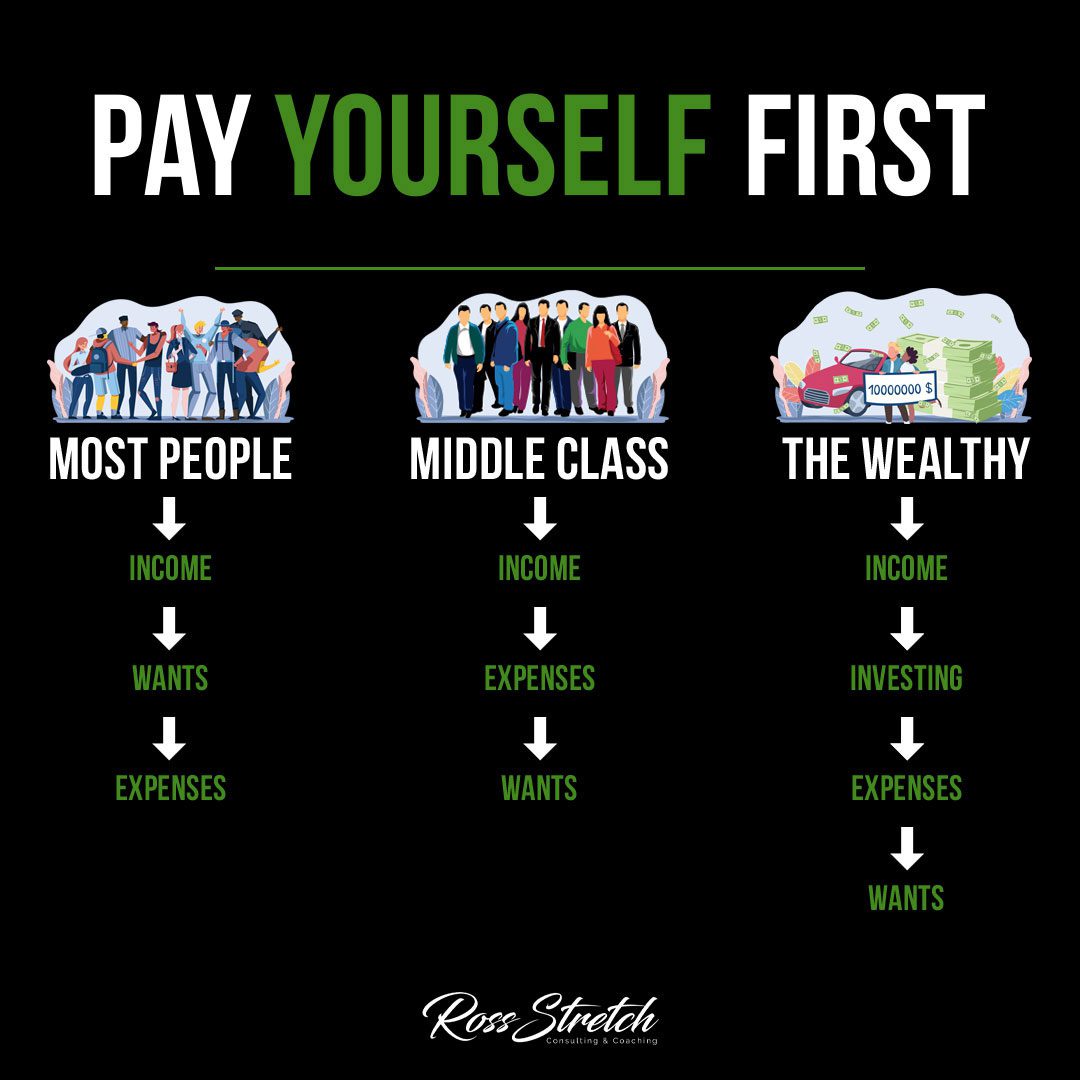
At its core, Pay Yourself First is a prioritization strategy. It treats your future financial security as a non-negotiable expense — not as something you will get around to if there is anything left over at the end of the month. Most people handle money in the opposite order: income arrives, spending happens, and whatever remains (often very little) goes toward savings. This approach fails because spending expands to fill available income.
\
\
Lifestyle inflation is real and relentless. Without a deliberate mechanism that removes money from the spending pool before decisions are made, most people find that saving what’s left leaves very little to save. Pay Yourself First solves this by making the decision once — how much to set aside — and automating it so it happens before any other spending occurs.
\
\
The typical recommendation is to save or invest 15-20% of gross income, though even 5-10% is a powerful start for those just beginning the habit. The exact percentage matters less than the consistency. A modest amount invested every month for decades produces results that a large, irregular contribution cannot replicate.
\
\
\
\
How Spending-First Thinking Keeps People Financially Stuck
\
\
The majority of working adults fall into what financial educators call the spend-first, save-later trap. Income arrives, fixed expenses are paid, discretionary spending happens throughout the month, and then a savings decision is made — if anything remains. This sequence systematically disadvantages the saver because spending is active, visible, and emotionally satisfying, while saving is passive and easy to defer indefinitely.
\
\
Over time, this pattern produces financial fragility. Without a growing savings buffer, unexpected expenses become emergencies. Without invested capital, retirement feels perpetually out of reach. The spend-first pattern also makes it nearly impossible to benefit from compound growth, because there is rarely a consistent base of capital growing over long periods.
\
\
The middle-class approach — earn, cover expenses, then address wants — is more disciplined than pure reactive spending, but it still treats saving as secondary to living. Building genuine wealth requires inverting this entirely: investing first, then building a lifestyle on what remains.
\
\
\
\
The Wealth-Building Advantage of Investing First
\
\
Wealthy individuals are not wealthier simply because they earn more — many high earners are financially fragile. They are wealthier because they invest before they spend. Every paycheck triggers a transfer to investment accounts first; the remainder funds their lifestyle. This ensures that wealth compounds regardless of how other spending decisions unfold in a given month.
\
\
The mechanism behind this advantage is compound growth. When money is invested consistently over time, it earns returns. Those returns then earn returns on themselves. A $500 monthly investment at a 7% average annual return grows to approximately $601,000 over 30 years. The same $500 spent instead of invested costs far more than its face value — it costs every dollar it would have compounded into over those three decades.
\
\
Starting early amplifies this benefit dramatically. A 25-year-old who invests $300 per month will accumulate significantly more by age 65 than a 35-year-old who invests $600 per month — simply because of the additional decade of compounding. Time in the market matters more than the size of each individual contribution.
\
\
\
\
Automating the Strategy
\
\
The most effective implementation of Pay Yourself First is automated savings. Set up an automatic transfer from your checking account to a savings or investment account on the same day your paycheck is deposited. This removes both the temptation and the cognitive load of making the decision each month. What never arrives in your spending account is never spent.
\
\
Employer-sponsored retirement plans like 401(k)s and 403(b)s are perhaps the most seamless version of this strategy — contributions are deducted from your paycheck before it ever reaches your bank account. If your employer offers a matching contribution, contribute at least enough to capture the full match. It is an immediate 50-100% return on those dollars, regardless of what the market does.
\
\
For savings beyond retirement accounts, set up automatic recurring investments through a brokerage account at Vanguard, Fidelity, or Schwab — or through a robo-advisor like Betterment or Wealthfront. Automate the contributions, invest in low-cost index funds, and ignore the day-to-day noise of market fluctuation. The power is in the consistency, not the timing.
\
\
\
\
Diversifying Where You Save
\
\
Once the Pay Yourself First habit is established, the next question is where that money should go. A layered approach is most effective. First, build a liquid emergency fund covering three to six months of essential living expenses in a high-yield savings account. This is the financial foundation that prevents you from raiding long-term investments at the worst possible moment — during a market downturn or a job loss.
\
\
Second, maximize contributions to tax-advantaged retirement accounts — your 401(k), IRA, or HSA if eligible. Tax-deferred and tax-free growth dramatically amplifies the long-term result by eliminating the annual drag of taxes on investment gains. Third, invest the remainder of your Pay Yourself First allocation in a diversified portfolio of low-cost index funds — total market funds, international funds, and bond funds proportioned to your age and risk tolerance.
\
\
As your income grows, the amount you pay yourself first should grow proportionally. Commit to directing at least 50% of every raise directly into savings or investment before your lifestyle adapts to the higher income. This one rule, maintained over a career, can be the single most powerful driver of long-term wealth accumulation.
\
\
\
\
Conclusion
\
\
Pay Yourself First is not a complex strategy — but its simplicity is deceptive. Applied consistently over years, it is one of the most powerful financial habits available to anyone at any income level. It shifts your relationship with money from reactive to proactive, and from scarcity-driven to growth-oriented. Set the amount, automate the transfer, invest with discipline, and let time do the heavy lifting. The results, compounded over decades, are genuinely transformative.
\
\
\
\
Resources
\
\
- \
- Investopedia: Pay Yourself First — clear explanation with examples and implementation steps
- The Wealthy Barber by David Chilton — the classic guide to personal finance built around this principle
- I Will Teach You to Be Rich by Ramit Sethi — a practical system for automating your finances and investing on autopilot
- Vanguard — low-cost index fund investing designed for long-term wealth building
\
\
\
\

 Ross Stretch