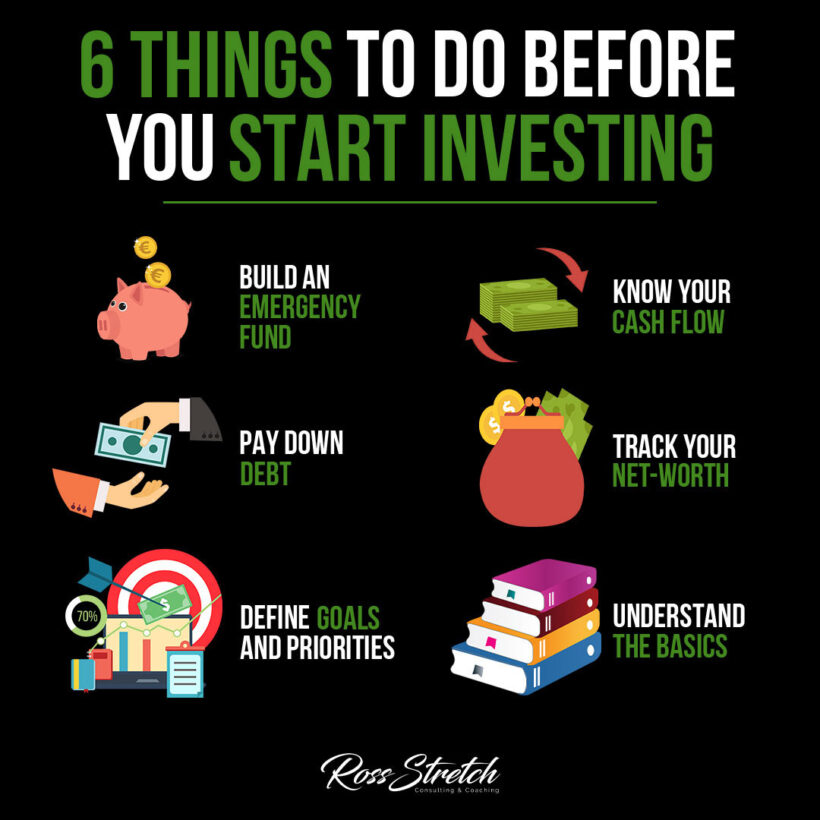

Investing is one of the most powerful tools for building long-term wealth — but jumping in without preparation is one of the fastest ways to lose money and confidence simultaneously. The investment decisions that hurt people most aren’t made in markets; they’re made before a single share is purchased, when the financial foundation is shaky and the strategy is unclear. Here are six essential steps to complete before you invest a single dollar, so that when you do start, you start from a position of genuine strength.
1. Build an Emergency Fund
Your Financial Safety Net Before Anything Else
An emergency fund is the non-negotiable foundation of any sound financial plan. Without one, the first unexpected expense — a job loss, medical bill, or major car repair — forces you to liquidate investments at whatever price the market offers, often at a loss. The rule of thumb is three to six months of essential living expenses held in a liquid, accessible account. High-income earners or those with variable income should target the higher end.
- Actionable Tip: Open a dedicated high-interest savings account separate from your daily checking account. Automate a fixed monthly transfer into it until you hit your target — treat it like a bill, not an option.
- Why It Works: Separating emergency funds from investment accounts creates a psychological firewall. You’re far less likely to raid a dedicated emergency fund than a general savings pool — and far less likely to panic-sell investments when an unexpected expense hits.
Pro Tip:
A high-interest savings account (HISA) or money market fund is the right vehicle for your emergency fund — not a chequing account earning nothing, and not the stock market. Liquidity and stability matter more than returns for this specific pool of money.
2. Know Your Cash Flow
Understand What’s Coming In Before Deciding What Goes Out
Cash flow is the lifeblood of your personal finances — the gap between what comes in and what goes out each month. Most people have a rough sense of their income, but a surprisingly poor understanding of where it actually goes. Before you allocate money to investments, you need a precise picture: fixed expenses, variable expenses, irregular expenses (like annual insurance premiums), and what’s genuinely left over after everything.
- Actionable Tip: Run a 90-day spending analysis by reviewing three months of bank and credit card statements. Categorize every transaction. The patterns that emerge — and the spending you didn’t realize was there — will inform your investment budget far more accurately than guessing.
- Why It Works: Investing money you don’t actually have available creates the worst possible outcome: forced liquidation of positions at inopportune times, often at a loss. Real cash flow clarity prevents this entirely.
Pro Tip:
Use a free budgeting app like YNAB or Monarch Money to track cash flow in real time going forward. The goal isn’t to restrict your spending — it’s to understand it well enough to make intentional decisions about where each dollar goes.
3. Pay Down High-Interest Debt
The Guaranteed Return You’re Already Passing Up
High-interest debt — particularly credit card balances averaging 19 to 22% annually — is the most important financial priority before investing. Here’s the math that most people miss: paying down a debt charging 20% interest delivers an immediate, guaranteed, tax-free return of 20%. No investment reliably produces that kind of return. Carrying high-interest debt while investing is like trying to fill a bathtub with the drain open.
- Actionable Tip: Use the avalanche method — list all debts by interest rate and direct every additional dollar at the highest-rate debt first while making minimum payments on others. Once that’s eliminated, roll that payment into the next highest-rate debt.
- Why It Works: The avalanche method minimizes total interest paid over time, which is mathematically superior to other approaches. It also creates a clear, sequential plan that makes progress visible and motivation sustainable.
Pro Tip:
Low-interest debt — a mortgage below 4%, a student loan at 3% — doesn’t need to be fully eliminated before investing. The threshold question is whether your expected investment return exceeds your debt interest rate. For high-interest consumer debt, that answer is almost always no.
4. Track Your Net Worth
Your Financial Scoreboard
Net worth — total assets minus total liabilities — is the single most honest measure of your financial position. Unlike income, which tells you what you earn, net worth tells you what you’ve kept and built. Knowing your current number gives you a baseline from which every investment and financial decision can be evaluated. It also reveals the full picture of your liabilities, which is often where financial blind spots live.
- Actionable Tip: Calculate your net worth today using a simple spreadsheet: list every asset (savings, retirement accounts, property value, vehicle) and every liability (mortgage balance, loans, credit card balances). Subtract liabilities from assets. Update this quarterly.
- Why It Works: Tracking net worth over time shifts your focus from month-to-month income to long-term wealth accumulation — which is the metric that actually matters. Watching it grow is also one of the most motivating financial habits you can build.
Pro Tip:
Free tools like Personal Capital (now Empower) or Mint can aggregate all your accounts and calculate net worth automatically. Remove the friction from the tracking process and you’re far more likely to stay consistent with it long-term.
5. Define Clear Goals and a Timeline
Investment Without a Destination Is Just Speculation
Every investing decision — what to buy, how much risk to take, how long to hold — should flow from a clearly defined goal with a specific timeline. Investing for retirement in 30 years demands a completely different strategy than investing for a house down payment in five years. Without this clarity, you’re making asset allocation decisions in a vacuum, which is how investors end up with the wrong portfolio for their actual situation.
- Actionable Tip: Write down every financial goal you have, assign a target dollar amount and target date to each, and rank them by priority. Then determine which accounts and investment vehicles are appropriate for each goal based on its timeline and tax treatment.
- Why It Works: Goal-specific investing prevents the most common behavioral mistake in personal finance: panic-selling during downturns. When you know exactly why you own an investment and when you’ll need it, short-term volatility becomes easier to hold through.
Pro Tip:
Separate your goals into buckets: short-term (under three years), medium-term (three to ten years), and long-term (over ten years). Each bucket warrants a different risk level and investment type. This framework prevents you from exposing near-term savings to long-term risk — a costly and common mistake.
6. Learn the Fundamentals Before You Deploy Capital
Knowledge Is the Highest-Return Investment You Can Make
The investing landscape is full of terminology, products, and strategies that sound more complex than they are — but also more complex strategies that sound simpler than they are. Before committing real money, invest time in learning the basics: how stocks and bonds work, what index funds and ETFs are, how registered accounts like TFSAs, RRSPs, and 401(k)s function, and how diversification reduces risk without reducing expected returns. This knowledge pays dividends in avoided mistakes for the rest of your life.
- Actionable Tip: Start with three resources: “The Little Book of Common Sense Investing” by John Bogle, the Investopedia Simulator (which lets you practice with virtual money), and your country’s government financial consumer agency website for registered account rules specific to your tax situation.
- Why It Works: Investors who understand what they own and why are dramatically less likely to panic during market downturns — and less likely to be sold inappropriate, high-fee products by advisors whose incentives don’t align with theirs.
Pro Tip:
You don’t need to become an expert before you start — you need to understand enough to make one good first decision. A diversified, low-cost index fund held in a tax-advantaged account is a legitimate starting point that outperforms the majority of active strategies over time. Learn as you go from there.
Conclusion
The best investment you can make before entering the markets is the one you make in your financial foundation. An emergency fund, a clear understanding of your cash flow, eliminated high-interest debt, a tracked net worth, defined goals, and foundational knowledge — these six steps don’t just prepare you to invest. They are the conditions under which investing actually works.
Most people who lose money in the markets didn’t lose it because the markets failed them — they lost it because they entered unprepared, panicked at the wrong moment, or didn’t have a clear reason to hold. Do the preparation work, and you change the entire probability of your outcome before a single trade is placed.
Resources


 Ross Stretch