
The creator economy has fundamentally changed who can build a profitable business — and the answer is anyone with genuine expertise and the willingness to share it. Teaching a skill online is one of the most accessible, low-overhead business models available today, with zero inventory, no physical storefront, and the ability to serve students anywhere in the world simultaneously. Whether you know Excel, guitar, photography, coding, copywriting, or personal finance, someone right now is actively searching online for exactly what you know how to do — and willing to pay for it.
Why This Matters
The global e-learning market was valued at over $250 billion in 2023 and is projected to exceed $1 trillion by 2032. Online course creators are capturing a meaningful slice of that growth — not just major educational institutions, but individual subject-matter experts who have taken the time to package what they know into structured, accessible learning experiences. The barrier to entry has never been lower, and the appetite for skill-based learning has never been higher.
Beyond the financial opportunity, teaching a skill online creates a scalable income stream that decouples your earnings from your hours. Unlike consulting or freelancing, where you trade time directly for money, a well-built online course continues to generate revenue long after you finish creating it. Top instructors on Udemy report earning $5,000 to $50,000 per month from courses they built years ago, while spending only a few hours on updates and student questions. That leverage — where one hour of work today pays indefinitely — is the defining advantage of the online course business model.
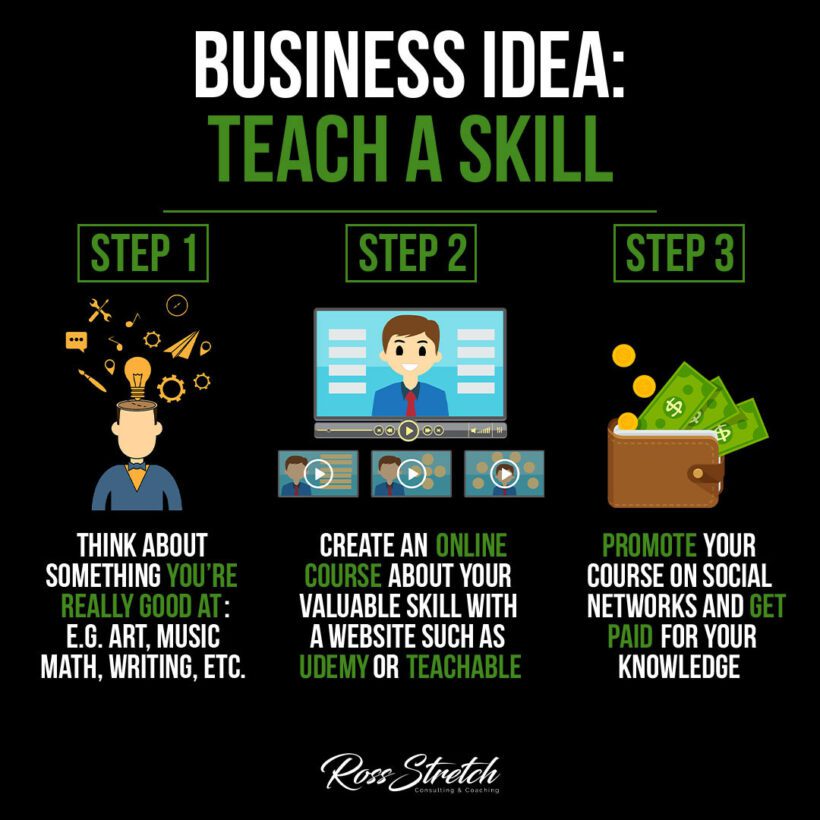
Step-by-Step: How to Build and Sell an Online Skill Course
Step 1: Identify and Validate Your Teachable Skill
The most profitable skill to teach is not necessarily the one you’re most passionate about — it’s the intersection of what you know deeply and what people are actively paying to learn. Start by listing every skill you’ve developed that took more than six months to acquire. Then validate demand before building anything.
- Search your topic on Udemy and look for courses with 1,000 or more enrolled students — existing demand is a green light, not a red flag
- Check Google Trends to see whether interest in your topic is growing or declining over the past two years
- Browse Reddit communities and Quora for questions people repeatedly ask about your subject — these are the gaps your course can fill
- High-demand categories include: digital marketing, financial literacy, coding and data analysis, productivity systems, creative skills (photography, graphic design, writing), fitness, and language learning
Step 2: Choose the Right Platform for Your Goals
The platform you choose determines how much control you have over pricing, branding, and your relationship with students. The two dominant options are Udemy and Teachable, each with distinct trade-offs that suit different stages of business development.
- Udemy: Built-in audience of 60 million-plus students — ideal for getting initial traction without a pre-existing audience. Trade-off: Udemy controls pricing through frequent discount promotions and takes up to 63% of revenue from platform-driven sales
- Teachable: You set your own prices, own your student email list, and build on your own domain. Better long-term economics, but requires you to drive your own traffic
- Kajabi: All-in-one platform covering course hosting, email marketing, website, and community — higher monthly cost but maximum control over the student experience
- Skillshare: Royalty-based model suited to shorter, project-focused classes for creative professionals — works best as a supplementary revenue stream alongside a primary platform
Step 3: Build Your Course Content Efficiently
Most aspiring course creators overestimate how long and polished a course needs to be. Students pay for outcomes, not production values — a concise, action-oriented course that delivers real results will outperform a beautifully produced course that meanders. Plan your content around the transformation: what specific, measurable outcome will a student achieve by the end, and what is the shortest path to that outcome?
- Structure your course as a series of short modules — 5 to 12 minutes each — as completion rates drop sharply with longer individual lessons
- Invest in decent audio before anything else — poor sound quality kills perceived professionalism faster than imperfect video
- Use screen recording tools like Loom, Camtasia, or OBS Studio for technical subjects — screen-based instruction is perfectly effective and removes the camera-shyness barrier
- Include exercises, templates, or worksheets with every module — active learning dramatically improves student outcomes and generates the positive reviews that drive future sales
Step 4: Price Your Course to Reflect Real Value
One of the most consistent mistakes first-time course creators make is underpricing. A $297 course on a marketable professional skill is not expensive — it’s a signal of quality. Low prices attract price-sensitive students who are less committed to completing the work, which produces lower completion rates, fewer success stories, and worse reviews. Price for the value of the outcome your course delivers, not the number of hours of content it contains.
- Professional skill courses (marketing, coding, writing, finance) typically price between $97 and $997 depending on depth and specificity
- Offer an introductory launch price for your first cohort to generate early reviews and social proof
- Include a no-questions 30-day money-back guarantee — this removes purchase risk and consistently increases conversion rates without meaningfully increasing refund rates
Step 5: Promote Your Course to Reach Real Students
Creating a great course and publishing it is only half the work. Marketing is where most courses succeed or fail. Start with the channels where your potential students already spend time, and focus on demonstrating value before asking for a sale.
- Content marketing: Write blog posts, create YouTube videos, or record a podcast that teaches a slice of your course topic for free — this builds trust and positions you as an authority before anyone spends a dollar
- Email list: Offer a free lead magnet (checklist, template, or short email mini-course) in exchange for email addresses, then nurture that list with consistent valuable content and occasional offers
- Social proof: Give your first cohort access at no cost or heavily discounted in exchange for honest testimonials — social proof is the single most powerful conversion tool available to course sellers at any price point
- Affiliate partnerships: Offer a 20 to 40% commission to others in your niche who promote your course to their audiences — this scales reach without upfront advertising cost and aligns incentives perfectly
Common Mistakes to Avoid
- Building before validating: Creating a full course before confirming that people will pay for it. Pre-sell a beta version first — if you can’t get 10 paying students before the course exists, reconsider the topic or the target audience before investing weeks in production.
- Making it too long: Adding content to justify the price rather than to serve the student. Length doesn’t create value — outcomes do. Cut anything that doesn’t directly serve the transformation you’re promising.
- Ignoring student feedback: The questions and reviews from your first students are the most valuable data you have. Early feedback tells you exactly what’s confusing, what’s missing, and what could be expanded — treat it as free product research.
- Waiting for perfect production quality: Good-enough is good enough to start. Perfectionism at the production stage delays your launch by months, and most of the refinements you’d make before launching are irrelevant to students who care primarily about the content.
- Teaching too broadly: “Learn to code” competes with everything. “Python for data analysts who have never programmed before” is a course that speaks directly to one specific person’s exact situation — and converts dramatically better because of it.
Conclusion
Teaching a skill online is one of the few businesses that rewards expertise directly — the more deeply you know your subject and the more clearly you can communicate it, the more valuable your course becomes. The overhead is minimal, the upside is real, and the impact is tangible: every student who applies your teaching and achieves a better result in their life or career is a direct return on the time you invested in building the course.
The most important move is to start before you feel fully ready. Launch a beta version, collect feedback, iterate, and improve. The course you launch on day one will not be the course you’re proud of in year two — but the course you never launch will never teach anyone anything.
Resources

 Ross Stretch