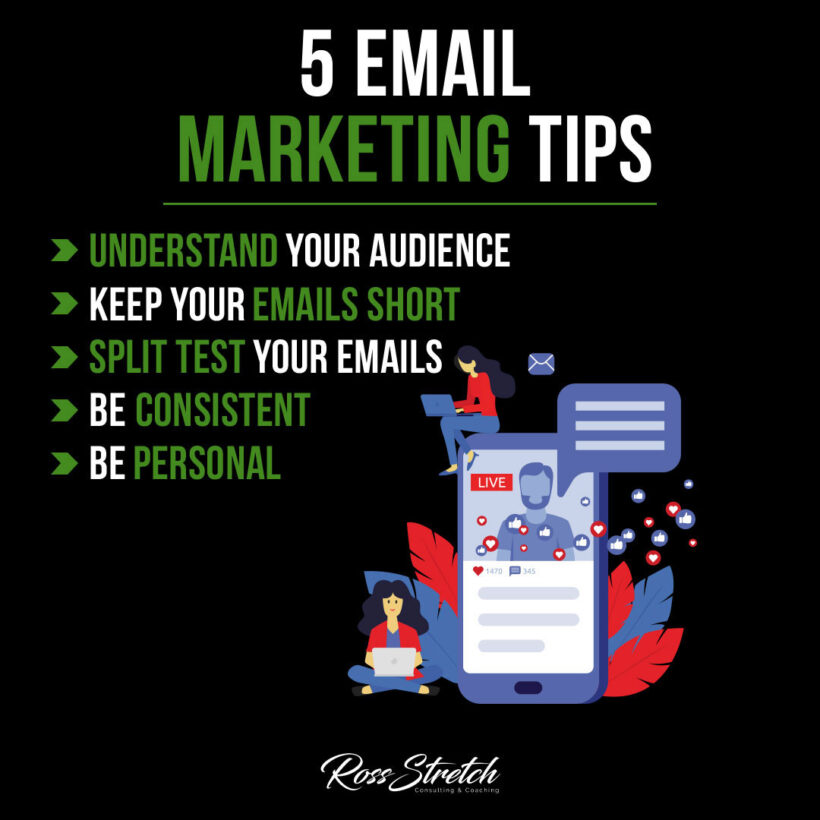

Email marketing consistently delivers one of the highest returns on investment of any marketing channel — often $36 for every $1 spent. But a bloated list and a weak strategy won’t get you there. These five email marketing tips will help you write better campaigns, build genuine relationships with your subscribers, and drive real revenue from your list.
1. Write Subject Lines That Demand to Be Opened
Your Subject Line Is the Most Important Copy You’ll Write
The best email in the world is worthless if no one opens it. Your subject line is your one shot at standing out in a crowded inbox. The average professional receives over 120 emails per day — yours needs to earn its open in under 3 seconds. Subject lines that trigger curiosity, urgency, or personal relevance consistently outperform generic ones.
- Actionable Tip: Test two subject lines for your next campaign using A/B testing. One should use a curiosity gap (e.g., ‘The mistake costing you sales every day’) and one should use specificity (e.g., ‘3 email changes that doubled our open rate’). Send each to 20% of your list, let the winner run for 4 hours, then send the winning version to the remaining 60%.
- Why It Works: Open rates determine everything downstream — clicks, conversions, revenue. A 10% improvement in open rate can mean thousands of additional dollars in revenue over the life of a campaign without changing a single word inside the email.
Pro Tip:
Keep subject lines under 50 characters so they display fully on mobile. Avoid spam-trigger words like ‘FREE,’ ‘GUARANTEED,’ or excessive punctuation. And always preview how your subject line looks on both desktop and mobile before sending — what looks clean on screen may get cut off on a phone.
2. Segment Your List for Laser-Targeted Messages
Stop Sending the Same Email to Everyone
Batch-and-blast email — sending the same message to your entire list — is a relic of the past. Today’s subscribers expect relevance. List segmentation means dividing your audience into groups based on behavior, demographics, purchase history, or interests, then sending each group a message tailored specifically to them. Segmented campaigns generate up to 760% more revenue than non-segmented ones.
- Actionable Tip: Start with three basic segments: new subscribers (send a welcome sequence), active buyers (send upsell and loyalty content), and inactive subscribers (send a re-engagement campaign). Even this simple structure will immediately improve your results.
- Why It Works: Relevant emails get opened, clicked, and acted on. Irrelevant emails get deleted, unsubscribed from, or marked as spam — damaging your deliverability for everyone on your list. Segmentation keeps your messages relevant and your sender reputation strong.
Expert Insight:
Behavioral segmentation is the most powerful form: segment by what subscribers actually do, not just who they are. Did they click a link about Topic A? Add them to a segment that gets more Topic A content. Did they abandon a cart? Trigger an automated recovery sequence. Platforms like Klaviyo, ActiveCampaign, and Mailchimp make this simple.
3. Craft a Single, Clear Call-to-Action
One Email, One Goal — Remove All Confusion
One of the most common email marketing mistakes is giving subscribers too many choices. When an email contains multiple calls-to-action — ‘Buy now,’ ‘Learn more,’ ‘Follow us,’ ‘Share this’ — readers experience decision paralysis and often do nothing. Every email should have one primary goal and one crystal-clear next step.
- Actionable Tip: Before writing your next email, write the CTA first: what exactly do you want the reader to do? Then build the entire email to support that single action. Remove any links, offers, or messages that don’t directly support that goal.
- Why It Works: Clarity converts. When subscribers know exactly what you want them to do and why it benefits them, click-through rates and conversions jump significantly. Multiple CTAs diffuse attention; a single focused CTA concentrates it.
Pro Tip:
Make your CTA button text specific and benefit-driven, not generic. ‘Get My Free Guide’ dramatically outperforms ‘Click Here.’ ‘Start My Free Trial’ beats ‘Sign Up.’ The button text should reinforce the value the subscriber gets by clicking, not just describe the mechanical action of clicking.
4. Personalize Beyond Just the First Name
True Personalization Is About Relevance, Not Just Names
Inserting a subscriber’s first name into an email subject line used to feel cutting-edge. Now it’s table stakes — and alone, it doesn’t move the needle. Modern email personalization means serving content that’s relevant to where each subscriber is in their journey: their past purchases, their interests, their behavior on your site, and their engagement history with your emails.
- Actionable Tip: Map out your customer journey and create at least three distinct email experiences: one for brand-new subscribers, one for engaged middle-of-funnel subscribers, and one for loyal buyers. Use your email platform’s automation features to deliver the right message automatically at each stage.
- Why It Works: Personalized emails deliver 6x higher transaction rates than generic ones, according to research from Experian. Subscribers who feel understood and valued stay on your list longer, buy more often, and refer others.
Expert Insight:
Use ‘if-then’ logic in your automations: if a subscriber clicks a link about Topic X, send them a follow-up email that goes deeper on Topic X. If they purchase Product A, send them content about getting the most from Product A, followed by a relevant upsell. This behavioral personalization feels uncannily well-timed and dramatically boosts engagement.
5. Test, Analyze, and Optimize Every Send
Your Data Tells You Exactly How to Improve
Email marketing isn’t set-and-forget — it’s an iterative process of constant improvement. The marketers who generate exceptional results aren’t smarter; they test more. Every campaign is an experiment that teaches you what resonates with your specific audience. Over time, this compounding knowledge makes your emails significantly more effective.
- Actionable Tip: After every campaign, review four key metrics: open rate, click-through rate (CTR), conversion rate, and unsubscribe rate. Compare them to your previous benchmarks. Pick the metric that moved least and make improving it the focus of your next campaign.
- Why It Works: Small, consistent improvements compound dramatically. Improving open rate by 2% and CTR by 1% might seem trivial, but over the course of a year those gains translate into thousands of additional engaged subscribers and significant additional revenue.
Pro Tip:
Run formal A/B tests on one variable at a time: subject line, send time, email length, CTA button color, or preview text. Testing multiple variables simultaneously makes it impossible to know what caused the change. Document your results in a simple spreadsheet so you build a library of insights specific to your audience over time.
Conclusion
Email marketing rewards those who take it seriously. By crafting irresistible subject lines, segmenting your audience, focusing on one clear CTA, personalizing for relevance, and committing to continuous testing and improvement, you’ll build an email program that generates consistent, predictable revenue. Your list is one of your most valuable business assets — treat it that way.
Resources

 Ross Stretch