
Self-improvement isn’t a destination — it’s a system. The people who make consistent progress in their health, mental clarity, and relationships don’t rely on motivation. They build structured habits that quietly compound over time. This guide explores six foundational practices for holistic self-improvement, addressing your physical health, cognitive development, social skills, and long-term goal achievement. Whether you’re starting from scratch or sharpening existing routines, these habits offer a practical framework for becoming a more capable, fulfilled version of yourself.
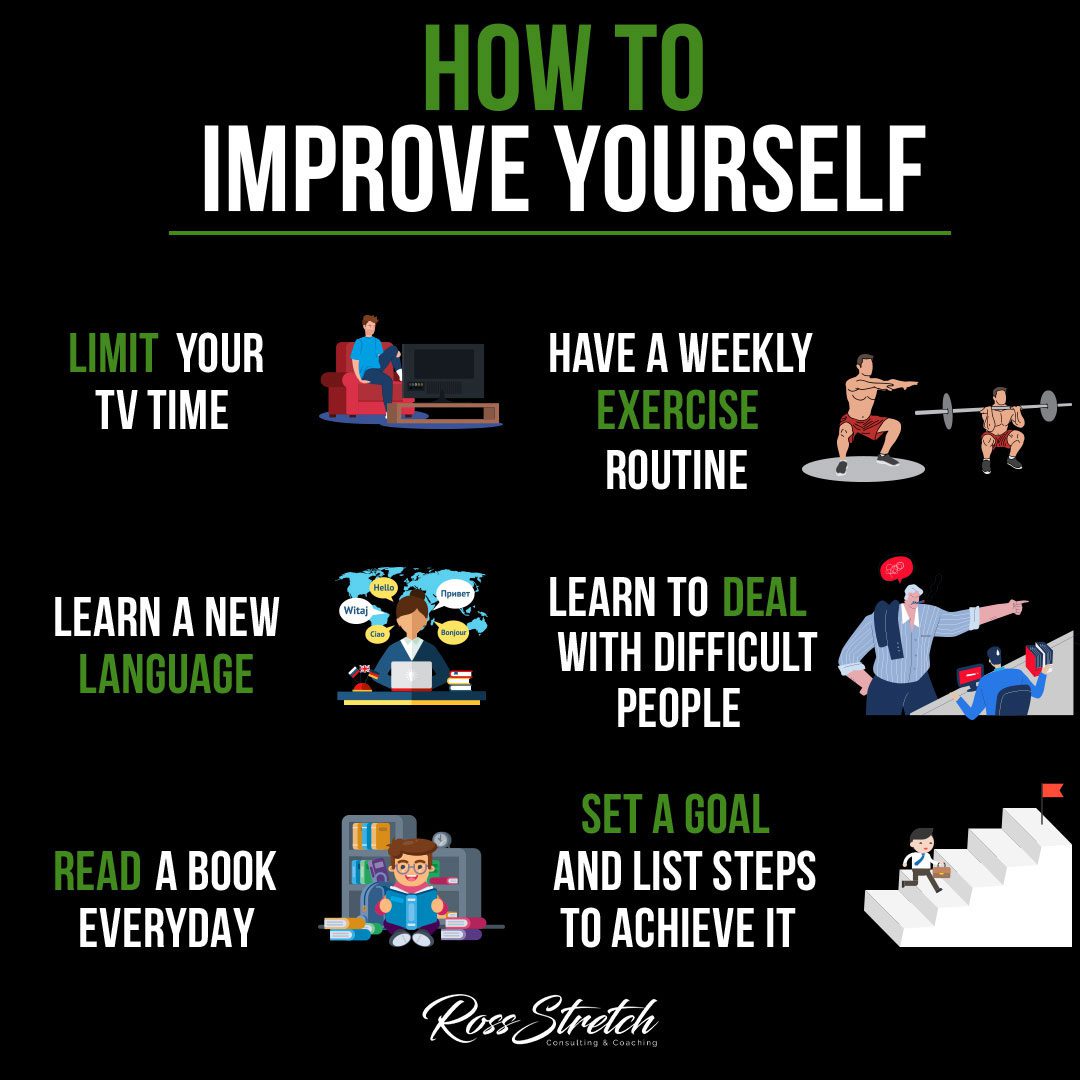
1. Limiting Screen Time: The Modern-Day Detox
Reclaiming Your Hours from Passive Consumption
The average person now spends over six hours per day looking at screens. While technology offers genuine utility, excessive passive consumption — particularly television and social media scrolling — erodes time that could be invested in higher-quality activities. Limiting screen time isn’t about becoming a technophobe; it’s about being intentional with your most finite resource: attention. Every hour reclaimed from passive consumption is an hour that can build capability, relationships, or financial progress over time.
- Actionable Tip: Set a daily screen time limit using your phone’s built-in tools — Screen Time on iOS or Digital Wellbeing on Android. Start by reducing current usage by 30 minutes per day and fill that window with a specific, pre-decided replacement activity.
- Why It Works: Research consistently shows that reducing screen time improves sleep quality, attention span, and mood — measurably, within two to three weeks of consistent reduction.
Pro Tip:
The most effective approach isn’t willpower — it’s environmental design. Delete social apps from your phone and restrict them to your laptop only. When passive consumption requires slightly more effort, your brain naturally gravitates toward more rewarding alternatives without requiring constant self-discipline.
2. Prioritize Physical Health with a Weekly Exercise Routine
Movement as a Foundation for Everything Else
Physical exercise is one of the most studied and consistently validated levers for improving quality of life — and its effects extend far beyond the body. Regular movement increases neuroplasticity, improves mood through endorphin and serotonin release, sharpens cognitive function, and significantly reduces the risk of chronic disease. A weekly routine doesn’t need to be elaborate. Thirty minutes of moderate-intensity movement, three to five times per week, produces measurable improvements in virtually every health marker within eight to twelve weeks.
- Actionable Tip: Choose one form of exercise you genuinely enjoy — not the one you think you should do. Schedule sessions like appointments in your calendar and treat skipping as genuinely exceptional rather than a default fallback when life gets busy.
- Why It Works: Enjoyment is the single most reliable predictor of exercise adherence. Programs people stick with consistently outperform theoretically optimal programs that prove practically unsustainable within six weeks.
Pro Tip:
Pair exercise with a social commitment — a workout partner, a class, or a running group. When another person expects you to show up, the psychological bar for skipping rises significantly, and long-term adherence rates climb with it.
3. Venturing into the World of Languages
The Cognitive and Cultural Rewards of Bilingualism
Learning a new language is one of the most cognitively demanding — and rewarding — pursuits available to an adult. Research from institutions including the University of Edinburgh and York University has shown that bilingual individuals demonstrate delayed onset of cognitive decline, stronger working memory, and superior attentional control. Beyond the neurological benefits, language learning opens genuine cultural doors. Understanding a language at a conversational level transforms how you engage with literature, travel, music, and relationships in ways translation cannot replicate.
- Actionable Tip: Dedicate 20 minutes per day to language learning using a structured app like Duolingo, Babbel, or Pimsleur. Add immersive listening — podcasts or YouTube channels in your target language — during commutes or exercise to reinforce vocabulary in context.
- Why It Works: Consistency beats intensity. Twenty minutes daily for one year equals roughly 120 hours of study — a meaningful conversational foundation in any language. Making practice a daily non-negotiable rather than a weekend project is the difference between progress and stagnation.
Pro Tip:
The fastest path to conversational fluency is real conversation, not grammar drills. Once you have basic vocabulary, find a language exchange partner through Tandem or HelloTalk. Real conversations expose gaps that textbooks and apps consistently miss, accelerating usable fluency far more effectively than study alone.
4. Mastering Interpersonal Dynamics: Dealing with Difficult People
Turning Conflict into Competence
Every professional and personal environment contains difficult personalities — people who are defensive, aggressive, passive-aggressive, or chronically negative. The ability to navigate these dynamics without losing your own composure pays dividends across every area of life. This isn’t about winning conflicts or changing other people’s behavior. It’s about developing the emotional regulation and communication tools to respond rather than react, and to maintain productive relationships with people whose styles differ significantly from your own.
- Actionable Tip: When a difficult interaction triggers an emotional reaction, practice the “pause and label” technique: mentally name the emotion you’re feeling before responding — “I notice I’m feeling defensive.” This brief step creates space between stimulus and response.
- Why It Works: Emotional labeling activates the prefrontal cortex and reduces the amygdala’s reactive pull — giving you room to choose your response deliberately rather than reacting from instinct in high-stakes moments.
Pro Tip:
Read Crucial Conversations by Kerry Patterson and Never Split the Difference by Chris Voss. Both provide concrete, field-tested frameworks for navigating high-stakes interpersonal situations — from workplace disagreements to salary negotiations — with techniques that apply immediately in everyday interactions.
5. The Power of the Written Word: Reading Daily
Why Books Remain the Highest-ROI Learning Tool
In an age of podcasts and short-form content, books remain uniquely powerful. A well-written book delivers decades of research, experience, or imagination in a format that demands deep, focused attention — a rare cognitive state in the era of constant notifications. Reading daily builds vocabulary, expands conceptual frameworks, reduces cognitive decline, and is associated with longer lifespans according to research from Yale’s School of Public Health. The habit requires far less time than most people assume: 20 pages per day equals 15 to 20 books per year.
- Actionable Tip: Read one non-fiction book in your professional area and one fiction or narrative non-fiction title concurrently. Read 20 pages of each per day. Keep both books wherever you naturally have downtime — your nightstand, your desk, your bag.
- Why It Works: Alternating between professional and narrative reading sustains motivation across weeks. Non-fiction builds applicable knowledge; fiction builds empathy, creativity, and sustained attention — qualities that transfer directly to professional performance.
Pro Tip:
Keep a simple reading journal. After each chapter, write two to three sentences summarizing the key insight and one concrete way you intend to apply it. This habit dramatically improves retention and transforms passive reading into active learning — which is where real behavioral change originates.
6. Goal Setting and Achieving: Mapping the Route to Success
From Vague Intentions to Concrete Progress
Setting goals without a system for executing them is wishful thinking, not strategy. Effective goal setting requires clarity on the outcome you want, the specific actions that will produce it, and the metrics by which you’ll know you’re on track. The most common failure point isn’t lack of ambition — it’s vague goal definition. “Get healthy” is not a goal. “Run a 5K in under 30 minutes by June 1st, training four times per week” is a goal. Specificity creates accountability, a deadline creates urgency, and weekly actions sustain momentum when motivation is low.
- Actionable Tip: Use the OKR framework — Objectives and Key Results — for quarterly goal setting. Define one clear objective and three to four measurable key results that would indicate you’ve achieved it. Review progress every two weeks and adjust your actions accordingly.
- Why It Works: OKRs force you to define what success actually looks like, preventing the common trap of feeling busy without making meaningful progress toward your most important priorities.
Pro Tip:
Share your goals with at least one accountable person — ideally someone pursuing ambitious goals of their own. Research from the American Society of Training and Development found that making a specific accountability commitment to another person increases goal completion rates to around 65 percent, compared to roughly 25 percent for unshared intentions.
Invest in Yourself Consistently
Holistic self-improvement doesn’t require dramatic life overhauls or expensive programs. It requires choosing a few high-leverage habits, embedding them into existing routines, and sustaining them long enough to see compounding results. Start with one habit from this list — the one that addresses your most pressing current limitation. Build consistency before adding another. Over one year of deliberate, compounding effort, the person you become will be dramatically different from the one you are today.
Resources
- Atomic Habits by James Clear — The most practical framework available for building habits that actually stick over the long term.
- Crucial Conversations by Kerry Patterson et al. — Essential reading for improving interpersonal effectiveness under pressure.
- Duolingo — Free, structured language learning with gamified daily practice designed to build lasting habits.
- Huberman Lab — Science-backed protocols for exercise, sleep, and cognitive performance from Stanford neuroscientist Andrew Huberman.

 Ross Stretch