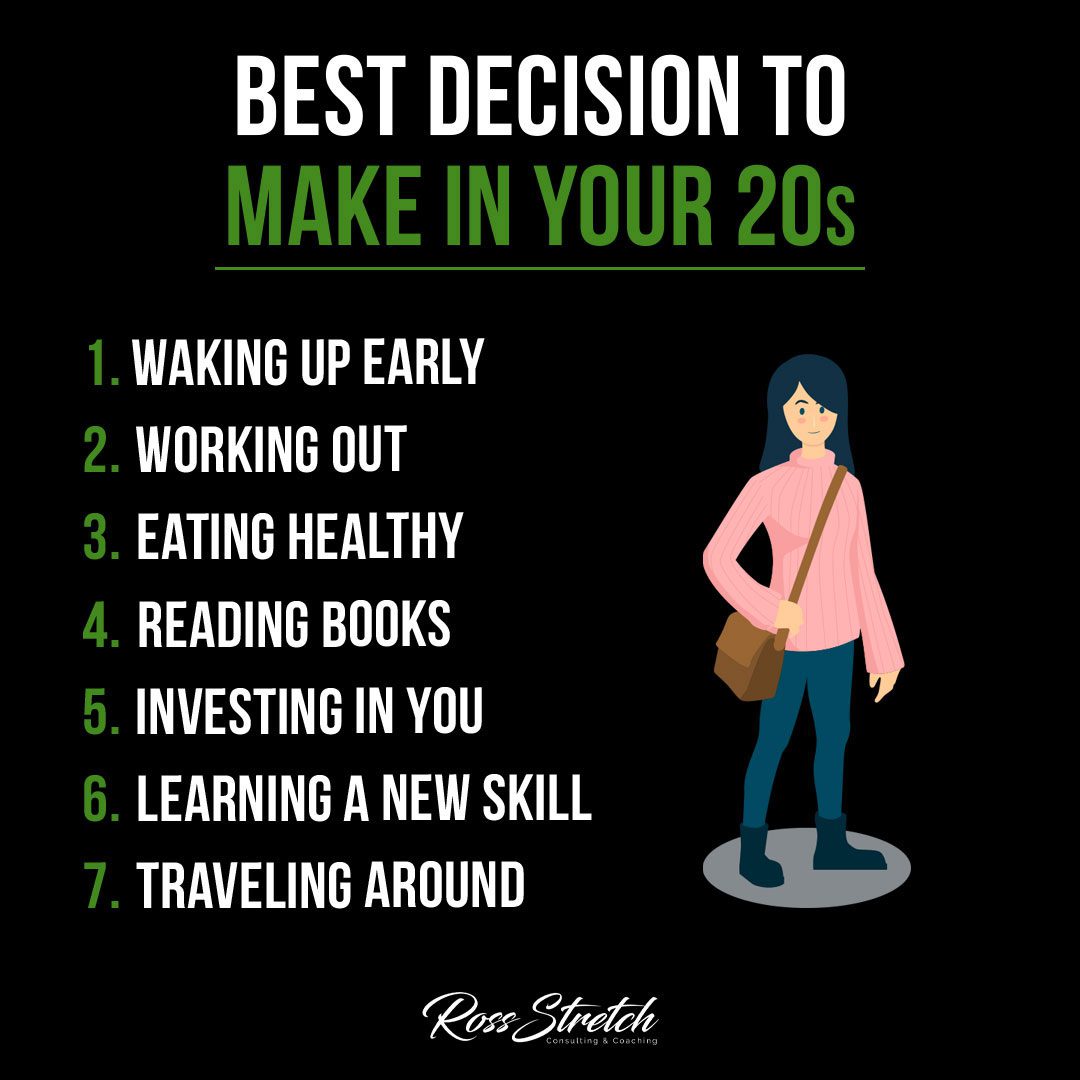
Your 20s are the most consequential decade of your life — not because the decisions you make are irreversible, but because the habits, skills, and mindsets you build now compound over the next 40 years. The people who thrive at 35, 45, and beyond rarely credit a single lucky break. They point to a series of intentional choices made early when they had energy, optionality, and time on their side. Here are seven of the best decisions you can make in your 20s to set a strong foundation for everything that follows.
1. Wake Up Early — Own Your Mornings Before the World Demands Them
The First Hour Sets the Tone for Everything
Waking up early — even 60 to 90 minutes before you need to — gives you a quiet window of uninterrupted time that belongs entirely to you. Before emails arrive, before your phone buzzes, before the demands of the day pile up, you have space to invest in yourself. The most successful entrepreneurs, executives, and athletes consistently cite a morning routine as one of their core disciplines. When you control your first hour, you operate proactively rather than reactively — and that shift alone changes how you carry yourself through the rest of the day.
- Actionable Tip: Set your alarm 30 minutes earlier than usual for two weeks. Build one anchor habit into that window — journaling, stretching, or reviewing weekly goals — before expanding the routine.
- Why It Works: Willpower and mental clarity are highest in the morning before decision fatigue sets in. Protecting that window ensures your best energy goes toward your own priorities, not someone else’s agenda.
Pro Tip:
Pair your early wake-up with a hard rule: no social media or news for the first 30 minutes. The morning information diet you allow shapes your mindset for the entire day. Start with intention, not stimulation.
2. Build a Consistent Exercise Habit — Your Body Is a Long-Term Investment
Physical Fitness Pays Dividends for Decades
Exercise in your 20s is not primarily about aesthetics — it is about building a biological foundation that carries you through the mental and physical demands of a long career and an active life. Regular movement improves cardiovascular health, sharpens cognitive function, regulates mood, and dramatically reduces the risk of chronic disease. Three to five sessions per week of any movement you enjoy — weightlifting, running, cycling, yoga, or sports — done consistently will compound into extraordinary health outcomes. The person who trains moderately every week for a decade beats the person who trains intensely for two months and quits.
- Actionable Tip: Schedule your workouts like appointments. Block the time in your calendar and treat cancellation the same way you would canceling a meeting with your boss.
- Why It Works: Exercise releases endorphins and regulates cortisol, making you more resilient to stress — the defining challenge of ambitious professional life in your 20s and 30s.
Pro Tip:
Find a form of exercise you genuinely enjoy rather than one you tolerate. Sustainability matters far more than optimization. A workout you love and stick with for ten years is infinitely more valuable than a perfect program you abandon after six weeks.
3. Eat Well — Nutrition Is Performance Fuel, Not Just Weight Management
What You Eat Shapes How You Think, Feel, and Perform
Your 20s are when you establish your default relationship with food — and that relationship follows you everywhere. A diet built on whole foods, lean proteins, vegetables, and healthy fats fuels your brain and body to perform at a high level. Poor nutrition creates chronic inflammation, energy crashes, and mood instability that compound quietly until they become impossible to ignore in your 40s. You do not need to be perfect, but you should be deliberate. Cooking most of your meals at home and building plates around nutritional value rather than convenience are habits far easier to establish at 24 than at 34.
- Actionable Tip: Dedicate one hour each week to meal prep. Preparing lunches and dinners in advance eliminates the decision fatigue that leads to fast food and poor choices on busy days.
- Why It Works: Stable blood sugar from consistent whole food eating reduces brain fog and afternoon energy crashes, keeping your focus sharp throughout the workday.
Pro Tip:
Do not overcomplicate nutrition with fad diets. A simple framework — mostly whole foods, mostly home-cooked, mostly plants and protein — applied consistently over years will outperform any trendy protocol you follow for 90 days and abandon.
4. Read Every Day — Books Are the Cheapest Form of Mentorship
The Leaders Who Read Most Tend to Grow Fastest
Reading is the single highest-ROI personal development habit available to anyone — it gives you access to the thinking, frameworks, and hard-won lessons of the world’s greatest minds for the cost of a few dollars. In your 20s, when you are hungry to learn, reading can accelerate your development by years. Read broadly across finance, biography, psychology, history, and your own industry. The cross-pollination of ideas from different fields is where your most original thinking comes from. A book on behavioral economics will make you a better negotiator. A biography of a historical leader will sharpen your long-term thinking.
- Actionable Tip: Commit to reading 20 pages per day. At that pace, you will finish 15 to 20 books per year. Always have your next book queued before you finish your current one.
- Why It Works: Reading builds vocabulary, analytical thinking, empathy, and the ability to communicate complex ideas clearly — all of which translate directly to professional and financial success.
Pro Tip:
Replace 20 minutes of mindless scrolling before bed with reading. You will retain material better when you are not distracted, and you will fall asleep with your brain working on ideas rather than anxiety from social media.
5. Invest in Yourself First — Skills and Knowledge Compound Like Interest
Your Earning Capacity Is Your Greatest Financial Asset
Before you invest in stocks, real estate, or any other asset class, invest in the asset that generates the capital to invest in everything else: yourself. Taking courses, earning certifications, seeking mentorship, and building expertise in high-value skills increases your earning potential in ways that compound exponentially over a career. A $500 course that leads to a $15,000 salary increase pays a 2,900% return. Your 20s are the lowest-risk window to invest aggressively in personal development — you have fewer obligations, more energy, and more time than you will in your 30s and 40s.
- Actionable Tip: Allocate a fixed percentage of your income — even 5% — to personal development each month. Courses, books, coaching, conferences, and networking events all qualify.
- Why It Works: A growth mindset backed by consistent investment in learning creates an upward spiral: better skills lead to better opportunities, which generate more resources to invest in further growth.
Pro Tip:
Do not wait until you feel ready to take on a stretch role, course, or leadership opportunity. Competence follows action — not the other way around. The most valuable learning happens slightly outside your comfort zone, not inside it.
6. Learn a High-Value Skill Outside Your Job Description
Versatility Is the Career Insurance Policy of the Modern Economy
The job market of your 30s and 40s will reward people who can do more than one thing well. Learning a high-value skill outside your primary role — whether that is coding, data analysis, copywriting, public speaking, design, or financial modeling — makes you more valuable to employers, opens additional income streams, and gives you options when your industry shifts. Your 20s offer something that becomes rare as life grows more complex: time and curiosity. Use both to explore skills that interest you, even if the immediate payoff is not obvious. The compounding of adjacent skills is one of the most underrated career strategies available.
- Actionable Tip: Pick one skill to develop outside your current job description and dedicate 30 minutes per day to it for 90 days. Platforms like Coursera, LinkedIn Learning, and YouTube make almost every skill accessible for free or low cost.
- Why It Works: Cross-disciplinary skills create a unique combination of capabilities that makes you difficult to replace and easy to promote — a genuine competitive advantage in any market.
Pro Tip:
Prioritize skills that are in high demand and that complement what you already do. A marketer who learns basic data analysis, a finance professional who learns to code dashboards — these combinations are rare and highly compensated in almost every industry.
7. Travel — Exposing Yourself to Different Cultures Expands How You Think
A Wider Worldview Produces Better Decisions
Traveling in your 20s is not frivolous — it is an investment in self-awareness and intellectual breadth. Encountering cultures that organize society differently challenges your default assumptions in ways no book or classroom fully can. The person who has navigated a foreign city alone, communicated across a language barrier, or built friendships with people from radically different backgrounds is more adaptable, more empathetic, and more creative. You do not need a large travel budget. A road trip through a region you have never visited or a budget international trip built around local experiences can be profoundly formative. The goal is exposure to difference, uncertainty, and the realization that your way of life is one of many valid ones.
- Actionable Tip: Set a modest travel goal for the year — two or three new destinations — and build them into your budget as line items rather than afterthoughts. Treat travel as an educational expense, not a luxury.
- Why It Works: Exposure to diverse cultures and environments enhances creative thinking and problem-solving, translating directly into stronger leadership and innovation capacity.
Pro Tip:
When you travel, skip the tourist shortcuts and seek genuine interaction. Eat where locals eat, stay in smaller accommodations that put you in contact with the community, and say yes to conversations. The richest experiences rarely happen on a scheduled tour.
Conclusion
The best decisions you can make in your 20s are not dramatic or sudden — they are quiet, daily, and compounding. Waking up with intention, moving your body consistently, nourishing yourself well, reading widely, investing in your skills, expanding your capabilities, and exposing yourself to the breadth of the world: these are not habits of the lucky. They are habits of the intentional. The version of you a decade from now is being built right now, one decision at a time. Start building deliberately.
Resources
- James Clear — Atomic Habits: How Small Habits Compound Over Time
- Coursera — Online Courses for Skill Development from Top Universities
- National Institutes of Health — Exercise Enhances Mood and Reduces Anxiety
- Harvard Business Review — Why Reading Books Is Still One of the Most Effective Ways to Improve Your Life

 Ross Stretch