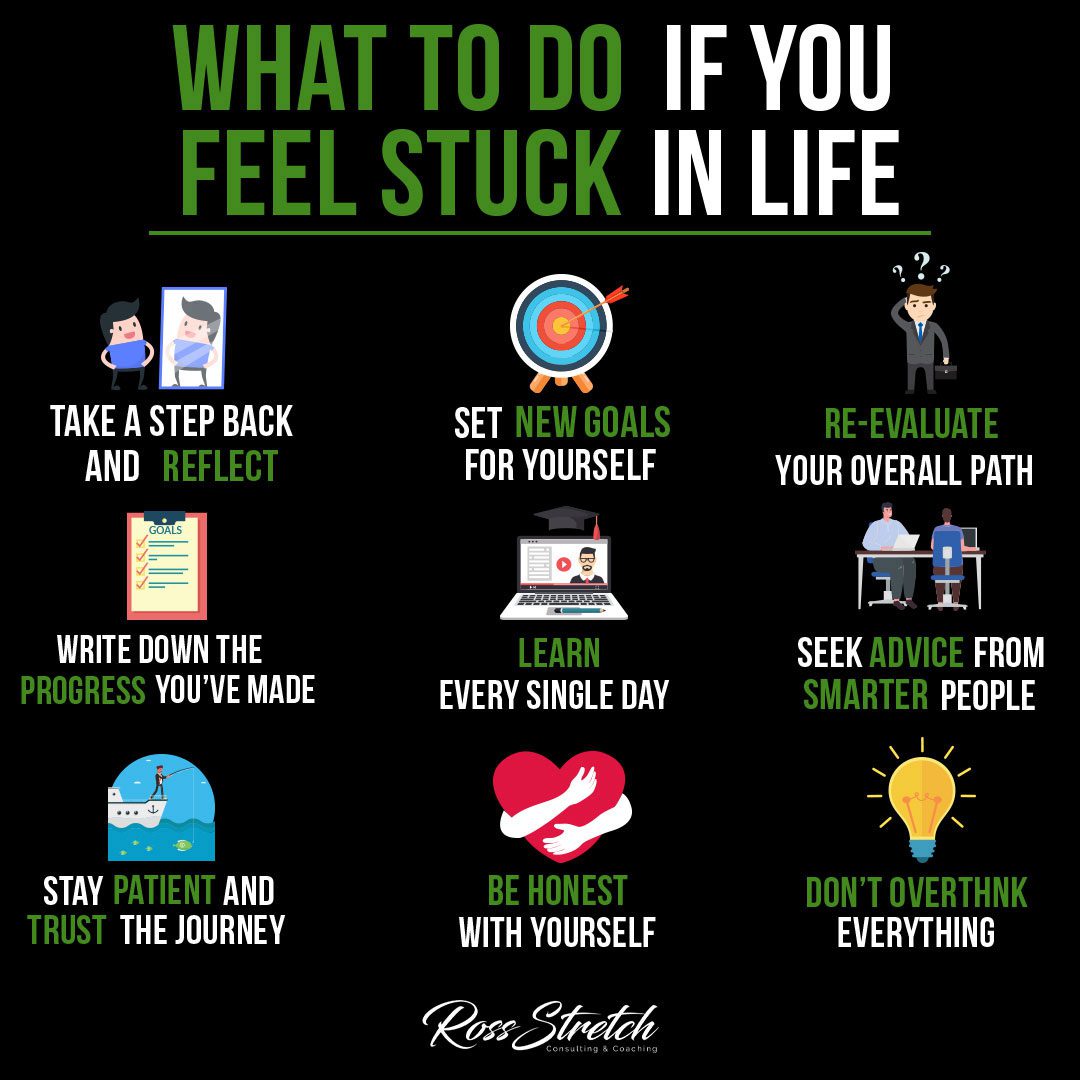
Life is a journey filled with unexpected pauses, and sometimes those pauses stretch into weeks, months, or even years where nothing seems to move forward. Feeling stuck — that frustrating sense of stagnation where you’re neither progressing nor fully stopping — is one of the most common experiences among ambitious people. The cruel irony is that high achievers often feel it most acutely, because the gap between where they are and where they want to be is the most visible. The good news: feeling stuck is temporary, and it almost always contains important information about what needs to change.
Why This Matters More Than You Think
Stagnation isn’t just uncomfortable — it’s expensive. Research from Gallup consistently shows that disengagement (the professional equivalent of feeling stuck) costs the global economy over $8 trillion annually in lost productivity. But beyond economics, prolonged stagnation erodes self-efficacy — your belief in your own ability to produce results. The longer you feel stuck, the harder it becomes to believe that action will change anything, which makes taking action even less likely. It’s a self-reinforcing cycle that gets harder to break the longer it runs.
The most dangerous part of feeling stuck isn’t the stagnation itself — it’s the story you tell yourself about it. Most people interpret feeling stuck as evidence of personal failure: that they’re not talented enough, disciplined enough, or deserving of the life they want. In reality, feeling stuck is usually a signal that your current environment, approach, or goals no longer match who you’re becoming. It’s a growth signal, not a failure signal.
Understanding this distinction changes everything. Instead of asking “what’s wrong with me?” the more productive question becomes “what’s no longer working, and what does that tell me about what I actually need?” That reframe is the first step out of stagnation — and it requires nothing more than a willingness to get honest with yourself.
The Science Behind Feeling Stuck
Neuroscience offers a useful explanation for why we get stuck. The brain’s default mode network — the system that activates when you’re not focused on a task — tends to ruminate on unresolved problems. When you feel stuck, this network can trap you in repetitive thought loops that feel productive but generate no new insights. Breaking out requires deliberately shifting to a different cognitive mode, which is why physical exercise, creative work, and new experiences are so effective at generating breakthrough thinking.
Psychologist Carol Dweck’s research on growth mindset also helps explain the stuck feeling. People with fixed mindsets interpret stagnation as confirmation of their limitations; people with growth mindsets treat it as a problem to solve. The difference isn’t innate — it’s a learned cognitive pattern that can be changed through deliberate practice. Recognizing which mindset is driving your interpretation of being stuck is often the most powerful first move.
How to Apply This in Your Life
Step 1: Take a Step Back and Audit Your Current Situation
When you feel stuck, the instinct is often to push harder — more hustle, more productivity tactics, more motivation content. Usually that makes things worse. The more effective move is to pause deliberately and audit what’s actually happening. Set aside 30 uninterrupted minutes and ask: what specifically feels stuck? Is it your career, relationships, health, finances — or everything at once? Identifying the specific domain narrows the problem from overwhelming to solvable.
- Practice self-reflection: Journal for 10 minutes on where you feel the largest gap between current reality and desired reality.
- Identify patterns and triggers: Notice if the stuck feeling intensifies around particular situations, environments, or people — that pattern reveals the real source.
Step 2: Set New Goals That Actually Excite You
One of the most common causes of feeling stuck is pursuing goals that belong to a past version of yourself — or worse, goals you adopted from other people’s expectations. If the goals you’re working toward generate no genuine excitement, motivational fuel will always run dry. The antidote is reconnecting with what you actually want, not what you’re supposed to want. This often requires radical honesty about whose definition of success you’ve been living by.
- Identify your real priorities: Write down your top three goals, then ask whether each one is truly yours or inherited from someone else’s script for success.
- Break goals into smaller steps: Goals that feel overwhelming produce paralysis. Reduce each objective to the smallest possible next action and start there.
Step 3: Document Your Progress, No Matter How Small
Feeling stuck often accompanies an inability to see the progress you’re actually making. When you’re in the middle of a long journey, day-to-day movement is nearly invisible. A progress journal — even five bullet points each evening about what moved forward — creates visible evidence that things are changing. Over weeks and months, that record becomes a powerful antidote to the narrative that nothing is working, because it proves, in your own handwriting, that it is.
- Keep a gratitude and progress journal: Note three wins each day, however small — the act of recording them trains your brain to notice forward movement.
- Celebrate milestones: Reward meaningful progress deliberately — the reward reinforces the behavior and builds the momentum that makes the next step easier.
Step 4: Commit to Learning Every Single Day
Stagnation and intellectual stagnation frequently travel together. When you stop learning, you stop growing — and when you stop growing, the stuck feeling intensifies. Committing to even 20 minutes of focused learning daily — a book, an in-depth article, an online course — introduces new inputs that generate new ideas. Many people report that their most important breakthroughs came not from working harder on their problem but from learning about something adjacent or completely unrelated.
- Expand your knowledge base: Read in fields adjacent to your current challenges — the cross-pollination often produces unexpected solutions that domain-specific thinking misses.
- Embrace a growth mindset: Frame every setback as data, not a verdict on your potential. The goal is learning, not flawless execution.
Step 5: Seek Guidance from People Who Are Ahead of You
One of the fastest ways out of stagnation is proximity to people who have already solved the problem you’re facing. Mentors, coaches, masterminds, and intentional peer groups all serve this function. The perspective of someone who has been where you are — and moved through it — can collapse years of struggle into months. The key is to seek people who have achieved specific things you want, not just generally successful people whose path has nothing to do with yours.
- Find mentors and role models: Identify two or three people who have navigated similar challenges and reach out directly. Most people are far more accessible than you assume.
- Join communities: Surround yourself with people who normalize ambition and progress — environment shapes behavior more reliably than willpower does.
Common Mistakes People Make When Feeling Stuck
- Waiting for motivation before taking action — motivation follows action, not the other way around. Start before you feel ready and the feeling will catch up.
- Overthinking instead of experimenting — analysis paralysis is the enemy of momentum. Treat your next move as an experiment, not a permanent commitment.
- Isolating yourself — stagnation thrives in isolation. Connection and community are among the most reliable and underused antidotes.
- Comparing your chapter 3 to someone else’s chapter 20 — this destroys confidence without providing any useful information about your own path.
The Bottom Line
Feeling stuck in life is a common experience, but it doesn’t have to define your journey. By taking a step back, setting goals that genuinely excite you, documenting progress, committing to daily learning, and seeking guidance from people ahead of you, you can break through stagnation and find renewed direction. This phase is temporary — and it contains information that will make the next phase stronger.
The most important thing to remember is that forward motion — even imperfect, messy forward motion — is always better than perfect planning. Clarity comes from action, not from waiting until everything feels figured out. Take one step. Then another. The path reveals itself through movement, not through standing still.
Resources
- Psychology Today: Feeling Stuck? Here Are 4 Ways to Get Unstuck
- Harvard Business Review: What Having a Growth Mindset Actually Means
- The New York Times: What to Do When You Feel Stuck in Life
- Forbes: Feeling Stuck in Life? Here’s How to Move Forward

 Ross Stretch