Every entrepreneur’s journey begins with a moment of decision — a point where the safe, predictable path diverges from the uncertain road toward something they are compelled to build. What separates those who cross that threshold from those who spend decades wondering “what if” is not superior knowledge, better connections, or even a stronger idea. It is a willingness to accept and manage risk intelligently.
Calculated risk-taking is not recklessness. It is the deliberate acceptance of uncertainty in exchange for the possibility of something more meaningful than certainty would ever produce. The five risks described here are not optional detours on the entrepreneurial path — they are the path. Understanding them in advance allows you to prepare strategically rather than encounter them blindly at the worst possible moment.
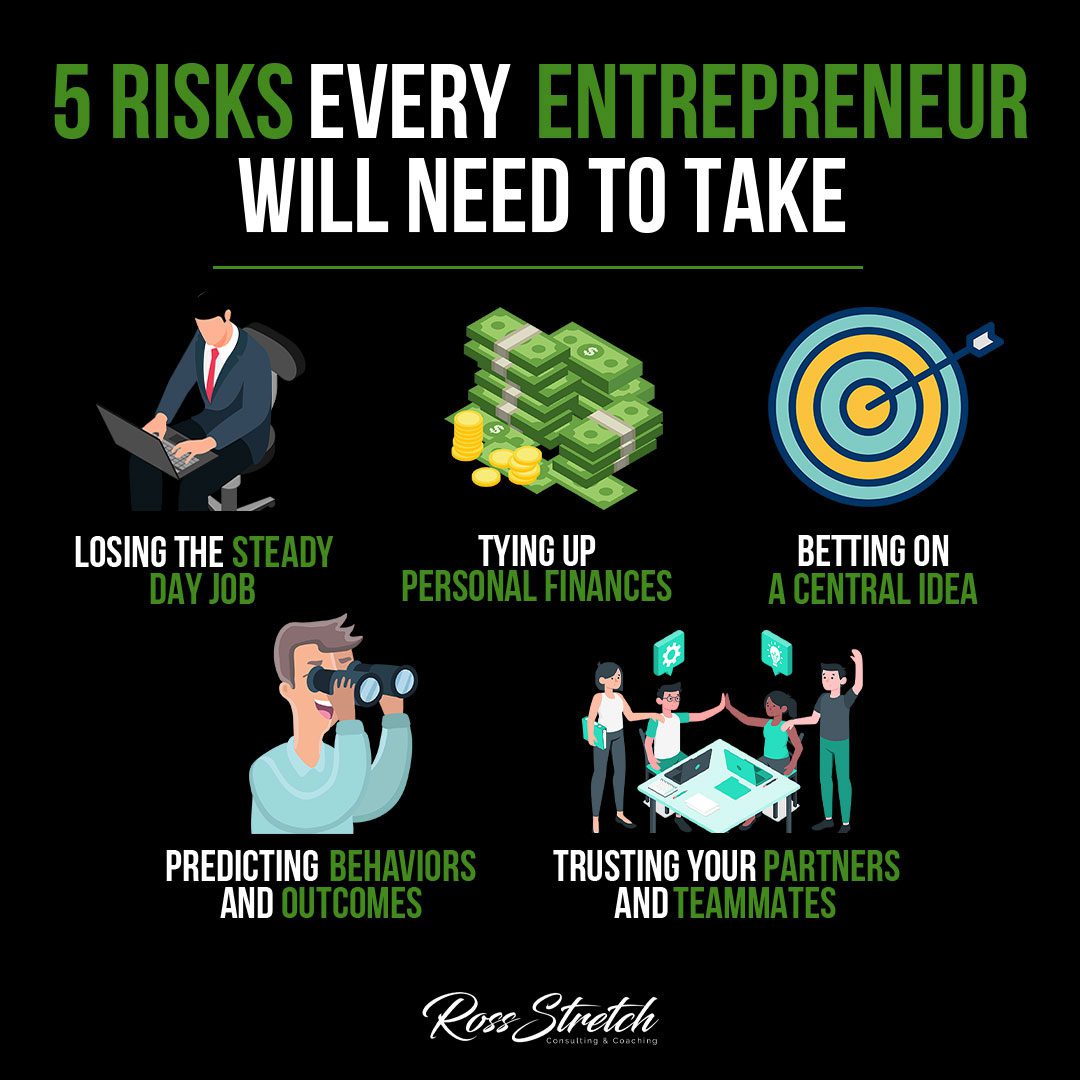
1. Leaving the Comfort Zone: Quitting the Day Job
Trading security for ownership
The decision to leave stable employment is one of the most psychologically difficult transitions an aspiring entrepreneur faces. A regular paycheck, employer-provided benefits, and a defined career ladder represent more than financial security — they represent identity, structure, and daily certainty. Giving that up for an income that does not yet exist requires a level of conviction that most people never fully access, and the social pressure from friends and family who see it as reckless makes the decision harder still.
The practical wisdom here is not to quit dramatically. Most successful founders make this transition gradually, building their business on evenings and weekends until revenue or funding reaches a level that justifies going full-time. A commonly cited benchmark is having at least six months of living expenses in reserve and some form of validated demand — paying customers, signed contracts, or committed pre-orders — before leaving the security of employment.
- Actionable Tip: Before quitting, run your business as a side project until it generates at least 30 percent of your current income. This de-risks the transition and validates demand before you are fully financially dependent on the outcome.
- Why It Works: Reducing financial pressure in the early stages allows you to make better decisions, attract better clients, and invest in the right areas without desperation driving your choices and undermining your negotiating position.
Pro Tip:
Set a specific trigger for your departure — a revenue number, a contract signed, a savings target reached — rather than an arbitrary date. Triggers tied to business milestones are more strategically sound than calendar-based decisions and signal to yourself and others that your move is evidence-based rather than impulsive.
2. Investing Personal Finances
Betting your own capital on your own vision
Almost every founder puts their own money into their business at some point. Whether it is savings used to fund a first prototype, a credit facility used to cover early operational costs, or a personal guarantee on a business loan, self-investment is a near-universal feature of the entrepreneurial experience. This financial commitment is also among the most clarifying — it is nearly impossible to be casually committed to a business when your own capital is genuinely at risk.
This risk should be taken seriously and managed carefully. Investing personal finances in a business means accepting that you could lose that capital entirely. The appropriate response is not to avoid the risk but to manage it — by investing only what you can genuinely afford to lose, maintaining a personal financial runway that covers your baseline living costs, and making each financial commitment conditional on achieving a specific milestone that justifies the next tranche of spending.
- Actionable Tip: Create a separate business bank account from day one, even before you have revenue. This structural separation makes it significantly easier to track where your investment is going and to determine whether the business is spending on genuine growth or just on overhead.
- Why It Works: Financial clarity in early-stage businesses prevents the common and costly mistake of conflating personal and business finances, which makes it nearly impossible to assess whether the business model is actually viable on its own terms.
Pro Tip:
Before investing a significant sum, write a one-page investment case for yourself: what specific outcome does this money enable, what is the realistic timeline to see a return, and what is your plan if it does not work? The discipline of writing this out often reveals assumptions that need to be tested before capital is committed.
3. Betting on a Central Idea
Committing fully to what you believe the market needs
Every business is a hypothesis. The central idea — the product, service, or model at its core — represents a bet that a specific group of people have a problem worth solving and that your solution is worth paying for. This sounds straightforward, but making this bet requires real conviction because the evidence rarely exists in advance. You are committing time and capital to an idea before the market has delivered its verdict.
The antidote to blind faith is early customer validation. Genuine conversations with 20 potential customers before building anything are worth more than months of market research reports. Real conversations reveal whether your hypothesis matches reality, and they consistently surface insights that sharpen your approach in ways you could not have arrived at alone from behind a desk.
- Actionable Tip: Run a pre-sale or a landing page test before building your full product. If you can get ten people to commit money in advance for something that does not yet exist, you have more meaningful validation than any survey can provide.
- Why It Works: Pre-validation eliminates the most expensive entrepreneurial mistake — building something no one wants. Revenue is the most honest and unambiguous form of market feedback available.
Pro Tip:
Stay committed to the problem, not the specific solution. Markets evolve, customer needs shift, and your initial idea will almost certainly require iteration. Founders who succeed are those who remain deeply attached to solving the core problem but hold their specific approach loosely enough to pivot when evidence demands it.
4. Navigating the Unknown: Predicting Outcomes
Making decisions with incomplete information
One of the defining characteristics of entrepreneurship is the constant requirement to make decisions before all the information you would ideally want is available. Pricing, hiring, market timing, product features, partnerships — every significant decision involves meaningful uncertainty. The entrepreneur who waits for certainty before acting will never act, because certainty is the one thing the early-stage business environment cannot provide.
Developing comfort with ambiguity is a skill that can be cultivated through practice. It begins with reframing the goal: rather than seeking the perfect decision, seek the best available decision given current information, commit to it, and adjust as new data arrives. This iterative approach treats every decision as a hypothesis rather than a permanent verdict, which makes it psychologically easier to act and practically easier to correct course without the weight of having been “wrong.”
- Actionable Tip: For any significant decision, set a specific review date — two to four weeks out — when you make it. This removes the pressure of needing the decision to be perfect immediately and builds in a structured checkpoint for reassessment based on real outcomes.
- Why It Works: Treating decisions as experiments rather than final verdicts reduces the psychological cost of being wrong, allowing you to move faster and learn more quickly than competitors who are paralyzed by the fear of an irreversible mistake.
Pro Tip:
Study how experienced operators in your specific industry think about uncertainty. Reading founder interviews and case studies from your sector — not just generic entrepreneurship content — reveals the particular uncertainties that matter most in your market and the practical heuristics that experienced builders use to navigate them.
5. Building a Trustworthy Team
Extending trust before it is fully earned
No business of any significance is built by one person. At some point, every entrepreneur must trust other people with their vision — a co-founder, an early employee, a contractor, a key partner. This is one of the most consequential risks in entrepreneurship because the people you bring into your business shape everything: culture, execution quality, customer experience, and ultimately whether the venture succeeds or fails.
The team risk is especially high in early-stage businesses because you often cannot afford experienced talent and must take bets on people whose potential you believe in but whose performance in this specific context you cannot yet verify. Many of the most painful entrepreneurial experiences involve a team member who did not share the founder’s values, work ethic, or commitment to the mission — problems that with a more rigorous evaluation process could often have been identified earlier at far lower cost.
- Actionable Tip: Before bringing anyone into a meaningful role, create a paid trial project — a real deliverable with a defined scope and timeline. This reveals how someone actually works under conditions that approximate the real role, rather than relying solely on how they present themselves in an interview.
- Why It Works: Paid work trials surface capability, communication style, and work ethic in ways that resumes and references cannot. The cost of a trial project is a fraction of the cost of a misaligned hire who must be exited months later.
Pro Tip:
Hire for values and work ethic before skills. Skills can be taught; character cannot be installed after the fact. A less credentialed person who is genuinely aligned with your mission and committed to growing will consistently outperform a more impressive resume that belongs to someone who is merely doing a job. In early-stage companies, cultural alignment is not a soft preference — it is a survival requirement.
Conclusion
Entrepreneurship is not about eliminating risk — it is about taking the right risks with as much intelligence and preparation as the situation allows. The five risks described here are universal. Every successful founder has faced each one, and none of them become easy with experience. What changes is the sophistication with which you approach them: with clearer frameworks, better information, and a growing capacity to act decisively despite uncertainty. That capacity — to move forward in the face of the unknown with both courage and strategy — is the defining competency of every entrepreneur who builds something that lasts.
Resources

 Ross Stretch