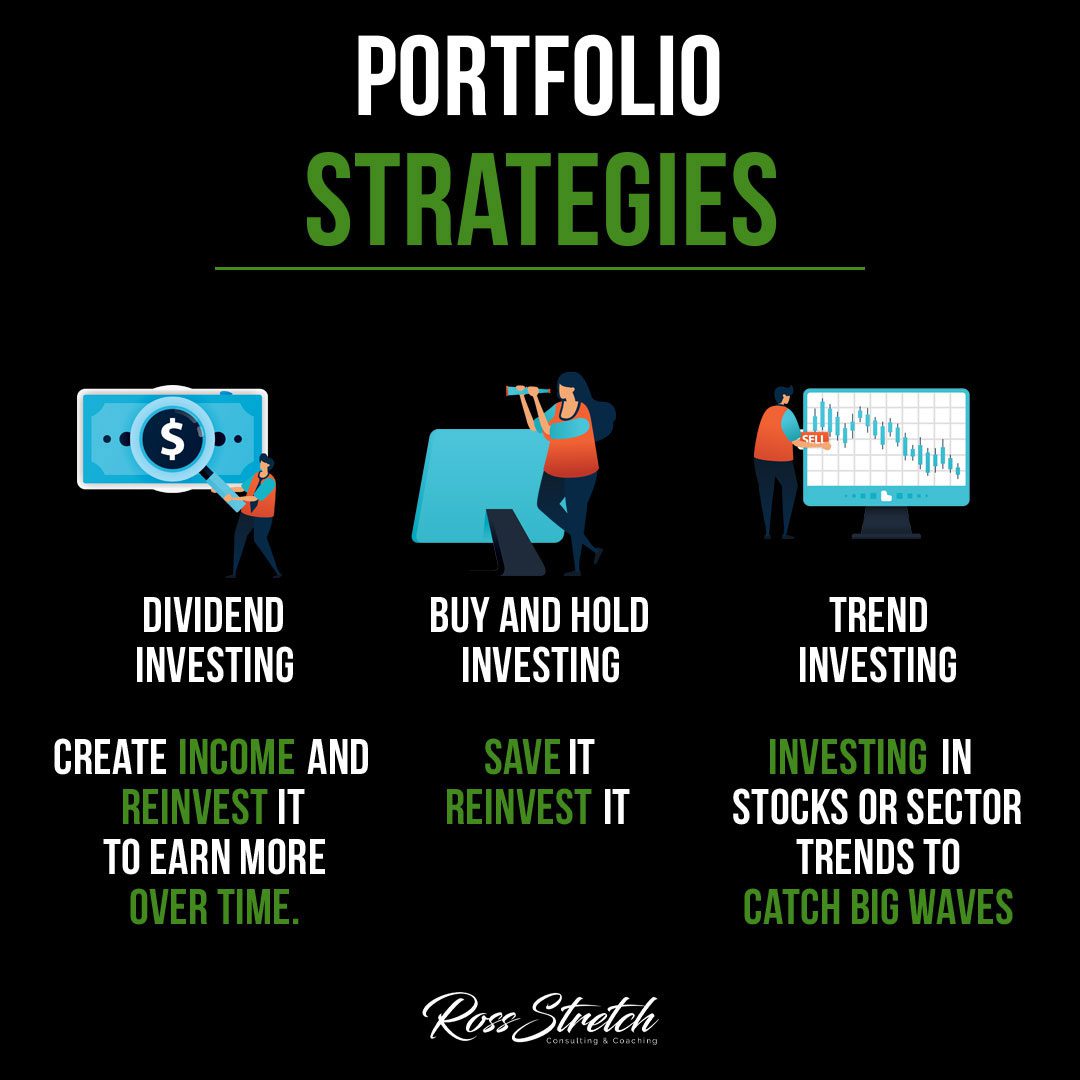
Investing is one of the most powerful tools available for building long-term wealth, but it is also a domain where overconfidence and underplanning consistently destroy returns. The investors who succeed over the long run are not necessarily the ones who pick the best individual stocks — they are the ones who build and maintain a thoughtful strategy that accounts for risk, time horizon, and personal goals. Understanding three proven portfolio approaches — dividend investing, buy-and-hold investing, and trend investing — gives you the frameworks to construct a portfolio designed around your actual financial situation, rather than following generic advice that may not fit your needs or risk tolerance.
Dividend Investing: Building an Income Stream From Your Portfolio
Dividend investing focuses on acquiring shares in companies that regularly distribute a portion of their profits to shareholders. These distributions provide an income stream that exists independently of whether the stock price rises or falls on any given day. For investors seeking consistent cash flow — particularly those approaching or already in retirement — dividend-paying stocks offer a compelling combination of income generation and continued equity participation in growing businesses.
The most important metrics to evaluate when selecting dividend stocks are yield, payout ratio, and dividend growth history. Yield tells you how much income you receive relative to the current stock price. Payout ratio tells you what percentage of the company’s earnings are being distributed as dividends — a ratio above 80% may signal that the dividend is vulnerable if earnings decline. Dividend growth history tells you whether the company has consistently raised its payout over time, which is one of the strongest indicators of financial strength and management confidence in future earnings.
Dividend reinvestment — automatically purchasing additional shares with dividend income rather than taking the cash payout — is where this strategy truly compounds over time. Over decades, reinvested dividends can account for a substantial portion of total portfolio returns. Exchange-traded funds focused on dividend stocks, such as those tracking the S&P 500 Dividend Aristocrats index, offer broad dividend exposure without the concentration risk of individual stock selection.
Buy-and-Hold Investing: Patience as a Competitive Advantage
The buy-and-hold strategy involves purchasing quality assets and holding them for an extended period regardless of short-term market fluctuations. This approach is grounded in the historical observation that markets tend to rise over long time horizons, despite experiencing significant volatility along the way. An investor who held a broad U.S. market index fund through every major crash of the last 30 years — including the dot-com collapse, the 2008 financial crisis, and the 2020 pandemic selloff — would have achieved substantial returns simply by staying invested and not reacting to market noise.
Buy-and-hold investors avoid the costs and risks associated with frequent trading. Every transaction generates potential tax consequences in non-sheltered accounts and may incur brokerage costs. More importantly, frequent trading tempts investors to make emotion-driven decisions — selling in fear at market bottoms and buying with excitement at market peaks — which is the most reliable way to underperform the broader market you are trying to beat. The data consistently shows that most active traders underperform a simple index fund held patiently over time.
The strategy works best when applied to high-quality, broadly diversified holdings. Individual stocks can and do go to zero. A total market index fund cannot. Warren Buffett has famously advised that the majority of investors would achieve better results by purchasing a low-cost S&P 500 index fund and holding it indefinitely than by attempting to pick individual winners or time the market’s entry and exit points. That advice has held up across decades and market cycles.
Trend Investing: Following Market Momentum Systematically
Trend investing is an active strategy based on the observation that assets performing well over recent periods tend to continue performing well over medium-term time horizons, while underperforming assets tend to continue underperforming. Rather than analyzing the fundamental value of a business in isolation, trend investors analyze price action, volume patterns, and sector momentum to identify where capital is flowing and position accordingly ahead of or alongside that movement.
This strategy requires significantly more active engagement than buy-and-hold. Trend investors monitor technical indicators — moving averages, relative strength indices, volume patterns — to identify entry points when momentum is building and exit points when it appears to be reversing. Sector rotation is a common application: moving capital from sectors losing institutional favor into those attracting it, based on macroeconomic conditions, earnings cycles, or shifts in monetary policy that historically benefit specific industries.
The risks of trend investing are meaningful. Active strategies generate higher transaction costs and potential tax liabilities in non-sheltered accounts. They also require behavioral discipline to execute cleanly. The tendency to hold losing positions too long, hoping for a reversal rather than cutting losses per the strategy’s rules, can quickly erase gains from positions that worked. Pre-defined entry and exit rules, enforced consistently regardless of emotional conviction, are what separate disciplined trend investors from those simply chasing recent performance without a systematic approach.
Combining Strategies for a Resilient Portfolio
Most sophisticated investors do not rely exclusively on a single approach. Combining strategies allows a portfolio to benefit from different market conditions while managing the specific risks each individual strategy carries. A common framework is to anchor the portfolio in a buy-and-hold core — broad market index funds held indefinitely — while allocating a portion to dividend-paying stocks for income generation and a smaller, more active slice to trend or momentum strategies for higher-potential tactical opportunities.
The appropriate proportions should reflect your time horizon, risk tolerance, and income requirements. A younger investor with a 30-year time horizon and no near-term income needs might allocate 80% to a buy-and-hold core and 20% to more active or income-generating strategies. An investor closer to retirement might weight more heavily toward dividend income and reduce the active component significantly, prioritizing capital preservation and reliable distributions over growth potential.
Rebalancing is the maintenance discipline that keeps the portfolio aligned with its intended allocation as markets move. As different assets grow at different rates, the portfolio drifts from its target weightings. Rebalancing — trimming positions that have grown disproportionately and adding to those that have lagged — enforces the structural discipline of buying relatively lower and selling relatively higher, independent of any specific market predictions.
Common Mistakes That Undermine Portfolio Performance
Even investors with sound strategies regularly undermine their own results through predictable behavioral errors. Checking portfolio values too frequently increases the emotional weight of short-term fluctuations and makes disciplined holding far more difficult to sustain. Research consistently shows that investors who check their portfolios less frequently make fewer emotion-driven decisions and achieve better long-term outcomes as a result — not because markets behave differently, but because they react to them less destructively.
Overconcentration is another common problem that frequently goes unrecognized until it is costly. Putting too large a portion of a portfolio into a single company, sector, or asset class means that a single bad outcome can be catastrophic for overall results. Even thorough fundamental analysis cannot eliminate the possibility of unforeseen events — regulatory changes, technological disruption, or fraud — that dramatically alter a company’s prospects. Diversification is not the enemy of conviction; it is the structural protection that allows you to stay invested through the surprises that inevitably arrive.
Conclusion
The most effective investment portfolio is one you can maintain through difficult market conditions without abandoning your strategy at exactly the wrong moment. Whether you focus on dividend income, long-term buy-and-hold positions, active trend strategies, or a combination of all three, the principles that determine long-term success are consistent: stay diversified, manage costs, reinvest returns where possible, and make decisions based on a clear plan rather than short-term market noise. Building wealth through investing is less about brilliance than about consistency, patience, and the discipline to stay the course when markets make that feel impossible.
Resources
- Investopedia: Portfolio Investment Strategies — comprehensive guides on dividend investing, buy-and-hold, momentum strategies, and portfolio construction principles.
- Vanguard: Portfolio Construction Principles — foundational guidance on building and maintaining a resilient portfolio from one of the world’s most respected investment managers.
- The Little Book of Common Sense Investing by John Bogle — the case for index fund investing made clearly and compellingly by the founder of Vanguard, accessible to investors at any experience level.
- Morningstar Portfolio Tools — free and premium tools for analyzing, tracking, and evaluating investment portfolios across all major asset classes and strategies.


 Ross Stretch