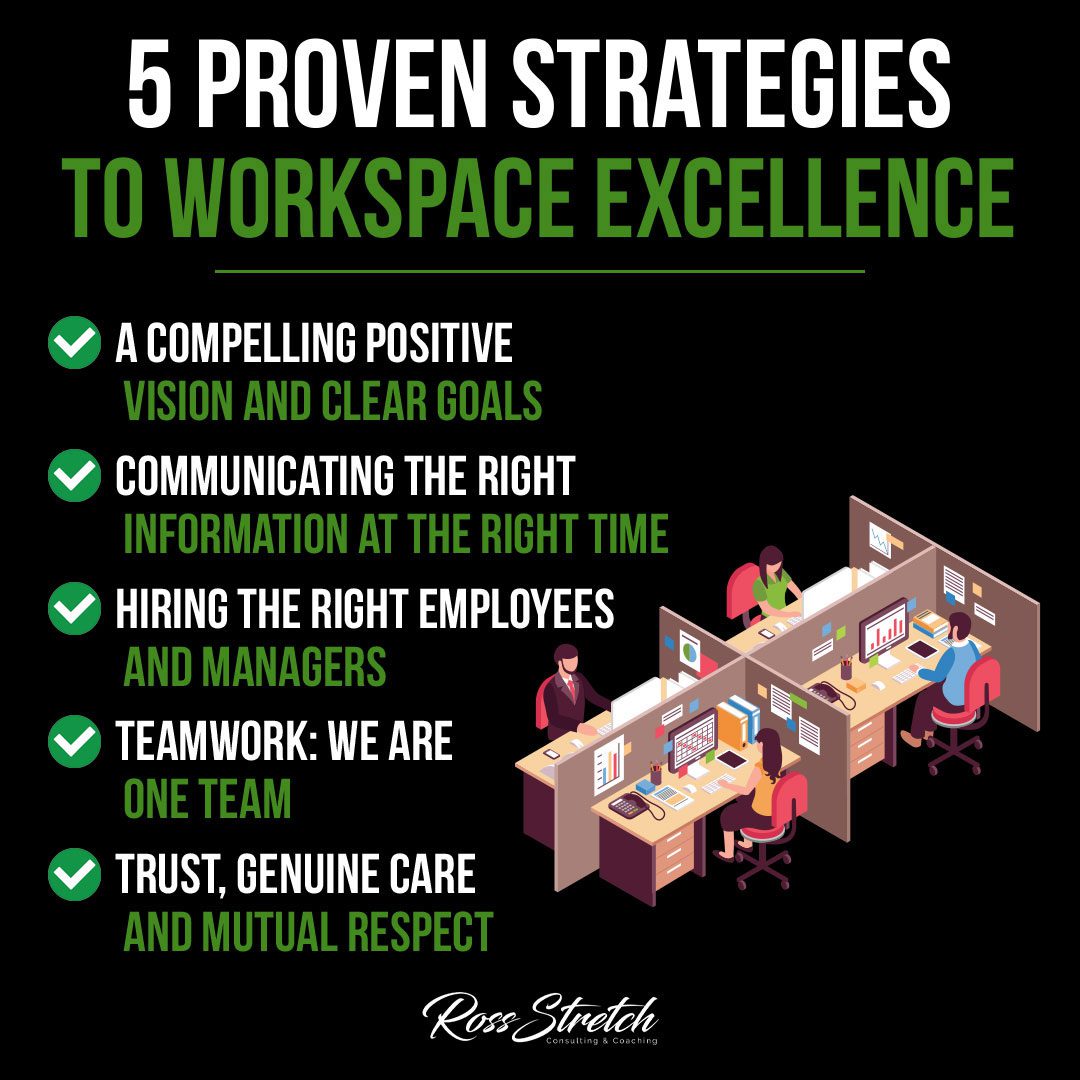
Creating a workspace that fosters excellence is one of the most powerful investments any business leader can make. A productive and harmonious work environment not only boosts employee morale but directly enhances overall business performance — from output quality to staff retention rates. The strategies below are not abstract ideals; they are proven frameworks used by high-performing organizations worldwide. Implement them consistently, and you will build a workplace where people want to show up and do their best work.
1. A Compelling Positive Vision and Clear Goals
Give Your Team a North Star Worth Following
A compelling vision and clearly defined goals are the bedrock of workspace excellence. When employees understand where the company is headed and why it matters, they become more motivated, aligned, and willing to go the extra mile. Research from Gallup shows that only 22% of employees strongly agree that their leadership has a clear direction — organizations that close this gap gain a measurable productivity advantage that compounds over time.
- Actionable Tip: Hold a quarterly vision-alignment session where leadership reaffirms company goals and teams share how their current projects connect to those goals.
- Why It Works: Psychological research on self-determination theory shows that employees perform significantly better when they understand the purpose behind their tasks — not just the tasks themselves.
Pro Tip:
Break annual goals into 90-day sprints using OKRs (Objectives and Key Results). This framework, used by Google and Intel, keeps teams focused on measurable outcomes without losing sight of the big picture. Celebrate milestone achievements publicly to reinforce momentum and signal that progress is being noticed.
2. Communicating at the Right Time
Timely Communication Is a Competitive Advantage
Effective communication does not just mean talking more — it means talking at the right time, to the right people, with the right message. Poor communication costs U.S. businesses an estimated $1.2 trillion annually, according to a Grammarly and Harris Poll report. The most productive workplaces are those where information flows clearly, without unnecessary friction or ambiguity slowing teams down.
- Actionable Tip: Establish communication protocols — define which updates go in Slack vs. email vs. a team meeting. Set clear expectations around response times to reduce constant interruptions and cognitive overload.
- Why It Works: Decision latency drops dramatically when teams know exactly where to find information and how to escalate issues. This reduces bottlenecks and prevents costly misunderstandings from compounding into larger problems.
Pro Tip:
Implement a weekly brief reporting system — each team member spends five minutes writing a concise update on their progress, priorities, and blockers. This keeps leadership informed without clogging everyone’s calendar with status meetings. The format scales effectively from a team of five to a company of five hundred and reduces the information asymmetry that creates poor decisions.
3. Hiring the Right Employees and Managers
Your Team Is Your Most Valuable Infrastructure
No strategy, technology, or process can compensate for a misaligned team. Hiring the right people — and placing the right leaders above them — is the single highest-leverage decision any organization makes. Studies from McKinsey and Company show that top-performing employees generate 400% to 800% more value than average performers in complex roles. That gap is not marginal — it is transformational.
- Actionable Tip: Develop a structured interview scorecard that assesses not just technical skills but values alignment, problem-solving approach, and cultural contribution. Involve multiple team members in final hiring decisions to reduce individual bias.
- Why It Works: Structured interviews are twice as predictive of job performance as unstructured conversations. Consistency in evaluation creates a fairer, more effective hiring process that improves outcomes over time.
Pro Tip:
Invest as much in onboarding as you do in recruiting. Research from the Brandon Hall Group found that organizations with a strong onboarding process improve new hire retention by 82% and productivity by over 70%. A structured 90-day onboarding plan dramatically accelerates time-to-impact and reduces the costly early attrition that plagues organizations with weak integration processes.
4. Teamwork — We Are One Team
Collective Intelligence Outperforms Individual Brilliance
The most innovative breakthroughs do not come from lone geniuses — they emerge from teams that communicate well, trust each other, and leverage diverse perspectives. Google’s Project Aristotle, a landmark study on team effectiveness, found that psychological safety — the belief that one can speak up without fear — is the single most important factor in high-performing teams, outweighing individual talent in every category measured.
- Actionable Tip: Create cross-functional project teams that bring together people from different departments. Rotate team compositions quarterly to build broader organizational relationships and prevent siloed thinking from becoming entrenched.
- Why It Works: Diverse teams make better decisions 87% of the time, according to research published in Harvard Business Review. Exposure to varied perspectives sharpens critical thinking and creative problem-solving across the entire organization.
Pro Tip:
Celebrate team wins publicly and specifically — not just individual achievements. Share the story behind the win, identify who contributed what, and make recognition a regular ritual. Teams that feel seen and valued perform at a consistently higher level and experience dramatically lower voluntary turnover rates compared to teams where recognition is rare or formulaic.
5. Trust, Genuine Care, and Mutual Respect
People Produce Their Best Work Where They Feel Safe and Valued
Trust is the invisible infrastructure of every high-performance workplace. When employees trust their leaders and each other, discretionary effort increases — people do more than what is required because they are genuinely invested in the outcome. A Great Place to Work survey found that employees at high-trust organizations report 74% less stress, 106% more energy at work, and 50% higher productivity compared to those in low-trust environments.
- Actionable Tip: Practice informal leadership check-ins — schedule brief, regular conversations with team members outside of formal performance reviews. Ask about challenges, listen without judgment, and follow through on every commitment you make.
- Why It Works: Trust compounds over time. Every kept promise, every acknowledged mistake, and every moment of genuine care adds to the reservoir of goodwill that sustains teams through difficult periods and keeps your best people from looking elsewhere.
Pro Tip:
Implement a short monthly pulse survey — five to eight focused questions measuring employee engagement, psychological safety, and satisfaction. Use the data transparently: share results with your team and collaboratively develop action plans. The act of asking — and visibly responding to what you hear — builds trust faster than almost any other leadership intervention available to you.
Conclusion
Achieving workspace excellence is not a destination — it is a discipline. The five strategies outlined here require consistent effort, honest self-assessment, and a genuine commitment to the people who make your organization run. When vision, communication, talent, teamwork, and trust are all operating in alignment, the results compound: higher retention, stronger performance, and a culture that attracts the best people even in competitive hiring markets.
Start with one strategy this week. Audit your current team meetings for communication efficiency, revisit your hiring criteria, or schedule a one-on-one conversation with someone you have not connected with recently. Small, intentional actions are the building blocks of workplace transformation. The organizations that excel are not those with the biggest budgets — they are the ones that invest consistently in creating environments where people genuinely thrive.
Resources

 Ross Stretch