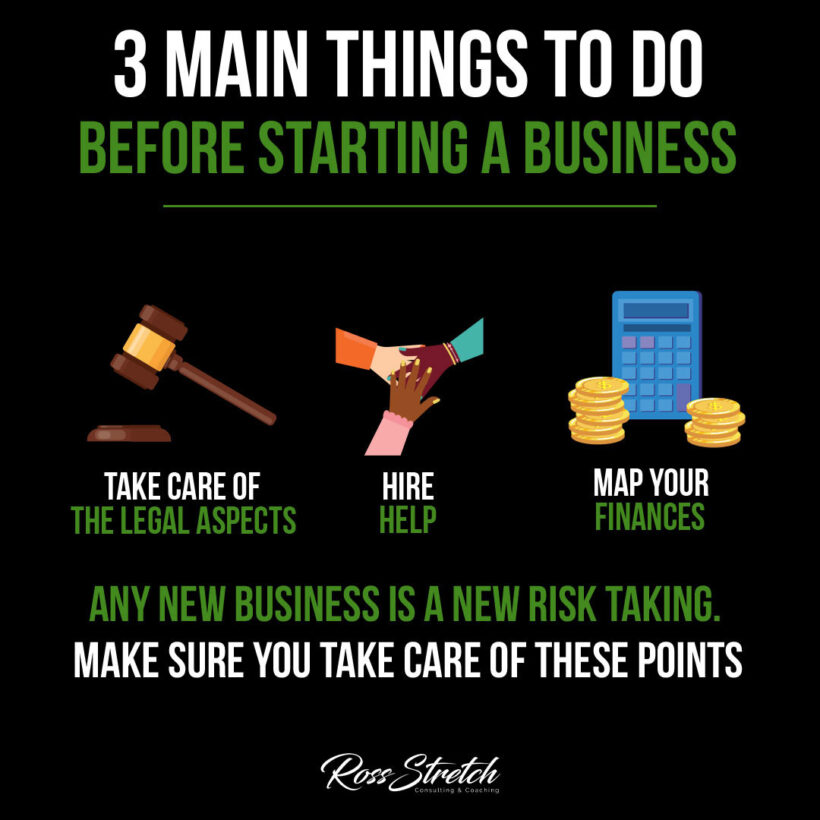

The excitement of launching a business can make you want to move fast — build the product, get the first customer, figure out the rest later. But the entrepreneurs who build lasting companies do the foundational work before they open their doors. Getting your legal structure, team, and financial plan right before you launch isn’t bureaucratic friction — it’s the difference between a business that survives the first two years and one that doesn’t. Here are the three most critical steps to take before you start your business, and how to approach each one with real intention.
1. Take Care of the Legal Aspects
A Solid Legal Foundation Protects Everything You Build
Legal mistakes made at the founding stage are often the most expensive to fix later. Choosing the wrong business structure, failing to register your name, or operating without required licenses can result in personal liability, IRS penalties, or forced closure. The first decision is your business structure: a sole proprietorship offers simplicity but leaves you personally liable for business debts; an LLC separates your personal assets from business liabilities and is the structure most small business owners choose; a corporation offers the most protection and is best suited for businesses planning to raise outside capital. Each structure has distinct tax implications, so consulting a CPA or business attorney before deciding is worth the cost.
Beyond structure, you need to register your business name with your state, obtain an Employer Identification Number from the IRS — required for taxes, banking, and hiring — and research what industry-specific licenses or permits apply to your business. Operating a food service business, a construction company, or a professional services firm each requires different permits at the local, state, and sometimes federal level. Don’t assume your business is exempt. Check with your local city or county clerk’s office and review the SBA’s licensing guide for your industry.
- Actionable Tip: Use the U.S. Small Business Administration’s step-by-step business registration guide at sba.gov to work through your legal setup systematically. Budget for a one-time consultation with a business attorney to review your structure choice and any industry-specific legal requirements.
- Why It Works: Getting legal setup right from the beginning is far cheaper than fixing it after a problem emerges. An LLC typically costs $50 to $500 to form depending on your state — a fraction of the potential cost of personal liability or regulatory fines.
Pro Tip: Open a Dedicated Business Bank Account Before Your First Transaction
Mixing personal and business finances is one of the most common mistakes new founders make — and one of the most painful to untangle at tax time. Open a separate business checking account the moment your entity is formed. This simplifies tax filing, protects your personal assets, and makes your business look more professional to vendors and clients from day one.
2. Hire Help
The Right People Amplify Everything — The Wrong Ones Drain Everything
Many first-time entrepreneurs try to do everything themselves. It’s understandable — budgets are tight, trust is hard to extend, and the belief that no one will care as much as you do feels entirely rational. But trying to handle accounting, legal, marketing, operations, and customer service simultaneously guarantees that none of them gets done well. Strategic delegation early — even before you have significant revenue — allows you to focus your limited time and energy on the activities that genuinely require you and generate the most value. The key is identifying which roles to fill first and finding people whose skills complement yours rather than duplicate them.
For most early-stage businesses, the highest-leverage external hires are an accountant or bookkeeper to keep your finances accurate and your taxes compliant, and possibly a part-time marketing or operations contractor depending on your model. Freelancers and fractional professionals have made it possible for very small businesses to access expertise that was previously only available to larger companies. Platforms like Upwork and Toptal connect you with vetted professionals across virtually every business function, letting you scale help up or down as needed without the commitment of a full-time hire.
- Actionable Tip: Before your first hire, write a clear description of the role’s responsibilities, success metrics, and time requirements. This clarity helps you find the right person and prevents the mismatched expectations that lead to costly turnover.
- Why It Works: A well-defined role attracts better candidates and sets the working relationship up for success. Vague job descriptions attract people who fill in the gaps with their own assumptions — often incorrectly, and expensively.
Pro Tip: Hire Your Weaknesses First
Self-awareness about where your skills are weakest is one of the most valuable things a founder can develop. If you’re a strong product person but weak on numbers, hire an accountant before a second product designer. If you’re a great salesperson but disorganized, hire an operations or administrative person before another salesperson. Building around your gaps creates a stronger company than building around your strengths.
3. Map Your Finances
A Clear Financial Plan Is Your Business’s Flight Plan
No business survives without money, and no money survives without a plan. Creating a financial map before you launch means knowing your startup costs, your ongoing fixed and variable expenses, your revenue projections — realistic ones, not optimistic ones — and how long your capital runway lasts before you reach profitability. Many new businesses fail not because the concept was bad, but because the founder ran out of cash before the market responded. A financial plan forces you to confront the real numbers, and if they don’t work on paper, they definitely won’t work in practice.
Your financial plan should include three components: a startup cost estimate covering equipment, legal fees, marketing, technology, and initial inventory; a monthly operating budget including rent, salaries, software subscriptions, utilities, and insurance; and a revenue forecast that models three scenarios — conservative, expected, and optimistic. The conservative scenario is your safety net. If your business can survive the conservative case, you’ve built something real. Most first-time founders discover through this process that their launch timeline needs to extend, their pricing needs to increase, or both — and it’s far better to discover that now than after you’ve opened your doors.
- Actionable Tip: Build your financial model in a spreadsheet before you spend a dollar. List every anticipated expense by category and month for the first 12 months. Then build your revenue model based on realistic assumptions about conversion rates, average transaction size, and customer acquisition timelines.
- Why It Works: A spreadsheet-level financial model forces you to think through every cost and revenue assumption explicitly. This process almost always reveals expenses you hadn’t considered and revenue timelines that are more conservative than initial enthusiasm suggested.
Pro Tip: Maintain a Six-Month Cash Reserve
Most businesses take longer to generate consistent revenue than founders expect. Build a six-month operating expense reserve before you launch — money that can cover your fixed costs regardless of what your revenue does in the early months. This buffer gives you time to learn, iterate, and build without the existential pressure of running out of cash forcing premature or desperate decisions.
Conclusion
Every business faces uncertainty — that’s the nature of entrepreneurship. But the legal foundation you build, the people you bring on, and the financial clarity you establish before you launch are entirely within your control. These three steps won’t guarantee success, but skipping them significantly increases your risk of failure. Do the foundational work now and you’ll spend your energy building, not untangling preventable mistakes.
Resources
- U.S. Small Business Administration — 10 Steps to Start Your Business
- SCORE — Business Plan Template for Startups
- Investopedia — How to Finance Your New Business
- IRS Small Business Center — Tax Information for Small Businesses and Self-Employed


 Ross Stretch