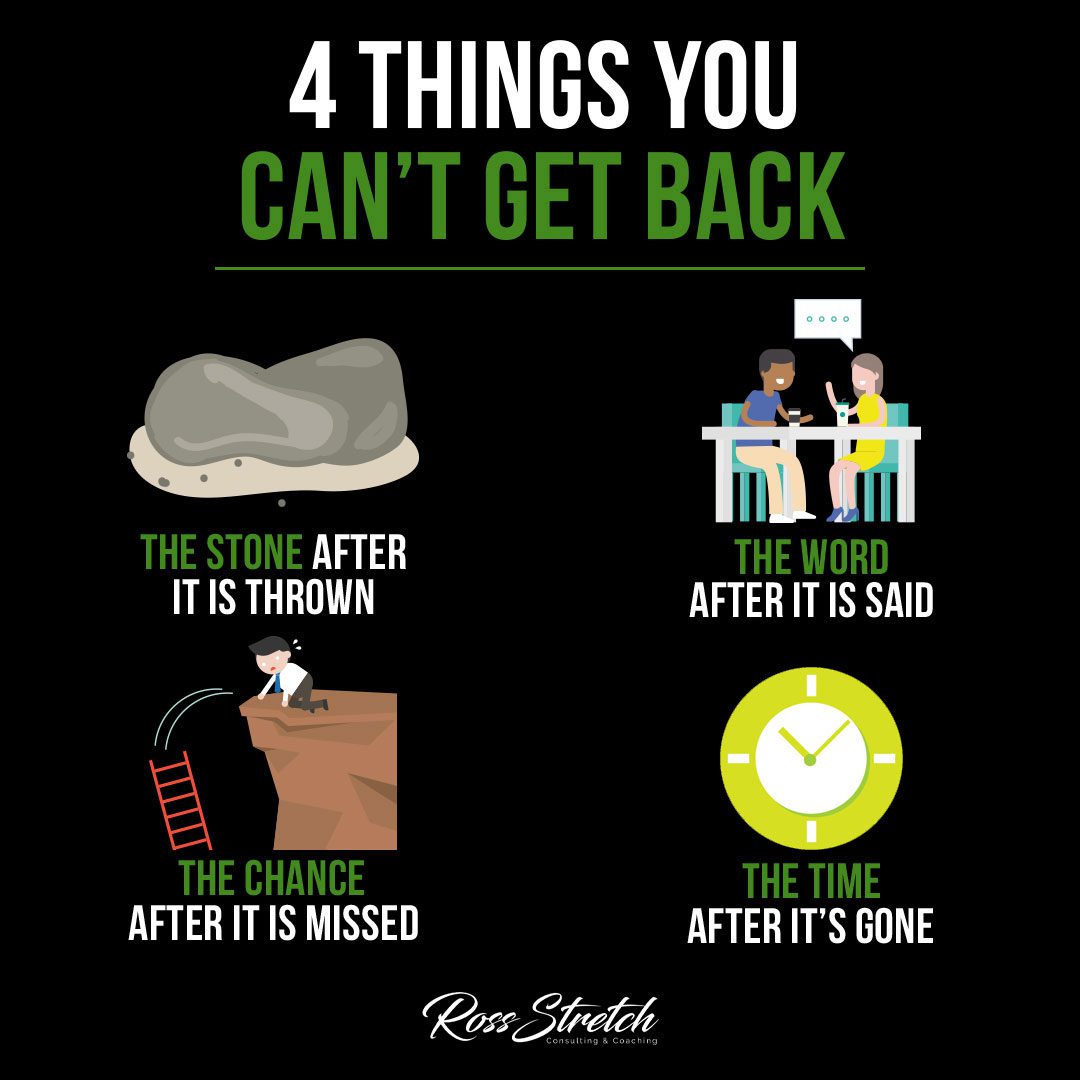
Some losses are recoverable. A financial setback can be reversed with discipline and time. A broken relationship can often be repaired with honesty and effort. But there are four things in life where no amount of money, effort, or regret buys you a second chance. Once the stone is thrown, once a word leaves your mouth, once an opportunity slips past, and once time moves forward — none of it can be recalled. Understanding the permanence of these four losses is not meant to create anxiety. It’s meant to instill the kind of intentional decision-making that shapes a life worth living — one built on deliberate choices rather than careless impulse.
1. The Stone After It Is Thrown: Actions Have Permanent Consequences
Why Every Action Leaves a Mark
When you throw a stone, the moment it leaves your hand, you have no control over where it lands or what it hits. Actions in life operate exactly this way. Every decision you make — how you treat a colleague, how you handle money under pressure, how you respond when you’re frustrated — sends ripples outward that you cannot recall. Some of those ripples are barely noticeable. Others define your reputation, your relationships, and your opportunities for years to come. The quality of your actions, compounded over time, becomes the architecture of your life.
- Actionable Tip: Before taking any significant action, ask yourself: “If this action became permanent and public, would I stand behind it?” That single question filters out most impulsive choices before they cause unrecoverable harm.
- Why It Works: Slowing down the decision-making loop even briefly activates the prefrontal cortex — the part of the brain responsible for long-term thinking — and reduces emotionally driven choices you’ll later regret.
Pro Tip: Build Pre-Action Rituals
High-performing entrepreneurs and executives often use pre-action rituals: a brief mental check-in before sending difficult emails, making significant investments, or having high-stakes conversations. Something as simple as a three-breath pause or writing out the intended outcome before acting dramatically reduces impulsive decisions with unrecoverable consequences. The habit takes thirty seconds and saves years of cleanup.
2. The Word After It Is Said: Language Shapes Everything Around You
Communication That Builds — or Destroys
Words are the primary tool through which humans influence one another. An encouraging word to a struggling employee can unlock performance that no financial incentive could. A dismissive comment to a partner during an argument can plant a seed of doubt that takes years to uproot. The permanence of spoken words — especially harsh or careless ones — is well-documented in psychology: people remember negative communication far more vividly and for far longer than positive feedback. The asymmetry is stark and worth respecting.
- Actionable Tip: Adopt the “speak last, listen first” principle in high-stakes conversations. Gather information and emotional context before offering your words. The pause protects both the relationship and your credibility.
- Why It Works: Most communication failures come from reacting rather than responding. A short delay between stimulus and response is the defining difference between a reactive communicator and a genuinely effective one.
Pro Tip: Write Before You Speak
When preparing for a difficult conversation — whether a negotiation, a performance review, or a relationship conflict — write out what you want to say in advance. The act of writing forces precision and reveals emotional bias that spoken words hide. Deliver what you’ve refined, not what you feel impulsively compelled to say in the heat of the moment. The extra preparation costs minutes and saves conversations that matter.
3. The Chance After It Is Missed: Opportunity Has an Expiration Date
Why Hesitation Costs More Than Failure
Missed opportunities follow a predictable pattern: the moment passes, the window closes, and the mind immediately constructs a comforting narrative about why it wasn’t the right time anyway. But behind that narrative is an uncomfortable truth — hesitation is often fear dressed up as wisdom. The difference between those who build wealth, advance careers, and create meaningful relationships and those who don’t frequently comes down to a willingness to act before certainty arrives. Perfect timing rarely exists. Good enough timing almost always does.
- Actionable Tip: Apply the 70% rule — if you have roughly 70% of the information you’d ideally want, make the decision. Waiting for 100% clarity usually means the opportunity has already moved to someone more decisive.
- Why It Works: Most opportunities don’t require perfect information — they require a reasonable assessment and the courage to commit. Those who act on sufficient but incomplete information consistently outperform those who wait for certainty that never arrives.
Pro Tip: Keep an Opportunity Log
Keep a simple running list of opportunities you declined or ignored, along with your reasoning at the time. Review it quarterly. Patterns will emerge — recurring fears, predictable hesitation points, and categories of opportunity you consistently undervalue. This self-awareness is one of the most powerful tools for improving your decision-making over time. You can’t correct a pattern you haven’t identified.
4. Time After It Is Gone: Your Only Non-Renewable Resource
How to Stop Leaking Your Most Valuable Asset
Money lost can be earned back. Reputations damaged can be rebuilt. But time spent cannot be recovered under any circumstances. This truth is intellectually obvious to virtually everyone and behaviorally honored by almost no one. Time leaks in predictable ways: excessive social media use, meetings that should be emails, low-value tasks crowding out high-value ones, and the perpetual postponement of things that matter in favor of things that feel urgent but are ultimately trivial. The cost of these leaks accumulates invisibly until years have passed.
- Actionable Tip: Conduct a weekly time audit for one month. Log how you actually spend your hours — not how you intend to spend them. Most people discover that 20 to 30% of their time goes to activities they wouldn’t consciously choose if given the option.
- Why It Works: Awareness precedes change. Until you see real data on how your time is actually spent, optimization is impossible. The audit creates contrast between current reality and intended priority — and that contrast is what motivates genuine change.
Pro Tip: Value Your Time in Dollars
Assign a dollar value to your hour — even if it feels arbitrary. If you want to earn $100,000 annually, your working hour is worth approximately $50. Every time you spend an hour on a task worth less than that, ask whether someone else could handle it for less, or whether it should be done at all. This reframe accelerates the shift from being busy to being genuinely productive — one of the most valuable transitions in any career or business.
Conclusion
The stone after it is thrown, the word after it is said, the chance after it is missed, and time after it is gone — these four irreversible losses share a common thread: they all demand presence, intentionality, and the courage to act before certainty arrives. These aren’t abstract philosophical concepts. They are practical daily reminders that the quality of your life is largely determined by how you treat the moments and opportunities in front of you before they slip past. Acknowledge the permanence of these four losses, and you’ll find yourself making far fewer decisions you’ll spend years regretting.
Resources

 Ross Stretch