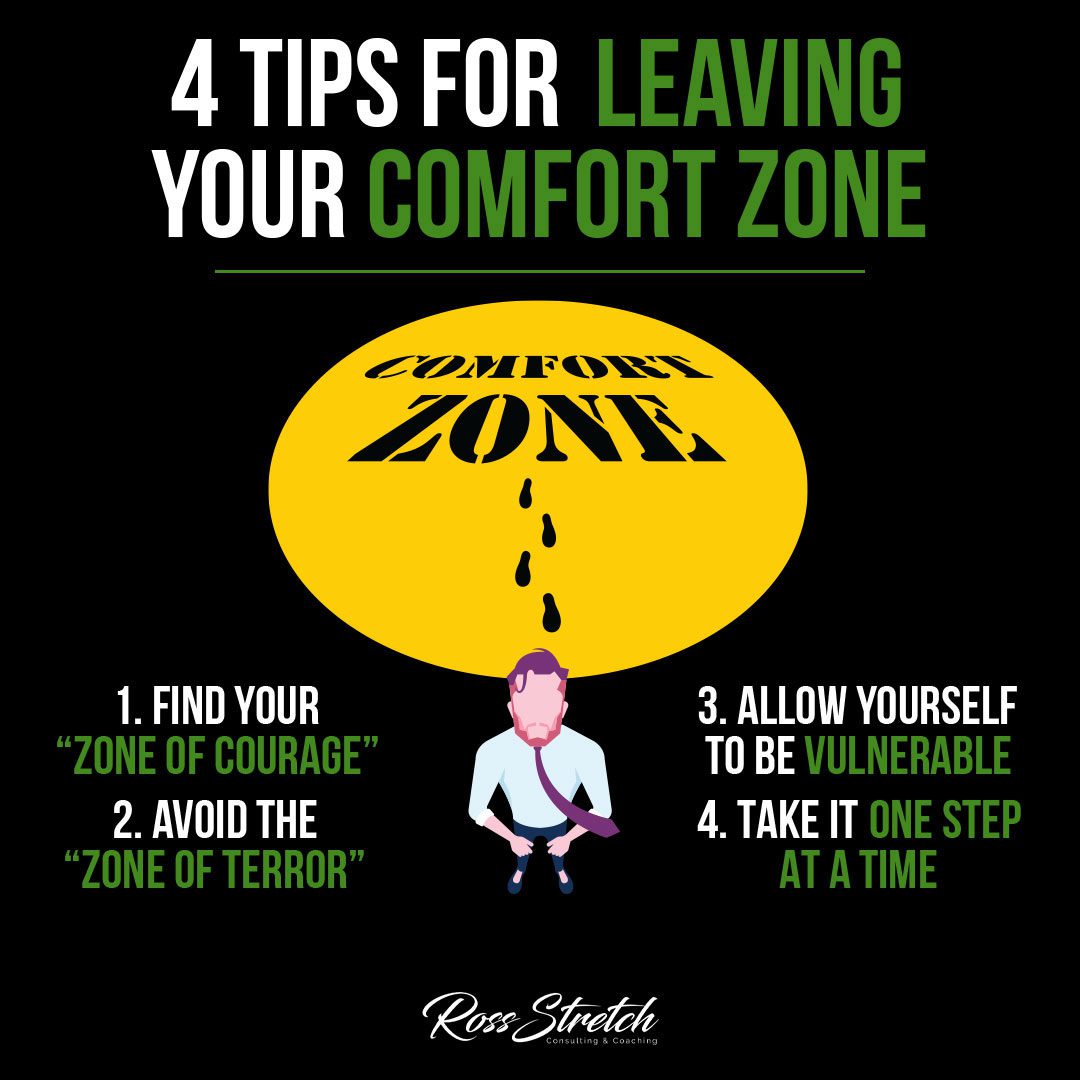
Most people talk about leaving their comfort zone. Very few actually do it — not because they lack ambition, but because they don’t have a strategy. The difference between those who grow and those who stagnate isn’t courage or talent: it’s knowing where your zone of courage ends and your zone of terror begins. These four tips give you a practical framework to expand your boundaries without burning out, embrace vulnerability as a competitive advantage, and build the momentum that turns small steps into life-changing transformation.
1. Find Your “Zone of Courage”
Discover the Sweet Spot Between Safe and Terrifying
Your comfort zone is the familiar territory where nothing challenges you. Just outside it lies your zone of courage — the space where growth actually happens. This is where you feel nervous but not paralyzed, stretched but not broken, excited despite the fear.
- Actionable Tip: List five things that make you slightly uncomfortable but curious — not terrifying, just a little edgy. Circle one and schedule it this week. That’s your zone of courage entry point.
- Why It Works: Research shows that moderate challenge triggers the release of norepinephrine and dopamine, sharpening focus and increasing motivation. The right amount of discomfort is neurologically rewarding — not punishing.
Pro Tip:
Keep a “courage log” — a simple journal where you record one uncomfortable thing you did each week and what happened as a result. Over 90 days, you’ll have proof that your comfort zone expands every time you push it, making the next push easier and more natural.
2. Avoid the “Zone of Terror”
Know When You’re Pushing Too Far, Too Fast
The zone of terror is where challenge becomes overwhelm. It’s the place where fear shuts you down instead of lighting you up. Jumping straight from comfort to terror doesn’t build courage — it builds avoidance and reinforces the belief that you can’t handle hard things.
- Actionable Tip: Before any new challenge, rate it on a scale of 1–10 for anxiety. Target challenges in the 5–7 range. Anything above 8 needs to be broken into smaller steps before you attempt it.
- Why It Works: Gradual exposure is the gold standard in behavioral psychology for overcoming fear. When you repeatedly face moderate challenges and survive them, your nervous system recalibrates what “dangerous” means — and the zone of terror shrinks.
Pro Tip:
If you find yourself in the zone of terror mid-challenge, use the 5-4-3-2-1 grounding technique: name five things you can see, four you can touch, three you can hear, two you can smell, and one you can taste. This activates your parasympathetic nervous system and returns you to a state where rational thinking is possible.
3. Allow Yourself to Be Vulnerable
Vulnerability Is the Price of Admission to Growth
Leaving your comfort zone demands vulnerability — the willingness to be seen trying, failing, and looking imperfect. Most people avoid this at all costs, which is exactly why most people never grow. The willingness to be vulnerable is one of the most powerful competitive advantages you can develop.
- Actionable Tip: Identify one area where you’ve been performing certainty you don’t feel — in your career, relationships, or creative work. Share the truth with one trusted person this week: “I’m not sure about this, and here’s what I’m learning.”
- Why It Works: Researcher Brené Brown’s two decades of work show that vulnerability is not weakness — it’s the birthplace of innovation, creativity, and meaningful change. When you model vulnerability authentically, you earn deeper trust and respect from others.
Pro Tip:
Separate vulnerability from oversharing. Vulnerability is sharing your real experience in service of connection or growth — not emotional dumping. Know your audience, choose your moment, and lead with intention. Purposeful vulnerability accelerates relationships and opens opportunities that performed confidence never will.
4. Take It One Step at a Time
Small, Consistent Moves Beat One Giant Leap Every Time
The fantasy of leaving your comfort zone is a single dramatic moment of transformation. The reality is a series of small, deliberate steps — each one slightly beyond the last. Sustained growth isn’t about heroic leaps; it’s about building the habit of reaching just a little further every single day.
- Actionable Tip: Use the “1% rule” — identify your comfort zone in one specific area and commit to expanding it by just 1% per week. That’s one conversation you’ve been avoiding, one skill session you’ve been postponing, one email you’ve been scared to send.
- Why It Works: Compound growth is exponential. A 1% improvement every week yields a 67% improvement in a year. More importantly, each completed micro-challenge builds identity-level evidence that you are someone who does hard things — and identity drives long-term behavior.
Pro Tip:
Pair each step outside your comfort zone with an immediate reward. This isn’t bribery — it’s behavioral science. Immediate positive reinforcement after a courageous act strengthens the neural pathways that associate discomfort with reward, making the next brave action easier and more automatic over time.
Start Where You Are, Not Where You Wish You Were
Leaving your comfort zone is not a one-time event — it’s a practice. By finding your zone of courage, respecting your limits, embracing vulnerability, and making incremental progress, you build a life that continually expands. The goal isn’t to be fearless. The goal is to act despite the fear — and those two things are very different.
Resources


 Ross Stretch