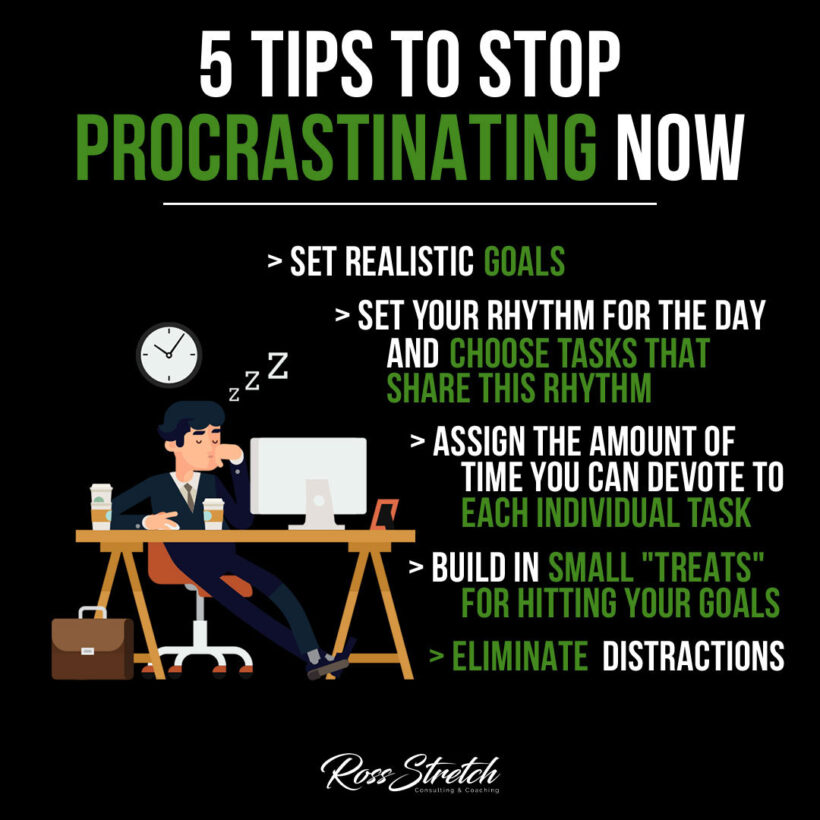

Procrastination is one of the most costly habits in the world — it steals time, erodes confidence, and keeps talented people from reaching their potential. The good news: procrastination isn’t a character flaw. It’s a habit that can be broken. These five science-backed tips will help you stop delaying, start doing, and reclaim control of your day.
1. Break Every Task Into Micro-Steps
Make Starting So Easy You Can’t Say No
Procrastination rarely strikes because a task is hard — it strikes because the task feels overwhelming. Our brains resist big, vague projects and default to easier activities. The solution is to shrink tasks down until starting feels effortless. When the first step is genuinely tiny, resistance evaporates.
- Actionable Tip: Take any task you’ve been avoiding and break it into steps so small they take less than 5 minutes each. Instead of ‘Write report,’ write ‘Open document and type the title.’ Do only that first micro-step right now. Momentum builds from there.
- Why It Works: Psychologists call this ‘implementation intention’ — specifying exactly when, where, and how you’ll start a task dramatically increases follow-through. The brain responds to clarity and recoils from ambiguity.
Pro Tip:
Keep a ‘next action’ list where every item starts with a verb and takes under 10 minutes. When you have a spare moment, pick one and do it. This system, popularized by David Allen’s Getting Things Done, keeps you moving without overwhelm.
2. Use the Two-Minute Rule
If It Takes Less Than Two Minutes, Do It Now
One of the simplest and most effective anti-procrastination rules comes from productivity expert David Allen: if a task takes less than two minutes to complete, do it immediately rather than adding it to a list. This rule eliminates the small tasks that accumulate and create mental clutter.
- Actionable Tip: Go through your to-do list right now. Find every item that would take less than two minutes to complete — reply to that email, make that quick call, file that document — and do those items first. Clear the decks before tackling anything bigger.
- Why It Works: Small undone tasks create ongoing cognitive load, constantly draining mental energy as your brain tracks them in the background. Clearing them quickly frees up focus for the work that actually matters.
Pro Tip:
For tasks that take slightly longer than two minutes but still feel easy to avoid, use the ‘5-minute rule’: commit to working on the task for just 5 minutes. You’ll almost always continue past the timer because starting is the hardest part — once you’re in motion, momentum takes over.
3. Design Your Environment for Focus
Remove Friction Between You and the Work
Your environment has enormous power over your behavior. If distractions are easy to access and productive tools require effort, your brain will default to distraction every time. Redesigning your workspace to make productive work the path of least resistance is one of the most powerful anti-procrastination moves you can make.
- Actionable Tip: Before your next work session, spend 5 minutes setting up your environment: close unnecessary browser tabs, put your phone in another room or use an app blocker, clear your desk of everything except what you need, and open the specific document or tool you’ll use. Make productive work visually unavoidable.
- Why It Works: Research in behavioral psychology shows that environmental cues trigger habitual behaviors. By designing your space for focus, you’re essentially programming yourself to work — without relying on willpower.
Expert Insight:
Consider creating a dedicated ‘deep work’ location — a specific chair, desk, or even a coffee shop — that your brain learns to associate exclusively with focused productivity. Over time, simply sitting in that spot triggers focus automatically, like Pavlov’s bell for productivity.
4. Commit to Starting, Not Finishing
Lower the Bar and Let Momentum Do the Work
The biggest lie procrastination tells you is that you need to be ‘in the mood’ or have enough time to finish before you start. Neither is true. Motion creates motivation, not the other way around. When you commit only to starting — not to finishing — you remove the psychological weight that triggers avoidance.
- Actionable Tip: The next time you feel resistance, make a single commitment: ‘I will work on this for 10 minutes, then I can stop guilt-free.’ Set a timer. When it goes off, ask yourself if you want to continue. Most of the time, you will — because getting started was the only barrier.
- Why It Works: Neuroscience shows that starting a task activates the brain’s reward circuits, releasing small amounts of dopamine that make continuing feel good. The first action is the hardest; every subsequent one gets easier.
Pro Tip:
Use the Pomodoro Technique to formalize this: 25 minutes of focused work followed by a 5-minute break. These focused sprints make procrastination nearly impossible because the commitment is so small, and the built-in breaks prevent mental fatigue from building up.
5. Track and Reward Your Progress
Make Productivity Feel as Good as Procrastination
Procrastination often wins because it delivers immediate rewards — entertainment, relief, social connection — while productive work pays off later. To rewire this pattern, you need to attach immediate positive feedback to completing tasks. Tracking progress and celebrating small wins makes productivity itself satisfying.
- Actionable Tip: Start a simple ‘done list’ at the end of each day — write down everything you completed, no matter how small. After finishing a significant task, give yourself a genuine reward (a walk, a coffee, a short YouTube break). Make the reward immediate and non-negotiable.
- Why It Works: The brain’s motivation system runs on dopamine, and dopamine is released when we make progress toward a goal. Visibly tracking progress — checking boxes, filling a streak calendar, seeing a done list grow — triggers these reward chemicals and builds a positive feedback loop.
Expert Insight:
Jerry Seinfeld’s ‘don’t break the chain’ method works on this principle: mark an X on a calendar every day you complete your target task. The growing chain of X’s becomes its own motivator — you work not just to complete the task, but to protect the streak. Apps like Streaks or Habitica can automate this system.
Conclusion
Procrastination is a battle between your present self and your future self — and with the right tools, your future self can win. By breaking tasks into micro-steps, using the two-minute rule, designing your environment for focus, committing only to starting, and rewarding your progress, you’ll find that getting things done becomes a habit rather than a struggle. Pick one tip, apply it today, and feel the difference immediately.
Resources

 Ross Stretch