Mental strength isn’t about suppressing emotions or pretending hardship doesn’t exist. It’s the practiced ability to face difficulty, uncertainty, and discomfort — and function effectively in spite of them. Mentally strong people are not invulnerable; they’re well-trained. They have developed specific habits of thought and behavior that allow them to process setbacks, maintain forward momentum, and consistently act in alignment with their long-term goals rather than their momentary feelings.
\
\
The five traits below aren’t personality quirks reserved for a gifted few. They are learnable, practical, and directly tied to outcomes in career, health, relationships, and financial wellbeing. The question isn’t whether you currently exhibit these traits — it’s how deliberately you’re working to develop them.
\
\
\
\
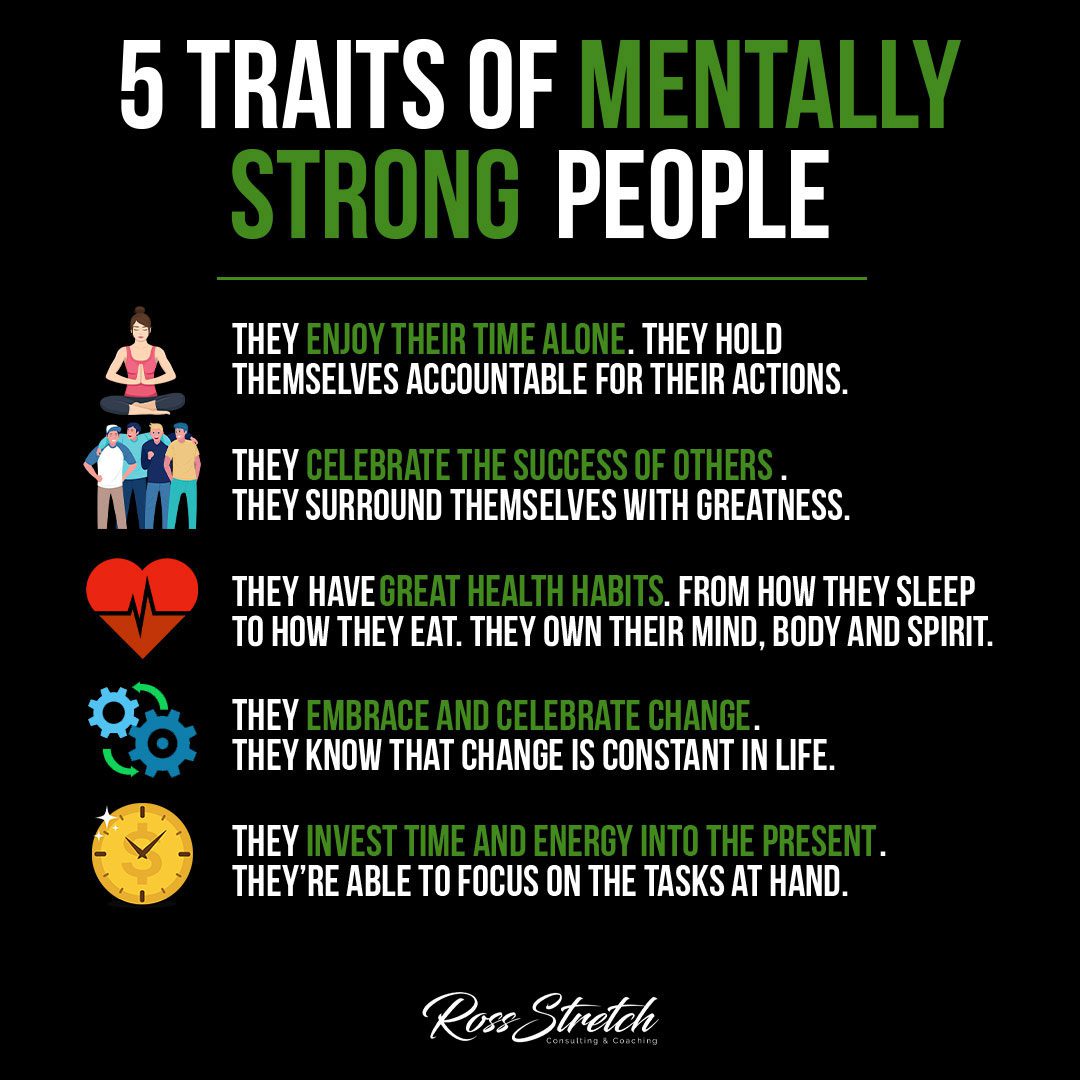
1. They Enjoy Their Time Alone
\
\
Solitude as a Competitive Advantage
\
\
In a culture addicted to stimulation, the ability to sit comfortably with your own thoughts is increasingly rare — and increasingly valuable. Mentally strong individuals actively seek out periods of solitude not as avoidance, but as a tool for clarity. Time alone allows them to audit their decisions, assess where they’re genuinely headed, and reconnect with what matters to them rather than what their environment is pressuring them to pursue.
\
\
Research on solitude consistently documents its cognitive advantages: enhanced creativity, better long-term decision-making, and stronger self-awareness. The professionals who understand themselves most clearly — their actual strengths, blind spots, and values — make better career and financial decisions than those who rely on external validation for every choice. Self-knowledge is the foundation of strategic thinking, and deliberate solitude is how it’s built.
\
\
- \
- Actionable Tip: Schedule 20 to 30 minutes of unstructured alone time each day — no phone, no podcast, no background TV. Use it to reflect on your current goals and whether your daily actions actually align with them.
- Why It Works: Self-awareness is the foundation of effective decision-making. Without deliberate reflection time, most people drift into choices shaped by external pressure rather than internal clarity and actual values.
\
\
\
\
Pro Tip:
\
\
Journaling during solo time amplifies its benefits significantly. Writing your thoughts forces more precise thinking than passive reflection alone. Even five minutes of free-writing at the end of the day builds a meaningful habit that compounds over weeks and months into genuine self-knowledge.
\
\
\
\
2. They Hold Themselves Accountable
\
\
Responsibility as the Foundation of Growth
\
\
Accountability is the quality that transforms experience into growth. Without it, mistakes become excuses and patterns repeat indefinitely. Mentally strong people are honest with themselves about their role in their outcomes — both good and bad. They do not reflexively externalize blame, and they do not catastrophize failures as evidence of permanent inadequacy.
\
\
This doesn’t mean ignoring external factors or pretending unfair circumstances don’t exist — it means directing energy toward what is within your control. The shift from “this happened to me” to “what can I do differently” is one of the most powerful reframes available in any professional context. Leaders who model accountability earn higher trust from their teams. Entrepreneurs who practice it course-correct faster and waste fewer resources on approaches that aren’t working. In both cases, personal accountability is the variable that determines whether experience produces wisdom or just time served.
\
\
- \
- Actionable Tip: After any significant setback or mistake, run a brief written post-mortem. Document what happened, what your role was, and one specific thing you would do differently. Focus on learning, not self-punishment.
- Why It Works: Accountability is a form of agency. It keeps the locus of control in your hands and maintains you in a problem-solving orientation rather than a victim orientation.
\
\
\
\
Pro Tip:
\
\
Find an accountability partner — a peer, mentor, or coach — who will ask hard questions without letting you off the hook easily. External accountability dramatically increases follow-through on commitments that are easy to quietly deprioritize when no one is watching.
\
\
\
\
3. They Celebrate the Success of Others
\
\
Abundance Thinking in Practice
\
\
Envy is a natural human response, but mentally strong people have learned not to let it govern their behavior or internal narrative. When they see someone else achieve something admirable — a promotion, a business milestone, a financial breakthrough — their default response is genuine appreciation rather than resentment. This isn’t naivety; it’s a strategic choice rooted in understanding how networks and opportunity actually function.
\
\
The people who celebrate others openly become known as generous, secure, and trustworthy — qualities that attract exactly the kind of relationships that create real professional opportunity. The abundance mindset operates on the premise that someone else’s success does not diminish your own possibilities, and in most cases, it expands them. The colleague who gets promoted can become your advocate. The competitor who lands a major client validates the market for what you offer. Scarcity thinking closes doors; abundance thinking opens them.
\
\
- \
- Actionable Tip: The next time a peer achieves something significant, reach out with a genuine, specific congratulation. Reference what you actually admire about what they accomplished rather than sending a generic reply.
- Why It Works: Genuine support is rare enough to be memorable. People who celebrate others authentically build reputations as leaders even before they hold formal leadership roles.
\
\
\
\
Pro Tip:
\
\
Track your internal reaction the next time you hear of someone’s success. If your first thought is competitive or diminishing, sit with that honestly rather than suppressing it. Awareness is the first step to shifting the pattern, and patterns only change when they’re acknowledged directly.
\
\
\
\
4. They Have Great Health Habits
\
\
The Physical Foundation of Mental Performance
\
\
The mind and body are not separate systems. Sleep deprivation impairs the prefrontal cortex — the region of the brain responsible for decision-making, emotional regulation, and complex thinking. Poor nutrition contributes to chronic inflammation that degrades cognitive function over time. Sedentary behavior is associated with increased rates of depression and anxiety. Mentally strong people understand this and treat their physical health not as a vanity project but as operational maintenance for peak performance.
\
\
Professionals who sustain high performance over decades are almost universally disciplined about their health fundamentals: consistent sleep schedules, regular physical movement, and deliberate nutrition. These habits don’t require perfection — they require consistency. A daily 30-minute walk, adequate sleep, and a diet that isn’t built around processed food will produce meaningfully better cognitive and emotional outcomes than any supplement, app, or productivity hack on the market. Physical health is the most underrated performance variable in professional development.
\
\
- \
- Actionable Tip: Identify the one health habit that most needs your attention — sleep, exercise, or nutrition — and make one specific, small change this week. Stack it onto an existing habit so it requires less willpower to sustain.
- Why It Works: Physical health is a force multiplier for every other area of performance. When your body is well-rested and properly fueled, your capacity for focused work, creative thinking, and emotional resilience increases across the board.
\
\
\
\
Pro Tip:
\
\
Protect your sleep first. Everything else in your performance toolkit — exercise, nutrition, mindset work — functions better when you’re adequately rested. Most adults need seven to nine hours per night, and the cognitive debt from chronic deprivation accumulates in ways that weekend catch-up sleep cannot fully reverse.
\
\
\
\
5. They Embrace and Celebrate Change
\
\
Adaptability as a Career Superpower
\
\
Change is not an occasional disruption — it is the permanent condition of modern professional life. Industries shift, companies restructure, technologies displace entire job categories, markets move faster than career plans account for. The professionals who consistently thrive are those who have made peace with impermanence and developed the adaptability to perform effectively in new circumstances, rather than expending their energy resisting what cannot be stopped.
\
\
Mentally strong people don’t just tolerate change — they look for the opportunity embedded within it. A layoff becomes a forcing function for a long-overdue career pivot. A market disruption creates an opening for new business models. A failed project generates the clearest set of learnings available about what to do differently. The capacity to reframe adversity as information rather than threat is one of the most durable career advantages any professional can cultivate, because adaptability is a skill that compounds the more it’s practiced.
\
\
- \
- Actionable Tip: When facing a significant change — planned or imposed — write down three potential opportunities the change creates before you allow yourself to list the challenges. This forces your brain into a problem-solving orientation rather than a defensive one.
- Why It Works: Adaptability is a trained response, not a fixed personality trait. By deliberately practicing the habit of finding opportunity in change, you rewire your default reaction over time toward resilience rather than resistance.
\
\
\
\
Pro Tip:
\
\
Seek out small, voluntary changes regularly — new skills, new environments, new perspectives outside your existing worldview. The more frequently you practice adapting to minor disruptions, the more resilient your response to major ones becomes when they inevitably arrive.
\
\
\
\
Conclusion
\
\
Mental strength is not a gift — it’s a practice. Solitude builds self-awareness. Accountability accelerates growth. Celebrating others cultivates an abundance mindset. Healthy habits sustain performance. Embracing change unlocks opportunity. Each of these traits reinforces the others, creating a compounding return on the investment you make in your own development. Start with the one that challenges you most, build that habit until it’s stable, and then expand from there. The cumulative effect is a version of yourself that performs better under pressure, recovers faster from setbacks, and moves toward meaningful goals with greater consistency than most people around you.
\
\
\
\
Resources
\
\
- \
- 13 Things Mentally Strong People Don’t Do by Amy Morin — A clinical therapist’s framework for identifying and dismantling the habits that undermine mental resilience
- Mindset by Carol Dweck — The foundational Stanford research on fixed versus growth mindset and its real-world consequences
- Psychology Today: Mental Strength — Articles and research summaries on building psychological resilience across life domains
- James Clear on Building Good Habits — Practical frameworks for establishing the daily habits that support long-term mental strength
\
\
\
\

 Ross Stretch