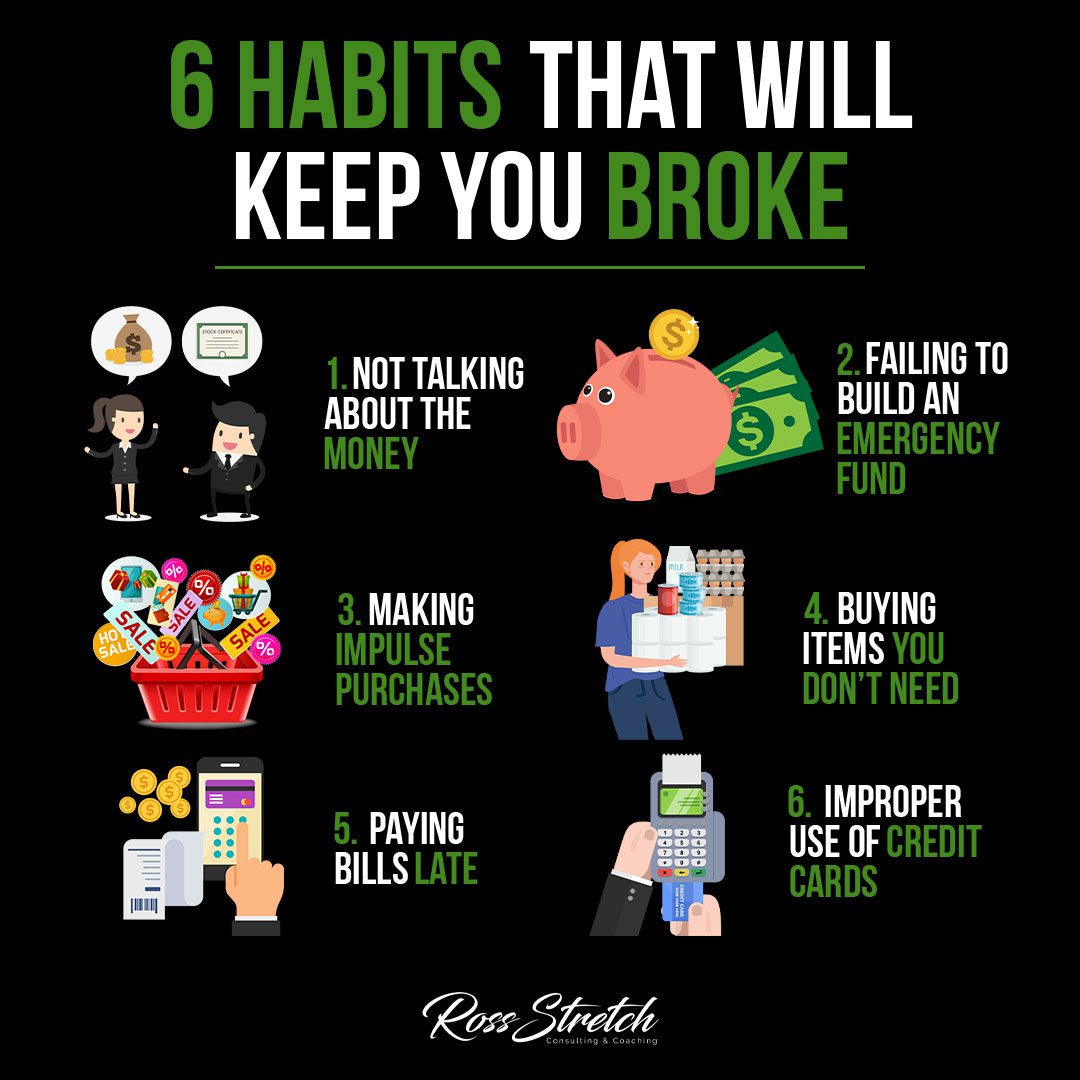
Most people don’t lose wealth all at once — they drain it one bad habit at a time. If you feel like your paycheck disappears before the next one arrives, the problem isn’t your income. It’s your financial habits. These six money mistakes are quietly keeping you broke, and the good news is that every single one is reversible starting today.
1. Not Talking About Money
The Silence That’s Costing You Thousands
Financial illiteracy thrives in silence. When money is treated as a taboo topic, you miss the conversations that could save you from costly mistakes. The people who build real wealth aren’t embarrassed to talk about money — they compare rates, negotiate salaries, and ask questions others are too uncomfortable to raise.
- Actionable Tip: Schedule a monthly “money conversation” with a trusted friend, mentor, or partner. Discuss income goals, debt payoff progress, or investment strategies — even 20 minutes a month changes your financial awareness dramatically.
- Why It Works: Talking about money normalizes healthy financial behavior and creates built-in accountability that solo willpower rarely provides. Peer-to-peer financial conversations expose blind spots faster than any book.
Pro Tip:
Join a personal finance community online. Reddit’s r/personalfinance has over 17 million members openly sharing strategies, mistakes, and wins in real time. Lurking for a single week will surface ideas most people never encounter in their social circles.
2. Failure to Build an Emergency Fund
One Crisis Away from Debt
Without an emergency fund, even a minor setback — a car repair, a medical bill, a job interruption — becomes a financial crisis that sends you into debt. The Federal Reserve has found that nearly 40% of Americans can’t cover a $400 emergency without borrowing. That’s not a budgeting failure; it’s a systemic vulnerability that makes every week financially fragile.
- Actionable Tip: Open a separate high-yield savings account today and automate a transfer of at least $50–$100 per paycheck. Treat it as a non-negotiable bill — not optional savings.
- Why It Works: Automation removes willpower from the equation. When saving happens before you see the money, it builds the fund without requiring daily discipline or decision-making.
Pro Tip:
Your initial goal doesn’t need to be six months of expenses. Start with $1,000. Research consistently shows that having even $1,000 in emergency savings dramatically reduces the likelihood of falling into high-interest debt when life inevitably throws a curveball.
3. Making Impulse Purchases
Your Dopamine Is Not Your Financial Advisor
Impulse buying is designed to feel good in the moment and painful in retrospect. Retailers, algorithms, and app designers have spent billions engineering the perfect conditions for unplanned spending. Every unplanned purchase is a vote against your future financial security — and they add up faster than you think.
- Actionable Tip: Implement the 48-hour rule. When you want to buy something that isn’t a planned necessity, wait 48 hours. If you still want it and can afford it after the delay, proceed. Most of the time, the urge simply vanishes.
- Why It Works: The urge to impulse buy is driven by a temporary dopamine spike, not genuine need. A 48-hour delay allows the emotional trigger to fade and rational judgment to take over — turning impulse into intention.
Pro Tip:
Unsubscribe from retail marketing emails and remove shopping apps from your phone’s home screen. Research in behavioral economics shows that adding friction to a purchase decision can reduce impulsive behavior by up to 50% — without requiring any willpower at all.
4. Buying Items You Don’t Need
Owning More Rarely Means Living Better
Consumer culture is engineered to make you feel like you’re always one purchase away from a better life. The result is closets full of unused items, forgotten subscriptions, and a bank account that never seems to grow. Intentional spending isn’t about deprivation — it’s about redirecting money toward what actually matters to you rather than what you were marketed into wanting.
- Actionable Tip: Before any discretionary purchase, ask: “Will this still bring me genuine value in 30 days?” If the honest answer is no, redirect that money to savings or debt repayment. This single filter can save thousands annually.
- Why It Works: This question creates a mental filter that separates emotional spending from value-aligned spending. It forces a delay and a reality check — two ingredients that consistently reduce regretted purchases.
Pro Tip:
Conduct a quarterly spending audit. Review your last three months of bank and credit card statements and highlight every purchase you would genuinely make again. Whatever isn’t highlighted is waste — eliminate it, redirect the money, and watch your savings accelerate.
5. Paying Bills Late
Late Fees Are a Luxury You Can’t Afford
Late payments cost you in multiple ways simultaneously — you pay the fee, you pay higher interest, and your credit score takes a hit that costs you even more on future loans, mortgages, and insurance premiums. What feels like a minor oversight can compound into thousands of dollars in unnecessary costs over the course of a decade.
- Actionable Tip: Automate the minimum payment on every recurring bill immediately. Then set a monthly calendar reminder to review accounts and pay the full balance wherever possible — especially on credit cards carrying any balance.
- Why It Works: Automation eliminates the human error factor entirely. Even when life gets chaotic, your financial commitments are protected without relying on memory or motivation.
Pro Tip:
If you’ve already missed payments, call your creditors directly. Many will waive a first-time late fee as a courtesy, and some will negotiate a payment plan if you’re genuinely struggling — but only if you proactively reach out rather than ignoring the problem.
6. Improper Use of Credit Cards
Debt Compounds Faster Than Most Investments Grow
Credit cards are powerful financial tools when used correctly — and silent wealth destroyers when misused. The average American carries over $6,500 in credit card debt, paying 20%+ interest on purchases they’ve already consumed. Used strategically, credit cards offer meaningful rewards and purchase protection. Used carelessly, they create a compounding debt cycle that is extremely difficult to escape.
- Actionable Tip: Set one firm personal rule: never charge more to a credit card than you currently have available in your checking account. Then pay the full statement balance every single month — not just the minimum.
- Why It Works: This rule ensures you’re using credit for its rewards and protections, not because you lack the funds. That’s the financial sweet spot — building credit history without building a debt load that compounds against you.
Pro Tip:
Use your credit card’s built-in spending alerts and category tracking to monitor your habits in real time. Most major cards now automatically categorize transactions, giving you a free monthly financial snapshot that makes overspending impossible to ignore.
Start Breaking These Habits Today
These six habits don’t require extreme sacrifice or a financial windfall to fix — they require awareness and a few deliberate system changes. Break the silence around money. Automate your safety net. Pause before you buy. Spend intentionally. Pay on time. And use credit as a strategic tool, not a financial crutch. Each habit you crack opens up more financial freedom — and freedom compounds just as fast as debt does.
Resources


 Ross Stretch