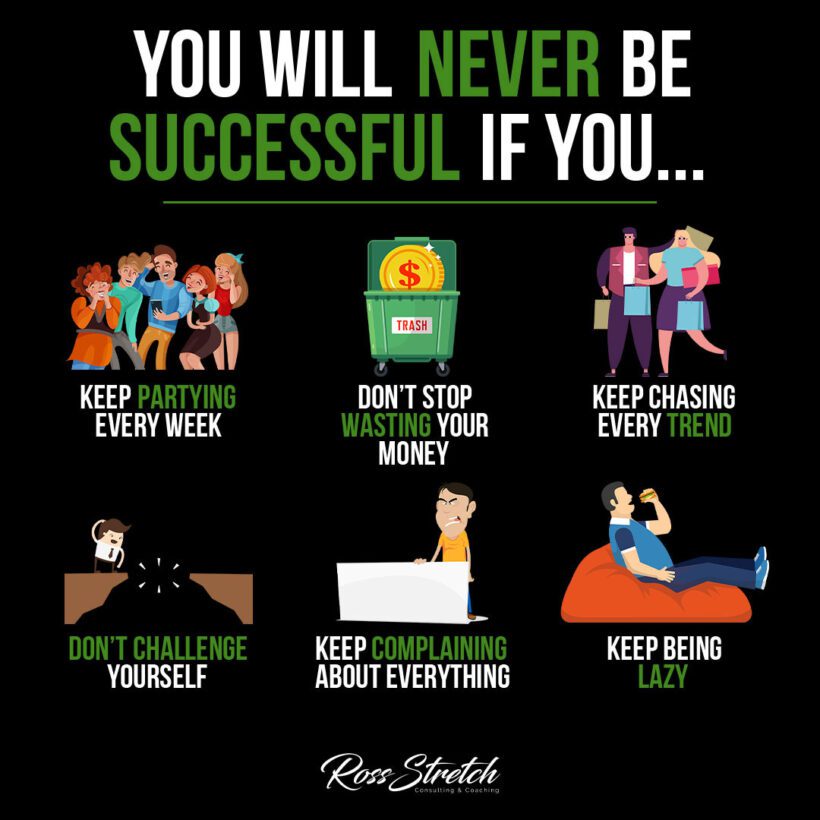

Most people don’t fail because of bad luck or a lack of talent. They fail because of habits — self-sabotaging behaviors repeated daily until they harden into identity. The good news: habits can be broken and replaced with intention. But first, you have to see them clearly for what they are. These six destructive habits are among the most common patterns keeping ambitious professionals stuck, stagnant, and wondering why success never seems to arrive on their terms.
1. Partying Every Week
The Social Trap That’s Quietly Burning Your Potential
Socializing matters — isolation kills creativity and momentum. But there’s a significant difference between intentional connection and habitual escape. Frequent late nights, alcohol, and recovery days compound over time into a serious drain on energy, focus, and discipline — the three resources that success actually runs on.
- Actionable Tip: Audit your last month of social activities. Calculate how many hours were spent recovering from late nights versus building skills, strengthening purposeful relationships, or doing revenue-generating work. Set a firm limit — no more than two late social nights per month — until you hit your next major goal.
- Why It Works: Sleep deprivation from even one late night impairs cognitive function for up to three days, according to National Sleep Foundation research. Elite performers protect their recovery ruthlessly because they understand that performance is a physical discipline, not just a mental one.
Pro Tip:
Replace weekend parties with high-value social environments: industry events, mastermind groups, or skill-based activities. You still get genuine connection and fun — but you’re also building your network and sharpening your capabilities at the same time. Same social need, exponentially better return.
2. Wasting Your Money on the Wrong Things
The Spending Habits That Make You Feel Rich Today and Broke Tomorrow
Financial carelessness is one of the most invisible success killers. It rarely looks dramatic — it’s an extra subscription here, an impulse buy there, restaurants five nights a week instead of groceries. Death by a thousand small purchases is still death. And money leaking out of your life daily is capital that could have been compounding for you instead.
- Actionable Tip: Implement a 48-hour rule for any non-essential purchase over $50. Put it in a cart or wishlist, wait two days, then decide with a clear head. Track every dollar for one month using a free tool like YNAB or Mint to reveal where your money actually goes versus where you assume it goes.
- Why It Works: Spending is emotional, not rational — marketers have spent billions ensuring that. Adding friction and time between impulse and purchase is one of the most evidence-backed strategies for reducing unnecessary spending. The 48-hour pause engages your deliberate thinking brain instead of your impulsive emotional brain.
Pro Tip:
Before any discretionary purchase, ask: “Does this make me more capable, more healthy, or more connected to what genuinely matters?” If the answer is no, default to investing that amount instead. The compounding gap between habitual savers and habitual spenders over a decade is almost impossible to overstate.
3. Chasing Every New Trend
The Shiny Object Syndrome That’s Keeping You Scattered and Stuck
Trend-chasing feels like staying ahead of the curve. It isn’t. It’s a form of avoidance — jumping to the next promising thing just before the current thing gets hard enough to produce real results. Serial trend-chasers build wide knowledge and shallow expertise, a combination that rarely translates into meaningful income or lasting impact.
- Actionable Tip: Choose one primary skill or business model and commit to it for a minimum of 12 months — no pivots, no new shiny objects until the 12-month mark. Document your progress weekly. At month 12, evaluate based on data and results, not emotion or restlessness.
- Why It Works: The compound effect applies to skills and business models exactly as it does to money. Every week you stay the course multiplies the value of every previous week’s work. Every pivot resets the counter to zero. Focus is not limiting — it is the specific mechanism by which excellence is built.
Pro Tip:
Keep a “parking lot” document where you capture new ideas and trends that excite you. This lets you honor the creative impulse without acting on it impulsively. Review the list quarterly. Most things that felt urgent in January will look completely irrelevant by April — and you’ll be grateful you stayed on course.
4. Refusing to Challenge Yourself
Your Comfort Zone Has a Rent — and It’s Your Growth
Comfort is not neutral. Every day you avoid a genuine challenge, you pay the comfort tax — the slow erosion of potential that comes from staying within your known capabilities. The skills you need to reach your next level are, by definition, skills you don’t yet have. Acquiring them will be uncomfortable, and that discomfort is not a warning signal — it is the price of admission to the next level.
- Actionable Tip: Identify the one thing in your career or business you’ve been avoiding because it scares you — a sales call, a public presentation, a difficult conversation. Schedule it this week. Not “soon.” This week. The deliberate choice to do the uncomfortable thing is precisely where real growth happens.
- Why It Works: Psychologists call it “desirable difficulty” — challenges that feel hard in the moment but accelerate long-term learning and retention. Research by cognitive psychologist Robert Bjork consistently shows that skills acquired under conditions of genuine effort are retained far longer than those acquired easily.
Pro Tip:
Create a 90-day “challenge budget” — commit to doing one deliberately uncomfortable thing per week and log each one. Looking back at 90 days of intentional discomforts is one of the most powerful confidence-building exercises available to ambitious professionals. You’ll stop fearing the hard things and start actively seeking them.
5. Complaining Instead of Problem-Solving
Constant Complaining Is a Strategy — Just a Terrible One
Complaining feels productive because it expends energy and attracts attention. It isn’t. Repeated complaints without corresponding action train your brain to view problems as fixed, external, and beyond your control — a posture that guarantees chronic underperformance. Worse, habitual complainers actively repel the mentors, collaborators, and opportunities that reliably follow solution-oriented people.
- Actionable Tip: Implement a self-imposed “complaint tax” for 30 days. Every time you catch yourself complaining without proposing a solution, write down one specific action you can take within 24 hours to improve the situation. The tax isn’t punishment — it’s forced redirection from problem-focus to solution-focus.
- Why It Works: Neurologically, habitual complaining rewires your brain toward negativity through a process neuroscientist Rick Hanson describes as “what fires together, wires together.” The complaint tax pattern-interrupts the loop before it reinforces itself into a permanent cognitive default that becomes nearly invisible to you.
Pro Tip:
Audit your five closest relationships and honestly assess whether each person defaults to “what can we do about this?” or “isn’t this terrible?” Your environment shapes your cognitive defaults more than willpower ever will. Raise the average of the room you consistently inhabit and your thinking will rise with it automatically.
6. Letting Laziness Win
Procrastination Isn’t a Personality — It’s a Habit You Can Break
Laziness rarely looks like doing nothing. More often, it looks like doing the easy things instead of the important things — scrolling when you should be building, reorganizing your desk when you should be making calls, confusing motion for progress. The gap between where you are and where you want to be is almost always filled with work you’ve been finding sophisticated reasons to avoid.
- Actionable Tip: Use the two-minute rule for small tasks — if it takes less than two minutes, do it immediately. For larger tasks, use the Pomodoro technique: 25 minutes of fully focused work followed by a 5-minute break. Together, these two tools dismantle the inertia that makes chronic avoidance feel inevitable.
- Why It Works: Inertia is the real enemy — not the work itself. Getting started is almost always the hardest part. The two-minute rule and Pomodoro technique both dramatically lower the activation energy of beginning, which is exactly where the battle against habitual laziness is won or lost every single day.
Pro Tip:
Design your environment for productivity before willpower is required. Remove distractions from your workspace the night before. Set out your materials. Lower every possible friction point between waking up and doing meaningful work. Willpower is a finite, depleting resource — environmental design is not.
Conclusion
These six habits don’t just slow you down individually — they compound against each other. Together they build a ceiling that feels like the natural limit of your potential but is actually just the limit of your current behaviors. Identify which one costs you the most right now and start there, this week. One habit changed changes everything downstream from it.
Resources

 Ross Stretch