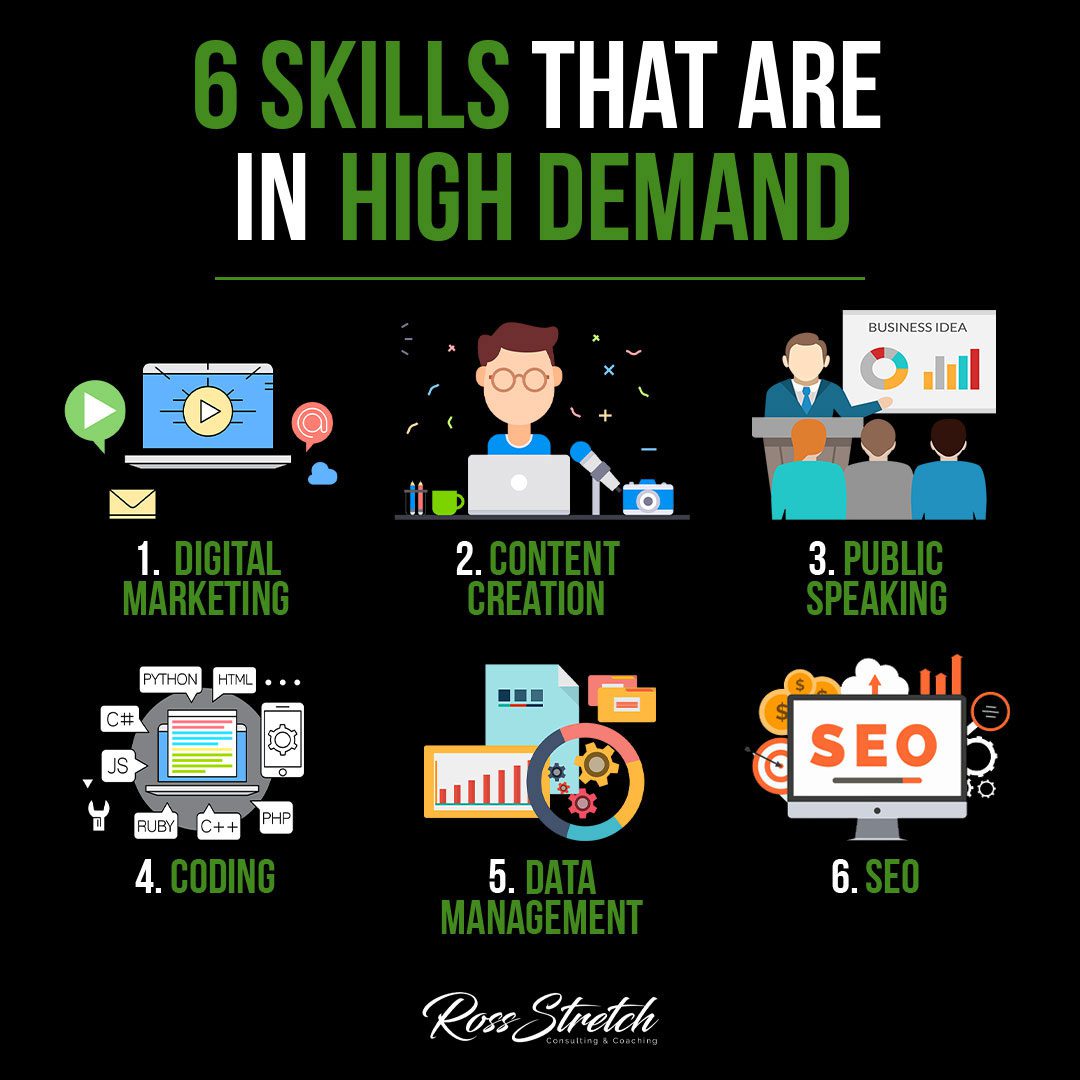
The job market rewards specialists. While a broad resume might open a door, in-demand skills are what determine your earning power, career trajectory, and long-term relevance. Whether you’re climbing the corporate ladder, launching a side business, or positioning yourself for a career pivot, the six skills covered here consistently rank among the most sought-after by employers and clients across industries.
These aren’t abstract concepts — they’re practical, learnable, and directly tied to business value. Master even two or three of them, and you’ll find yourself in rooms you weren’t previously invited to, commanding compensation that reflects your expertise rather than just your tenure.
1. Digital Marketing
How Businesses Find and Keep Customers Online
Digital marketing has moved from a competitive advantage to a baseline requirement for modern business. Companies of every size — from solo entrepreneurs to Fortune 500 brands — depend on professionals who understand how to attract, engage, and convert audiences online. The field spans paid advertising, email campaigns, social media strategy, analytics, and funnel optimization, making it one of the broadest and most transferable skill sets in the modern economy.
The demand for skilled digital marketers continues to outpace supply. LinkedIn’s annual Jobs on the Rise reports consistently rank digital marketing roles among the fastest-growing positions year over year. Professionals who can demonstrate measurable ROI from digital campaigns — not just vanity metrics like clicks and impressions — become indispensable to any growth-focused organization.
- Actionable Tip: Start with one channel, master it, and document your results. Google Ads, Meta Ads, or email marketing each offer clear performance metrics you can use as a portfolio of evidence.
- Why It Works: Employers want evidence of impact. Numbers speak louder than credentials when it comes to hiring and promoting digital marketers.
Pro Tip:
Get certified through Google’s free Digital Marketing Certification or HubSpot’s Marketing Certification. These credentials carry real weight with hiring managers and clients, and both programs can be completed online at no cost.
2. Content Creation
The Skill That Fuels Every Digital Channel
Every digital marketing campaign, every website, and every brand interaction is powered by content. Content creation encompasses written articles, video scripts, social media posts, podcast episodes, email newsletters, and more. As businesses invest more heavily in content marketing — with the global content marketing industry valued in the hundreds of billions — the ability to produce high-quality, engaging material is increasingly valuable across every sector.
What separates good content creators from great ones isn’t just writing ability — it’s an understanding of audience psychology, platform mechanics, and the ability to match tone and format to context. A creator who can write a compelling long-form blog post, adapt key points into a LinkedIn thread, and repurpose that material into a YouTube script is worth significantly more than someone who operates in only one format.
- Actionable Tip: Build a portfolio by publishing consistently on one platform — LinkedIn articles, Medium, or a personal blog. Volume builds skill; publication builds credibility.
- Why It Works: A live portfolio of published content demonstrates capability better than any resume line. Clients and employers can assess your voice, quality, and range immediately.
Pro Tip:
Study high-performing content in your niche using tools like BuzzSumo or by analyzing what gets shared most in your target communities. Reverse-engineer what resonates with that audience, then put your own angle on it rather than copying the format wholesale.
3. Public Speaking
The Skill Multiplier That Elevates Everything Else
Public speaking is one of the most career-accelerating skills available — and one of the most avoided. Research suggests that fear of public speaking affects a significant portion of the population, which means those who get comfortable presenting have an immediate edge over many of their peers simply by showing up and communicating clearly.
Whether you’re pitching a client, leading a team meeting, presenting at a conference, or speaking on a podcast, the ability to communicate ideas clearly and confidently creates outsized professional opportunities. Promotions, partnerships, and high-value clients often flow toward the person who can speak persuasively in the room — not necessarily the most technically skilled person present.
- Actionable Tip: Join a local Toastmasters chapter and commit to presenting at least twice per month. The structured feedback environment accelerates improvement faster than solo practice ever will.
- Why It Works: Repetition in low-stakes environments builds the neural pathways that allow you to perform under high-pressure conditions. Confidence is built through reps, not theory.
Pro Tip:
Record yourself speaking and watch the playback. Most people are surprised by habits they didn’t know they had — filler words, closed-off posture, lack of eye contact. Seeing yourself objectively is the fastest feedback loop available for improving your delivery.
4. Coding
The Language That Powers the Modern Economy
You don’t need to become a software engineer to benefit from coding skills. Even working knowledge of HTML, Python, or SQL can make you dramatically more effective in roles like marketing, operations, finance, or product management. Coding literacy allows you to automate repetitive tasks, analyze data efficiently, communicate more clearly with technical teams, and build tools that wouldn’t otherwise exist within your role.
For those who want to go deeper, full-stack web development, mobile app development, and machine learning engineering are among the highest-compensated specializations in the global job market. Remote-friendly, highly scalable, and relevant across virtually every industry sector, coding remains one of the most reliable investments of time and effort available to any ambitious professional today.
- Actionable Tip: Start with Python if you want data or automation capability; start with HTML, CSS, and JavaScript if you want to build web projects. Free courses on freeCodeCamp or Codecademy provide structured paths from beginner to proficient.
- Why It Works: Even basic coding knowledge eliminates your dependency on technical teams for simple tasks and signals to employers that you’re adaptable and self-directed.
Pro Tip:
Build a real project as soon as possible — even something small and imperfect. A working app or automation script you built yourself teaches more than hours of passive tutorial video. The constraint of a real problem forces you to actually learn the skill.
5. Data Management
Making Sense of the Numbers That Drive Business Decisions
Every significant business decision is increasingly data-driven. Organizations collect enormous volumes of customer, operational, and financial data — but data is only valuable when someone can organize, interpret, and extract actionable insights from it. Professionals who can manage databases, clean messy datasets, build dashboards, and communicate data-driven findings are in high demand across marketing, finance, healthcare, logistics, and operations.
Tools like Microsoft Excel remain foundational, but professionals who extend their capabilities into SQL, Tableau, Power BI, or Python’s data libraries are positioned for senior roles in analytics. The Bureau of Labor Statistics projects that data science and analytics occupations will grow significantly faster than the average for all occupations over the next decade, making this a skill with strong long-term career security and compelling compensation.
- Actionable Tip: Start with Excel or Google Sheets — become genuinely expert at pivot tables, VLOOKUP, and data visualization before moving to more advanced tools. The fundamentals transfer directly to every platform above them.
- Why It Works: Clean, well-visualized data presentations influence business decisions. The person who can translate raw numbers into a compelling story holds significant organizational influence regardless of their formal title.
Pro Tip:
Google’s Data Analytics Certificate on Coursera provides a widely recognized credential upon completion and covers the full analytical workflow from data collection through visualization. Most learners complete it in under six months working part-time, and it can be audited free of charge.
6. SEO
Getting Found When It Matters Most
Search Engine Optimization is the art and science of making web content discoverable through search engines like Google. When a potential customer searches for a product, service, or answer, SEO determines whether your content appears at the top of the results or gets buried where no one looks. For businesses, organic search traffic is one of the highest-converting and most cost-effective channels available, making skilled SEO professionals consistently in demand.
SEO has evolved well beyond keyword density and backlink volume. Today, effective practitioners understand technical site architecture, content strategy aligned with user intent, E-E-A-T signals (Experience, Expertise, Authoritativeness, Trustworthiness), and the analytics platforms needed to measure performance. The career path ranges from in-house marketing roles to freelance consulting to agency work, with strong opportunities across all three tracks.
- Actionable Tip: Learn to use Google Search Console and Google Analytics 4 — both are free and essential for understanding how any website performs in organic search. Practice on your own site or a friend’s before charging for the service.
- Why It Works: SEO results are measurable and attributable, making it straightforward to demonstrate the business value you provide through clear before-and-after comparisons in traffic, rankings, and conversions.
Pro Tip:
The Moz Beginner’s Guide to SEO remains one of the best free educational resources available on the subject. Pair it with consistent practice on a live website and you’ll develop genuine expertise faster than most formal courses deliver — because hands-on application is where SEO is actually learned.
Conclusion
The professionals who thrive in the next decade won’t just work hard — they’ll be strategically skilled. Digital marketing, content creation, public speaking, coding, data management, and SEO aren’t niche technical specialties reserved for a select few; they’re core competencies in the modern economy. You don’t need to master all six at once. Pick the one that aligns most closely with your current career goals, invest consistently over three to six months, and build from there. The compounding effect of developing high-value, demonstrable skills is one of the most reliable paths to income growth and career resilience available to any ambitious professional.
Resources
- HubSpot Academy — Free courses and certifications in digital marketing, content creation, and SEO
- Google Digital Garage — Free Google-certified digital skills training including marketing fundamentals
- freeCodeCamp — Free self-paced coding curriculum covering HTML, JavaScript, Python, and data analysis
- Moz Beginner’s Guide to SEO — Comprehensive free resource covering every core aspect of search engine optimization

 Ross Stretch