
Being good with money is not about earning a high salary or never experiencing financial stress — it is about consistently making smart decisions with whatever you have. The behaviors that signal strong money management are often quiet and undramatic: tracking expenses, paying bills reliably, setting aside savings each month. But these habits compound over years into real financial security. Here are six clear signs that you are already on the right path — and what to do if you want to strengthen any of them.
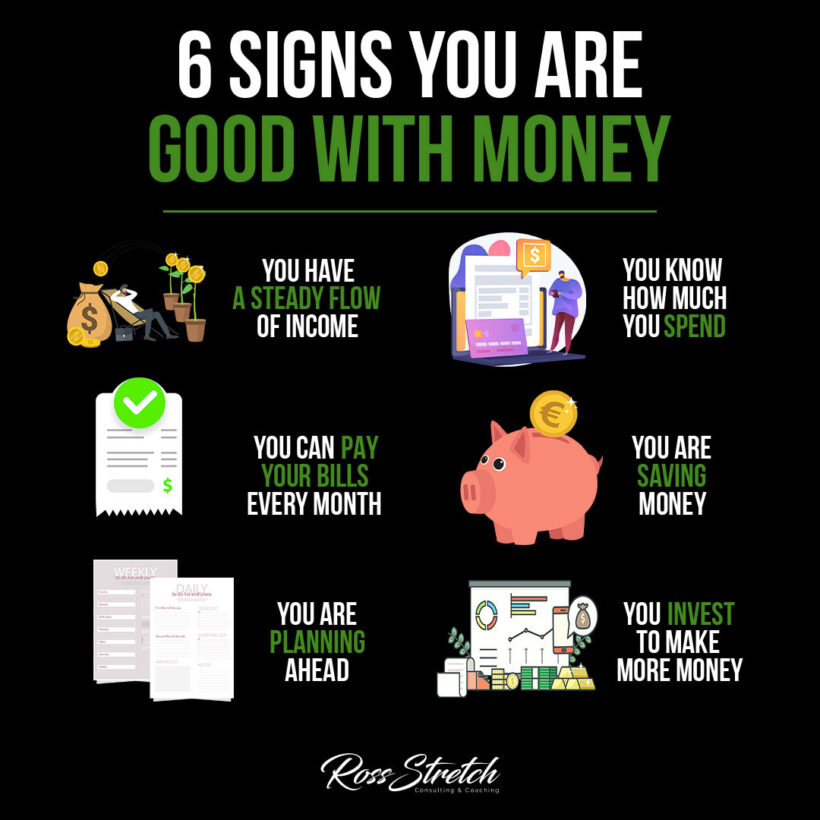
1. You Have a Steady Flow of Income
Financial Stability Starts With Reliable Cash Flow
A consistent income is the foundation of every sound financial plan. Without it, budgeting becomes guesswork, saving becomes reactive, and investment planning is nearly impossible. People who are good with money prioritize income stability — whether that means keeping a reliable primary job, building a business with predictable revenue, or diversifying into multiple income streams. The form of the income matters less than its reliability and predictability month over month.
- Actionable Tip: If your income is variable or inconsistent, calculate your average monthly earnings over the past six months and build your budget around that figure — not your best month or your highest expectation for the months ahead.
- Why It Works: Budgeting from an average prevents the common trap of spending at peak-income levels and then struggling when a slower month arrives. Consistency in planning, not just in earning, is what produces real stability over time.
Pro Tip: Even on a steady income, work toward building at least one additional income stream over the next twelve months. A second source — freelancing, a side business, dividends — reduces your vulnerability to job loss and accelerates your savings rate considerably.
2. You Know Exactly How Much You Spend
Awareness Is the First Step to Financial Control
Most people have a rough sense of their income, but far fewer have a precise picture of where that money actually goes. People who are genuinely good with money know their monthly expenses in detail — not just their rent or mortgage, but their streaming subscriptions, average grocery spend, dining-out frequency, and miscellaneous purchases. This level of awareness is not obsessive; it is strategic. You cannot make intelligent decisions about a resource you are not actively tracking.
- Actionable Tip: Use a free budgeting app like Mint or YNAB to automatically categorize your spending for one full month without changing any behavior. Review the results at the end and identify your top three discretionary spending categories.
- Why It Works: Seeing exact numbers breaks the vague mental justifications most people make for their spending. The majority of people who track their spending for the first time discover at least one category where they are spending significantly more than they realized — and that single discovery is often enough to motivate real change.
Pro Tip: Review your bank and credit card statements manually once a month rather than relying entirely on automated summaries. The act of reviewing each individual transaction creates personal accountability in a way that aggregated dashboards typically do not.
3. You Pay Your Bills Every Month Without Stress
Consistent Bill Payment Signals Organized, Forward-Looking Finances
Paying your bills reliably — on time, every time — is a stronger financial indicator than most people recognize. It signals that your income exceeds your obligations, that you have a system in place for managing due dates, and that you are not operating in a constant state of financial crisis. It also directly protects your credit score, which affects everything from loan interest rates to insurance premiums to rental applications in ways that compound over years.
- Actionable Tip: Set up automatic payments for every fixed bill — rent, utilities, insurance, minimum loan payments — so they are never missed regardless of how busy a particular month gets. Reserve manual payment only for variable bills you genuinely need to review before paying.
- Why It Works: Automation eliminates the most common cause of late payments: forgetting. A single missed payment can drop your credit score by 60 to 110 points depending on your credit history, and that mark stays on your report for seven years — affecting the cost of every loan you take out in that window.
Pro Tip: If you currently cannot pay all your bills comfortably each month, that is critical information. It means your spending exceeds your income or your obligations have grown beyond what your current income can support — both require immediate attention and a concrete plan, not avoidance.
4. You Are Consistently Saving Money
Regular Savings Build the Buffer Between You and Financial Disaster
Saving is not about the amount — it is about the habit. Someone who saves $150 per month without fail for ten years is in a fundamentally better financial position than someone who saves $1,000 occasionally and sporadically. Consistent savers have an emergency fund that absorbs unexpected expenses without forcing them into debt. They have money accumulating toward specific goals. And they have the psychological confidence that comes from knowing their financial situation is steadily improving.
- Actionable Tip: Aim to have three to six months of essential living expenses in an accessible, high-yield savings account before directing money into longer-term investments. This emergency fund is your financial foundation — without it, any setback forces you into debt rather than into your reserves.
- Why It Works: An emergency fund transforms unexpected expenses from crises into manageable inconveniences. Car repairs, medical bills, and temporary income disruptions are stressful by nature — but far more manageable when you have liquid savings to draw from rather than high-interest credit card debt to accumulate.
Pro Tip: Keep your emergency fund in a high-yield savings account rather than a standard bank savings account. Many online banks currently offer significantly higher annual yields, which means your emergency reserve earns meaningful interest while it sits ready for use.
5. You Are Planning Ahead for the Future
Financial Foresight Separates Long-Term Winners from Short-Term Thinkers
People who are good with money think in time horizons, not just in terms of this month’s budget. They are planning for retirement contributions, a home down payment, future education costs, or upcoming large expenses they know are coming well in advance. This forward-looking orientation means they are rarely caught financially off guard — because they anticipated the expense, set aside funds progressively, and arrive at the moment of need already prepared.
- Actionable Tip: Make a list of every significant financial goal you expect to reach in the next one, three, and ten years. Assign an estimated cost and a target date to each. Then work backward to determine how much you need to set aside monthly to hit each goal on schedule.
- Why It Works: Specific goals with timelines and dollar amounts attached are far more motivating than vague intentions. Research in behavioral finance consistently shows that people save more effectively when they can visualize exactly what they are saving for and have a concrete timeline tied to the goal.
Pro Tip: If your employer offers retirement plan matching, contribute at least enough to capture the full match before directing money anywhere else. Employer matching is a guaranteed 50 to 100 percent return on that money before it is ever invested — passing it up is one of the most expensive financial mistakes an employee can make.
6. You Invest to Grow Your Wealth
Investing Moves You from Preserving Wealth to Building It
Saving keeps you stable. Investing moves you forward. People who are genuinely good with money understand that holding cash in a savings account is not a wealth-building strategy — inflation erodes its purchasing power steadily over time. Investing in assets that generate returns above the inflation rate — index funds, individual stocks, real estate, or retirement accounts — is what allows ordinary incomes to compound into meaningful wealth over a working lifetime.
- Actionable Tip: If you are new to investing, start with a low-cost, diversified index fund through a platform like Vanguard, Fidelity, or Schwab. Set up automatic monthly contributions and leave them alone through market fluctuations. The simplest, most consistent strategy almost always outperforms complex active approaches over the long term.
- Why It Works: Compound growth is the mechanism by which ordinary investors build significant wealth. A consistent monthly contribution to a diversified fund, started early and held through market cycles, has historically produced strong returns without requiring expert knowledge or constant attention.
Pro Tip: Do not wait until you feel fully ready to start investing. The most expensive investing mistake is waiting for the perfect moment, which delays the compounding effect that makes early contributions disproportionately powerful. The best time to start was years ago. The second-best time is now.
Conclusion
Being good with money is not a personality trait you are born with — it is a set of behaviors you develop and reinforce through repetition over time. If you recognize yourself in most of these six signs, you are already practicing the habits that lead to long-term financial security. If some feel distant right now, identify the one or two that would have the biggest immediate impact and focus there first. Financial improvement rarely requires a complete overhaul — it requires consistent progress in the right direction, one month at a time.
Resources


 Ross Stretch