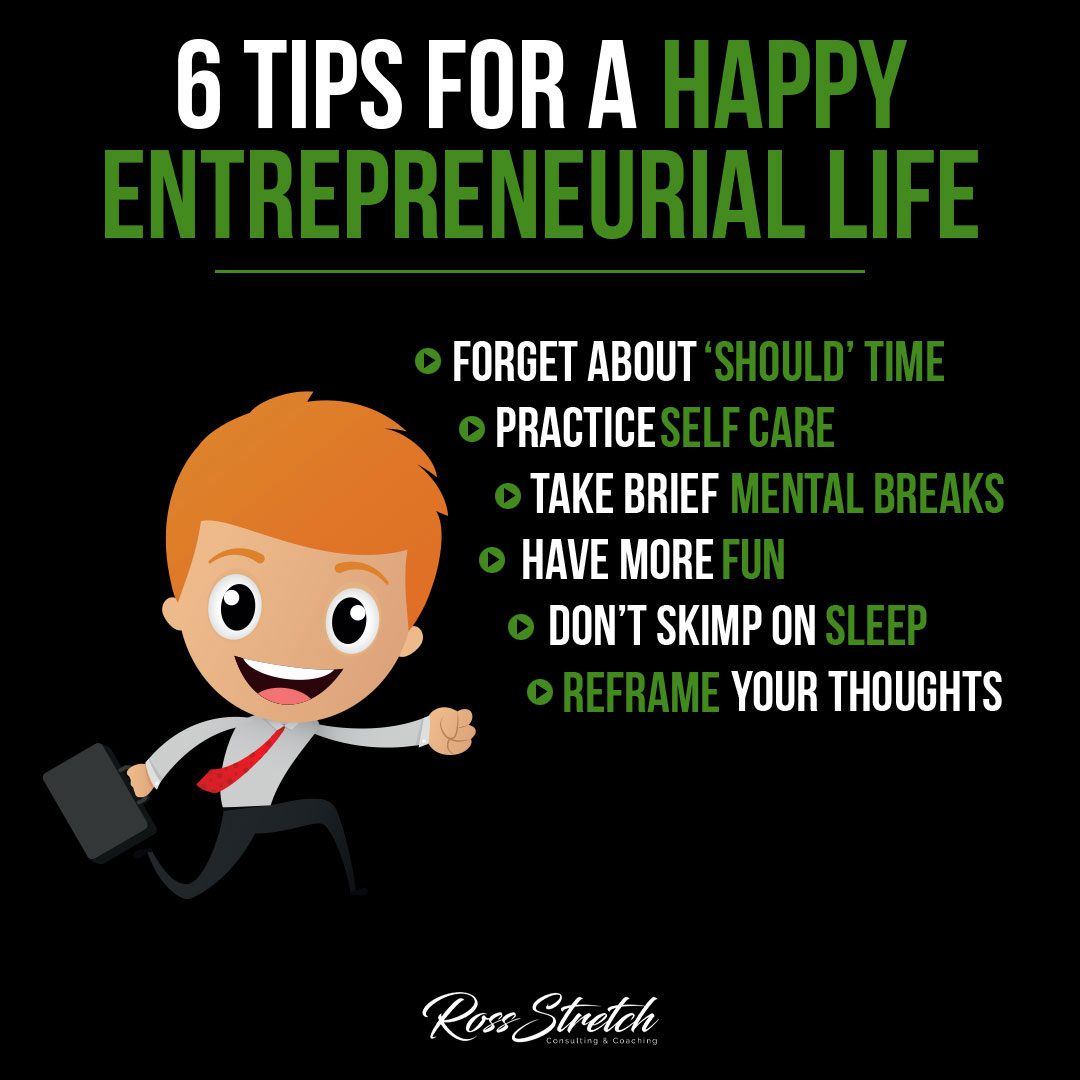
The hustle culture myth has cost entrepreneurs their health, their relationships, and their joy — all in the name of success. But here’s what the grind-at-all-costs crowd gets wrong: entrepreneurial wellness isn’t the opposite of productivity, it’s the engine of it. Founders who protect their mental health, physical energy, and sense of joy don’t just survive the long game — they dominate it. These six evidence-backed tips will help you build a sustainable entrepreneurial life where happiness and high performance coexist.
1. Forget ‘Should’ Time
The Hidden Cost of Living by Other People’s Expectations
Entrepreneurship is uniquely vulnerable to the “should” trap — the constant noise of what you should be doing, who you should be meeting, what you should be building. That noise doesn’t come from your vision; it comes from comparison, social pressure, and fear. When you let “should” drive your schedule, you end up busy but not productive, exhausted but not fulfilled.
- Actionable Tip: At the start of each week, write down your top three priorities. Before adding anything to your calendar, ask: “Does this move me toward those three things, or is it something I ‘should’ do because of external pressure?” If it’s the latter, decline or delegate it without guilt.
- Why It Works: Research on self-determination theory shows that autonomy — doing things because you choose to, not because external pressure demands it — is one of the strongest predictors of sustained motivation and life satisfaction. Protecting your autonomy preserves your energy for what actually matters to your mission.
Pro Tip:
Create a written “Not-To-Do List” — a document of the commitments, meetings, and tasks that drain your energy without advancing your mission. Review it monthly and add to it ruthlessly. Knowing what you won’t do is just as strategic as knowing what you will, and it becomes a compass every time someone asks for a piece of your calendar.
2. Practice Self-Care
Your Body Is the Business — Treat It Accordingly
Entrepreneurs often treat self-care as something they’ll get to “once things calm down” — which means never. But skipping exercise, eating poorly, and neglecting recovery doesn’t just hurt your health; it directly degrades your cognitive function, emotional regulation, and decision-making quality. Your business can only perform as well as you can, and every shortcut you take with your body is a shortcut the business ultimately absorbs.
- Actionable Tip: Block 30 minutes of movement into your calendar every morning before your workday starts — treat it as a non-negotiable meeting with yourself. Even a brisk walk counts. Stack it with consistent sleep and meal timing to establish a physical foundation that doesn’t crumble under pressure.
- Why It Works: Regular aerobic exercise increases BDNF (brain-derived neurotrophic factor), a protein that supports neural plasticity and cognitive performance. Founders who exercise regularly report higher energy, sharper focus, and greater resilience under pressure — the exact qualities that compound into long-term entrepreneurial success.
Pro Tip:
Treat your self-care routine the same way you treat client commitments — it goes in the calendar, it doesn’t get moved for non-emergencies, and missing it requires a rescheduling, not a cancellation. The identity shift from “I try to exercise” to “I am someone who shows up for myself first” is what makes the habit durable instead of fragile.
3. Take Brief Mental Breaks
The Counterintuitive Productivity Strategy That Actually Works
The myth of the 12-hour deep-work session is just that — a myth. Cognitive science consistently shows that the human brain can sustain focused attention for only 90 to 120 minutes before performance degrades. Pushing through mental fatigue doesn’t produce more work; it produces worse work that often needs to be redone, costing you more time than the break would have.
- Actionable Tip: Use the 90-minute work block method: set a timer for 90 minutes of deep, focused work, then take a 15- to 20-minute break where you step away from screens entirely. Walk, stretch, make tea, or sit quietly. Repeat this cycle two to three times per day and track your output quality against your old marathon-session approach.
- Why It Works: The brain’s default mode network — the system responsible for creative insight and problem-solving — activates during rest. Breaks aren’t downtime; they’re when your subconscious integrates information and generates the connections that look like breakthroughs when you return to your desk. Strategic rest is productive rest.
Pro Tip:
Keep a small notepad near your break space. Many entrepreneurs report that their best ideas surface during breaks — not at their desks. Capturing these insights immediately, then returning to your break, gives you the best of both worlds: restoration and inspiration. Your subconscious works best when your conscious mind steps aside.
4. Have More Fun
Fun Isn’t Frivolous — It’s Fuel for Innovation
When was the last time you laughed hard, played a game with no stakes, or did something purely because it delighted you? If you can’t remember, that’s a red flag. Play and fun are neurologically linked to creativity, risk tolerance, and the kind of lateral thinking that generates breakthrough ideas — the very thinking your business most depends on at its most critical moments.
- Actionable Tip: Schedule one activity per week that has zero business utility — a hobby, a sport, time with people you love, or an experience you’ve never tried. Protect that time as fiercely as you protect your highest-revenue meetings. Put it in the calendar under a real name, not “misc,” and treat canceling it as a serious failure of prioritization.
- Why It Works: Play activates the brain’s dopaminergic reward system, which enhances motivation and creative problem-solving. Research from the National Institute for Play shows that adults who maintain regular play behaviors report higher life satisfaction, better social connections, and greater resilience in the face of challenges — all directly relevant to entrepreneurial performance.
Pro Tip:
Look for ways to bring fun into your work itself — gamify a difficult task, celebrate small wins loudly and specifically, or introduce a team ritual that people actually look forward to. When work feels more playful, your best creative thinking shows up more consistently, and your team’s engagement rises alongside your own.
5. Don’t Skimp on Sleep
The Entrepreneur’s Edge That No Supplement Can Replace
Sleep deprivation is almost a badge of honor in startup culture — but the data tells a brutal story. After 17 to 19 hours without sleep, cognitive performance degrades to a level equivalent to a blood alcohol level of 0.05%. Chronically sleep-deprived founders make worse decisions, manage their emotions poorly, and miss the creative connections that distinguish great businesses from good ones.
- Actionable Tip: Set a hard stop time — a point each evening when all screens go dark and work ends. Give yourself a 30-minute wind-down ritual (no email, no news, no social media) before bed. Aim for seven to nine hours in a cool, dark room with consistent sleep and wake times, even on weekends. Consistency matters as much as duration.
- Why It Works: During deep sleep, the brain’s glymphatic system clears metabolic waste, including proteins associated with cognitive decline. REM sleep consolidates memory and processes emotional experiences — both critical for entrepreneurs who need to learn fast, adapt quickly, and remain emotionally steady under sustained pressure.
Pro Tip:
If you believe you function fine on five or six hours, you are almost certainly wrong. Sleep deprivation impairs your ability to accurately assess your own impairment — a phenomenon called the sleepiness paradox. Track your sleep with a wearable for 30 days and watch what happens to your decision quality and emotional regulation when you consistently hit eight hours. The data will change your mind.
6. Reframe Your Thoughts
Your Mindset Is the Most Scalable Asset in Your Business
Every setback in your business will be processed through the filter of your mindset — and that filter determines whether a difficult quarter becomes a lesson or a catastrophe. Cognitive reframing is the skill of choosing how you interpret events, and it is trainable. Entrepreneurs who master it bounce back faster, take more calculated risks, and maintain the optimism that attracts talent, capital, and customers.
- Actionable Tip: When something goes wrong, write down your immediate thought, then challenge it with three questions: What evidence actually contradicts this interpretation? What would I tell a trusted friend in this exact situation? What is one thing I can control right now? Write your answers and act on the third one immediately — action breaks the cycle of rumination.
- Why It Works: Cognitive behavioral therapy research consistently shows that thought-challenging techniques reduce anxiety, improve problem-solving, and build psychological resilience. Reframing doesn’t mean ignoring reality — it means choosing the most accurate and actionable interpretation of reality available to you, which is almost always more useful than the first automatic thought your brain generates.
Pro Tip:
Build a “wins journal” — a document where you record every small victory, positive piece of feedback, and moment of progress. Review it every Friday before the weekend. When your brain defaults to what’s broken and what’s missing, the wins journal provides the counterweight of evidence that things are also working. Over time, your baseline level of optimism shifts from practiced to genuine.
Conclusion
A happy entrepreneurial life isn’t something you stumble into after the business succeeds — it’s something you build deliberately, starting now. These six practices are not soft add-ons to your strategy; they are the foundation that makes every other part of your business sustainable. Take care of yourself with the same intentionality you bring to your most important business decisions, and watch how much further and faster everything else moves.
Resources
- Harvard Business Review: Entrepreneurs Don’t Have a Special Burnout Problem — They Have a Broader One
- Sleep Foundation: Sleep Hygiene and Why It Matters
- American Psychological Association: Building Your Resilience
- Mayo Clinic: Exercise and Stress — Get Moving to Manage Stress

 Ross Stretch