
The global fitness industry generates over $100 billion annually — and the barriers to entry have never been lower. But becoming a fitness entrepreneur who builds a sustainable, profitable business requires far more than passion and a compelling physique. It demands credentials, a content strategy, and the ability to build an audience that trusts you enough to pay for your expertise. These six tips will help you launch your fitness business on a foundation built to last through market trends and platform changes alike.
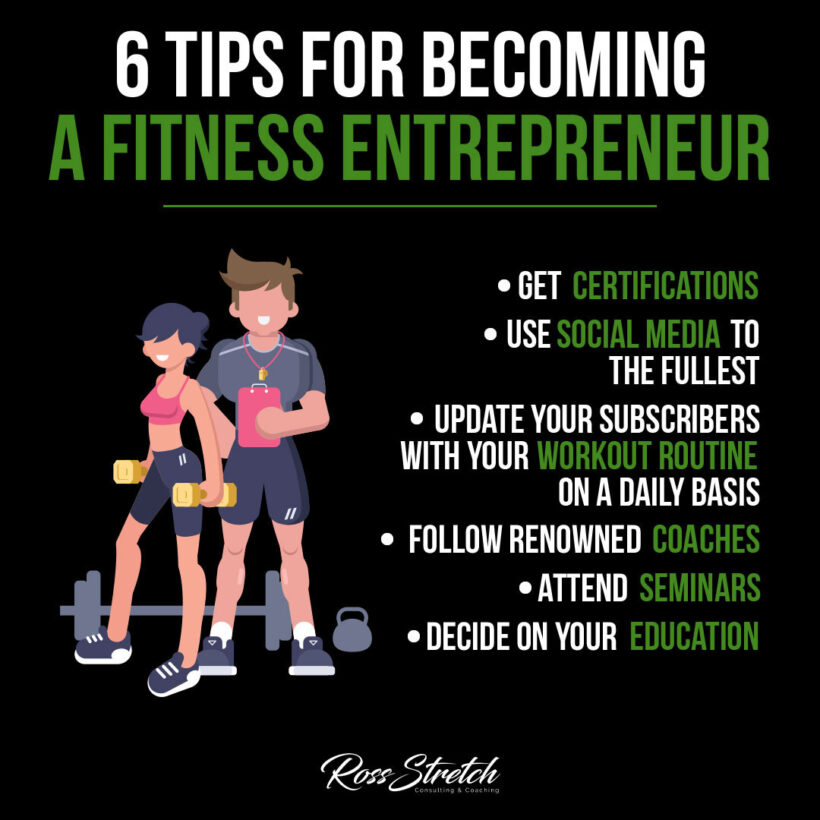
1. Get Certified by a Recognized Organization
Credentials Are the Foundation Your Business Stands On
In a market crowded with self-proclaimed fitness experts, your certification is your credibility. Clients are entrusting you with their physical health, and they need assurance that you have the training to deliver results safely and effectively. Certifications from NASM, ACE, or ISSA are widely recognized by gym facilities, insurance providers, and clients who do their research before spending money on a coach.
- Actionable Tip: Research certifications that align with your intended specialization. For strength and conditioning, consider the CSCS through NSCA. For weight loss coaching and general personal training, ACE and NASM both carry strong market recognition. Commit to a specific exam date before you begin the coursework — the deadline creates the accountability that self-study alone rarely provides.
- Why It Works: Certified trainers command significantly higher rates. NASM data indicates that certified personal trainers earn 20-50% more than uncertified competitors doing equivalent work. Certification also enables you to obtain professional liability insurance — a non-negotiable for any fitness business that intends to operate legally and protect both its clients and its revenue.
Pro Tip:
Don’t treat your first certification as a finish line. The most successful fitness entrepreneurs maintain continuing education units and layer additional specializations — corrective exercise, nutrition coaching, sports performance — over time. Each additional credential expands the client base you can serve and justifies premium pricing as your expertise deepens.
2. Build a Social Media Presence That Provides Real Value
Content Is Your Most Scalable Marketing Channel
Social media is not where fitness professionals go to post gym selfies — it’s where they build the trust that converts followers into paying clients. The accounts that generate sustainable business income consistently deliver educational content, honest transformation stories, and practical insights that make their audience’s lives measurably better. Presence without genuine value is just noise in an already overcrowded space.
- Actionable Tip: Choose one primary platform based on where your target client actually spends time — Instagram for aesthetics-focused audiences, YouTube for educational depth, TikTok for organic reach and discovery. Commit to three pieces of original, value-driven content per week for 90 consecutive days before assessing traction. Consistency over this timeframe is what separates professionals from hobbyists.
- Why It Works: Social proof drives purchase decisions in fitness more powerfully than almost any other industry. A potential client who has watched 20 of your videos before booking a session arrives pre-sold on your expertise. Content marketing generates warm leads — people who trust you before any sales conversation has taken place, which dramatically improves conversion rates.
Pro Tip:
Batch your content creation. Dedicate one four-hour block per week to filming and writing content for the following seven days. This removes content from your daily decision-making and frees your working hours for what actually generates revenue: delivering exceptional results to paying clients.
3. Create Consistent, Structured Content for Your Audience
Consistency Is the Compound Interest of Audience Building
The fitness entrepreneurs who build lasting audiences don’t post randomly — they show up on a predictable schedule their followers can anticipate and plan around. Structured series content (Monday movement breakdown, Wednesday nutrition myth-busting, Friday client transformation) builds habitual consumption in your audience and dramatically improves long-term retention. Random posting builds no habit in anyone.
- Actionable Tip: Design a content calendar with three recurring series that directly reflect your expertise and your target audience’s most pressing needs. Name each series, establish a consistent format, and commit to running all three for at least 12 weeks before reviewing engagement data. The first 12 weeks is about establishing the habit — in you and in your audience simultaneously.
- Why It Works: Structured series content reduces the cognitive friction of creation — you always know what you’re making next — while simultaneously building audience expectation and routine. When followers know your Wednesday post breaks down a common training mistake, they come looking for it. Anticipated content gets consumed; random content gets scrolled past.
Pro Tip:
Repurpose aggressively. A 10-minute YouTube video can become two Instagram carousels, five short-form clips for Reels and TikTok, and one email newsletter entry. A single content creation session can fuel an entire week of posting across multiple platforms — without producing a single redundant piece from your audience’s perspective.
4. Study the Best Coaches in Your Niche
Learn From Those Who Are Already Where You Want to Be
The fastest path to professional expertise is close, systematic observation of excellence. The top coaches in every fitness niche — whether functional strength, postpartum recovery, or elite athletic performance — have already solved the problems you’ll encounter in your first two years. Their content, their client communication, their pricing strategy, and their business model are a curriculum available to study, if you approach it with deliberate intent rather than casual scrolling.
- Actionable Tip: Identify three coaches who are three to five years ahead of where you want to be. Follow them on every platform. Analyze which content generates the highest engagement, study their business model (programs, group coaching, one-on-one, memberships, or hybrid), and identify the gap in their approach that you could fill differently or more effectively for a specific underserved audience segment.
- Why It Works: Modeling accelerates learning by compressing years of trial and error into months of focused observation. Rather than discovering every best practice independently, you inherit the hard-won lessons of someone who has already navigated the same terrain — and you identify the white space they’ve left open for you to occupy.
Pro Tip:
Go beyond free content — buy the programs and courses of coaches you respect. Experiencing their full client journey firsthand reveals the complete structure of their offer, gives you the customer perspective, and frequently exposes gaps you can position yourself to fill more effectively for a different audience or at a different price point.
5. Invest in Continuous Education and Industry Events
Your Knowledge Base Is Your Competitive Moat
The fitness and sports science fields evolve rapidly. New research on recovery, nutrition, movement quality, and behavior change appears constantly — and what was considered best practice five years ago is sometimes now understood to be counterproductive. Fitness entrepreneurs who treat education as a one-time credentialing event find both their knowledge and their credibility becoming outdated in a market that increasingly rewards evidence-based expertise over enthusiasm.
- Actionable Tip: Allocate 5% of your annual revenue to professional education from day one. Budget for at least one major industry conference per year — IDEA World, NSCA National, and Perform Better Summits are among the most respected — plus two online courses or workshops per quarter, and a subscription to one evidence-based educational platform in your specialty area.
- Why It Works: Continuous education compounds. Each certification, workshop, or course adds a layer of expertise that makes you more effective with clients and more credible in your marketing. Coaches who consistently stay at the forefront of evidence-based practice build reputations that survive market cycles — and justify premium rates without ever competing on price.
Pro Tip:
Treat conferences as networking investments, not just education events. The relationships you build with other fitness professionals at industry events frequently generate referral partnerships, collaboration opportunities, and mentorship relationships that compound your business growth far beyond what the conference content alone could provide. Come with a clear intent to connect, not just to learn.
6. Choose a Clear Niche and Own It Completely
In a Crowded Market, Specialization Is the Strategy
“I train everyone” is the positioning of a commodity. “I help busy professionals over 40 build lasting strength without chronic pain or spending more than four hours a week training” is a positioning that commands attention, attracts ideal clients at premium rates, and generates referrals through specificity. The more precisely you define who you serve and what specific transformation you deliver, the easier every aspect of your business becomes — from marketing copy to content creation to client selection.
- Actionable Tip: Complete this sentence and build your entire brand around it: “I help [specific person] achieve [specific outcome] through [specific method] in [specific timeframe].” Test two or three different niche framings for 60 days each, measuring inquiry rate and close rate for each positioning. The version that generates the most qualified conversations with the least friction is your niche.
- Why It Works: Niche positioning reduces competition and increases perceived expertise simultaneously. A client who matches your specific profile will choose you over a generalist almost every time — because your entire brand signals that you understand their exact situation, their specific obstacles, and their particular definition of success. Specificity is the engine of premium pricing and organic referrals.
Pro Tip:
Your niche doesn’t have to be permanent. Many of the most successful fitness entrepreneurs started with a tight, specific niche, built expertise and a reputation there, and then expanded deliberately. Starting narrow gives you the traction and proof points to grow credibly. Staying narrow forever is a valid strategic choice — if the niche is large enough and you can own it completely.
Build the Business Your Expertise Deserves
The fitness industry rewards professionals who combine genuine expertise with smart entrepreneurship — and it quickly exposes those who rely on enthusiasm alone. Certification builds your foundation, strategic content builds your audience, continuous education keeps your knowledge sharp, and a clear niche gives your business an identity that competitors can’t easily replicate. Execute these six pillars consistently for 12 months and you’ll have built something most fitness professionals never achieve: a business that grows because of its reputation, not despite the absence of one.
Resources

 Ross Stretch