
Meetings consume an average of 31 hours per month for the typical knowledge worker — and research consistently shows that nearly half of that time is considered wasted. Productive meetings are not accidental; they are the result of deliberate structure, disciplined facilitation, and an unwavering commitment to respecting people’s time. These six field-tested tips will transform your meetings from a recurring obligation into a genuine strategic advantage for you and your team.
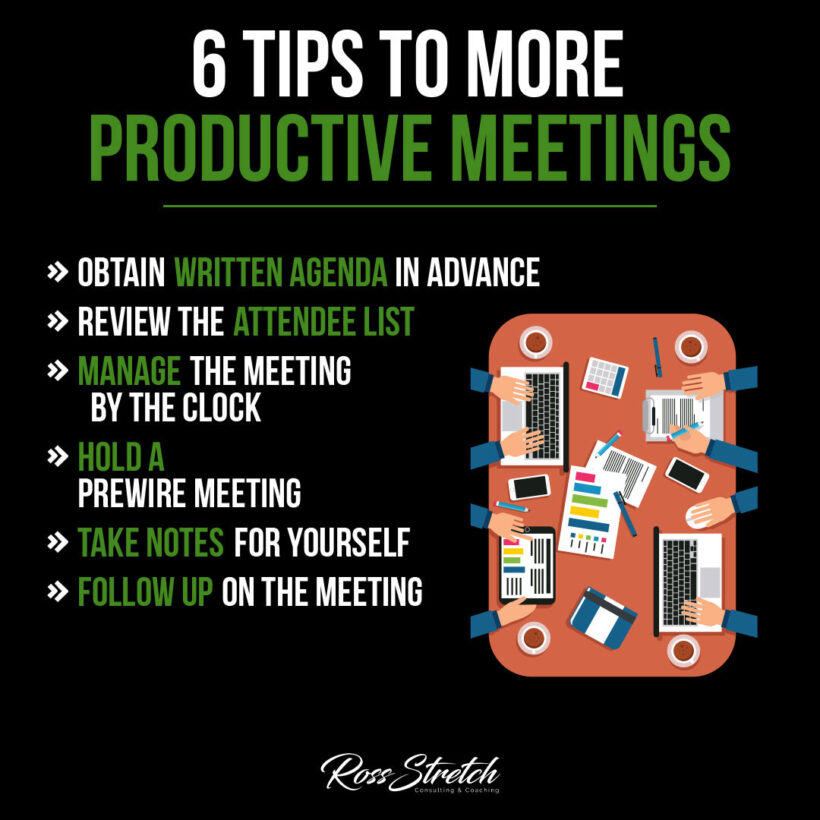
1. Require a Written Agenda Before Anyone Accepts the Invite
No Agenda, No Attendance
A meeting without an agenda is a conversation with an invoice attached. When attendees don’t know what will be discussed, they can’t prepare, can’t contribute meaningfully, and can’t protect their time. The written agenda is not administrative overhead — it is the meeting’s contract with every person in the room, defining what will be decided and what is expected of each participant before they walk in.
- Actionable Tip: Implement one rule immediately: you will not run or attend any meeting that lacks a written agenda distributed at least 24 hours in advance. When organizing, include not just the topic for each agenda item, but the specific decision or output required — so every attendee arrives knowing what success looks like.
- Why It Works: Harvard Business Review research found that a structured agenda significantly reduces discussion time per item because preparation replaces improvisation. When attendees arrive knowing what is expected of them, the cognitive load shifts from figuring out the meeting’s purpose to actually doing the meeting’s work.
Pro Tip:
Include the goal of each agenda item, not just the topic. “Q3 budget” is a topic. “Approve Q3 budget allocation or identify blocking issues to resolve by Friday” is a goal. Goal-driven agendas eliminate ambiguity, reduce scope creep, and make it immediately clear when an agenda item has been completed — so you can move on without debate.
2. Ruthlessly Audit the Attendee List
Every Extra Person in the Room Is a Compounding Cost
Amazon operates by the “two-pizza rule”: if you can’t feed the team with two pizzas, the group is too large for effective decision-making. Every unnecessary attendee represents not just their own wasted time — they add cognitive overhead, slow down discussion, and diffuse accountability. Precision in who you invite is not exclusion; it’s a form of organizational respect for everyone’s most finite resource.
- Actionable Tip: Before sending any invite, apply the RACI filter to every potential attendee — Responsible (owns the outcome), Accountable (final decision-maker), Consulted (needs to provide input), or Informed (needs to know the outcome afterward). Only R and A roles belong in the meeting. C and I roles get a post-meeting summary instead.
- Why It Works: Group dynamics research consistently shows that decision quality degrades with group size above five to seven people. Larger groups generate social loafing, diffusion of responsibility, and longer discussions that produce fewer concrete decisions. The most effective teams run lean meetings by deliberate design, not accident.
Pro Tip:
For recurring meetings that have grown over time, conduct a meeting audit: remove everyone from the invite list and re-add only those who actively request to return. You’ll typically find that 30-40% of attendees were there out of habit or fear of missing out — not because their presence was genuinely necessary.
3. Time-Box Every Agenda Item and Enforce It
The Clock Is the Most Honest Facilitator in the Room
Open-ended discussions expand to fill available time — Parkinson’s Law is ruthlessly predictable inside meeting rooms. The antidote is a time-boxed agenda where each item has a predetermined duration, a designated owner, and a clear deliverable. When people know they have eight minutes to reach a decision, they generally reach it. Remove that constraint and the same decision routinely takes forty minutes.
- Actionable Tip: Assign specific time allocations to every agenda item when you create the agenda. During the meeting, use a visible countdown timer — a physical device or a screen-shared app. When time runs out on an item, call it, note any unresolved issues, and move forward. Schedule a separate conversation for items that genuinely need more depth.
- Why It Works: Behavioral economics research demonstrates that constraints — even artificial ones — significantly improve decision velocity and task completion rates. Time pressure activates focused, convergent thinking. Without it, meetings default to divergent exploration with no natural stopping point and no real accountability for the time being spent.
Pro Tip:
Adopt the 50-minute meeting rule: schedule all meetings to end 10 minutes before the hour. This creates buffer time for back-to-back commitments and, paradoxically, improves both on-time starts and focused execution — because every participant knows the clock is real and the ending is fixed from the moment they walk in.
4. Run Prewire Conversations for High-Stakes Topics
Don’t Surprise Decision-Makers — Align Them in Advance
Presenting a bold proposal to senior stakeholders for the first time in a formal meeting is a high-risk strategy. Decision-makers who encounter an unfamiliar idea in a room full of peers often retreat into skepticism — not because the idea is bad, but because they feel unprepared and exposed. A prewire conversation solves this by converting the formal meeting from a discovery session into a confirmation session.
- Actionable Tip: For any proposal requiring senior sign-off or significant resource allocation, schedule 15-minute calls with each key stakeholder in the week before the main meeting. Frame it simply: “Here’s what I’m planning to propose — what questions or concerns do you have?” Incorporate their feedback before you walk into the room.
- Why It Works: Stakeholders who have already processed an idea are far more likely to engage constructively and decide efficiently in the formal meeting. Prewires reduce ambiguity, surface genuine objections early when they’re easy to address, and ensure you arrive with informed allies rather than cold audiences seeing your proposal for the first time.
Pro Tip:
Keep a prewire log. Note each stakeholder’s initial reaction, the specific objection they raised, and how you addressed it before the main meeting. If the same objection surfaces independently across multiple stakeholders, treat it as a genuine gap in your proposal — not a relationship problem — and revise your thinking accordingly before you present.
5. Capture Structured Notes in Real Time
If It Wasn’t Written Down, It Didn’t Happen
Memory is unreliable under cognitive load, and meetings are high-cognitive-load environments where everyone is simultaneously listening, thinking, and forming responses. Without structured real-time notes, action items get forgotten, decisions get re-litigated in the next meeting, and accountability evaporates entirely. Structured note-taking is not a nice-to-have — it is the operational backbone of any meeting that intends to produce results.
- Actionable Tip: Use a simple three-column format for every meeting you run: Decisions Made | Action Items (with owner name and deadline) | Open Questions (with the person responsible for answering). Share this document with all attendees before the meeting ends, or within one hour afterward at the absolute latest.
- Why It Works: Written records create shared reality. When decisions are documented and visible to everyone, the probability of misremembering or reinterpreting them drops dramatically. Research on accountability shows that action items with named owners and explicit deadlines are completed at three to four times the rate of verbal commitments made in meetings.
Pro Tip:
Rotate the note-taker role among team members in recurring meetings. Beyond distributing the labor, it forces active engagement — knowing you might be asked to capture a decision in real time produces a level of focused listening that passive attendance simply does not. It also builds meeting facilitation skills across your entire team over time.
6. Send a Follow-Up Summary Within 24 Hours
The Meeting Isn’t Over Until the Summary Is Sent
A meeting that produces no written output is a conversation, not a business process. The follow-up summary is what converts discussion into commitment — it documents what was decided, who owns what, and what needs to happen before the group reconvenes. Sent within 24 hours while context is still fresh, it becomes the single source of truth for every participant and a reliable reference for every follow-on conversation.
- Actionable Tip: Create a standard follow-up email template and use it after every meeting you run. Subject line: “[Meeting Title] — Decisions, Actions, and Next Steps.” Body sections: (1) Key Decisions Made, (2) Action Items with owner name and deadline, (3) Open Items and who is responsible for resolving them, (4) Next meeting date if applicable. Send it within 24 hours without exception.
- Why It Works: Follow-up summaries eliminate meeting creep — the recurring phenomenon where the same topics get re-discussed in subsequent meetings because no one has a record of prior decisions. They also create a culture of accountability: commitments made in the room are on record, visible to the whole team, and difficult to quietly let slide.
Pro Tip:
Copy your manager on meeting summaries when the outcomes are strategically significant or cross-functional. It builds visibility, demonstrates leadership presence, and creates a paper trail that protects you if decisions are later questioned. It also signals that you run tight, professional meetings — a leadership quality that gets noticed and rewarded over time.
Productive Meetings Are a Leadership Discipline
The professionals who run the best meetings in any organization are not just better organized — they are perceived as better leaders. When you require agendas, curate attendance, enforce time-boxes, align stakeholders in advance, capture structured notes, and follow up consistently, you transform meetings from the biggest drain on your team’s week into one of its most powerful levers for alignment and execution. Start with one tip this week. Add the next the following week. Within two months, your meetings will look fundamentally different — and so will your reputation for getting things done.
Resources

 Ross Stretch