
Excuses are the silent killer of ambition. Every time you say “I’m not ready,” “the timing isn’t right,” or “I don’t have what I need,” you’re choosing comfort over progress — and making that choice easier to repeat next time. Breaking the excuse habit isn’t a personality trait reserved for the naturally disciplined. It’s a skill you build deliberately, one decision at a time. These 6 proven strategies give you the psychological framework and concrete actions to take full accountability for your results, starting today.
\
\
\
\
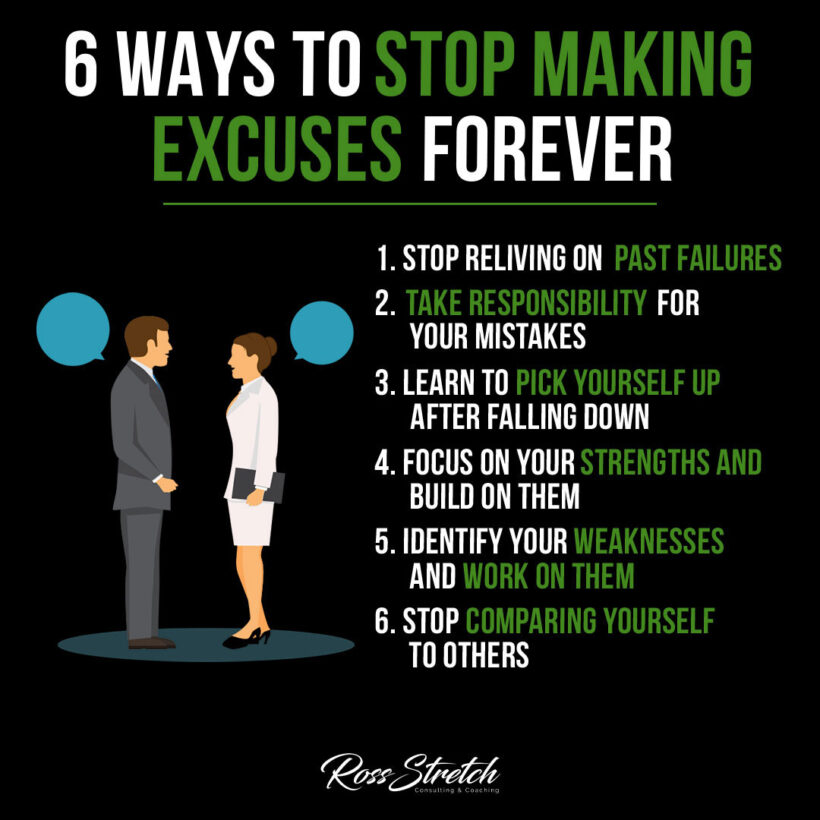
1. Stop Reliving Past Failures
\
\
Your Past Is Evidence, Not a Sentence
\
\
The brain is wired to replay painful memories as a protective warning system — but when those replays become a loop, they transform from protection into paralysis. Every minute you spend rehearsing what went wrong is a minute stolen from what could go right. The most successful people aren’t those who never failed; they’re those who failed, extracted the lesson, and moved faster because of it.
\
\
- \
- Actionable Tip: When a past failure surfaces in your mind, apply the “3-Lesson Rule” immediately: write down one thing you learned, one thing you’d do differently, and one action you’re taking right now as a result. This 5-minute exercise converts rumination into actionable intelligence and forces your brain out of the replay loop before it can paralyze you.
- Why It Works: Cognitive reframing — deliberately redirecting your brain’s narrative about a past event — is one of the most evidence-backed techniques in behavioral psychology. It interrupts the self-reinforcing cycle of shame and disengagement that fuels ongoing excuse-making, replacing a dead-end loop with a forward-moving one.
\
\
\
\
Pro Tip:
\
\
Keep a running “failure log” where you document setbacks alongside the specific lessons they produced. Reviewing this document monthly builds genuine, evidence-based proof that you grow through adversity — and makes the next failure feel proportionately less catastrophic than the one before it.
\
\
\
\
2. Take Responsibility for Your Mistakes
\
\
Accountability Is the Foundation of Real Personal Power
\
\
When you blame external circumstances for your results, you hand those circumstances control over your future. Blaming others may feel easier in the moment, but it permanently positions you as a passive observer of your own life. Radical personal accountability is uncomfortable — and it’s the only path to genuine agency over your outcomes.
\
\
- \
- Actionable Tip: After any meaningful setback, answer three accountability questions in writing — not just in your head: “What choices did I make that contributed to this outcome?” “What did I fail to anticipate or prepare for?” “What will I do specifically differently next time?” Writing forces honest reflection that internal monologue almost never achieves.
- Why It Works: Research in organizational psychology consistently shows that individuals with a high internal locus of control — the belief that their actions determine their outcomes — outperform those who attribute results to external forces. Practicing accountability in writing gradually builds that locus of control and makes ownership your default response to adversity.
\
\
\
\
Pro Tip:
\
\
Find an accountability partner who will push back when you slip into blame mode. Not someone who will validate your excuses, but someone who cares enough about your growth to hold you to your stated commitments. A weekly 15-minute check-in with the right person produces more behavioral change than months of solo effort.
\
\
\
\
3. Learn to Pick Yourself Up After Falling Down
\
\
Resilience Is a Skill — Not a Trait You Either Have or Don’t
\
\
The difference between people who reach their goals and those who don’t often has nothing to do with talent, resources, or opportunity — it’s the ability to recover from setbacks without losing momentum. Resilience isn’t something you’re born with; it’s something you practice until getting back up becomes your automatic response to going down.
\
\
- \
- Actionable Tip: When a setback hits, give yourself a defined “recovery window” — 24 hours to feel the frustration fully, then a deliberate shift into action mode. Before the window closes, identify the single smallest forward-moving step you can take and take it. This ritual prevents 24-hour frustration from becoming a 24-day paralysis.
- Why It Works: Momentum is self-reinforcing. Neuroscience research shows that completing even a small, forward-moving action after a setback triggers dopamine release — which directly counters the learned helplessness response and restores your confidence in your ability to influence outcomes.
\
\
\
\
Pro Tip:
\
\
Build a personal “bounce-back ritual” — a specific, pre-defined sequence of actions you take after any significant setback. A workout, a mentor conversation, a journal entry reviewing past wins. Ritualized recovery prevents emotional paralysis by giving your brain a pre-programmed response to failure, instead of leaving it to improvise one when you’re already depleted.
\
\
\
\
4. Focus on Your Strengths and Build on Them
\
\
Play to Your Advantages, Not Someone Else’s Scorecard
\
\
Most people spend enormous energy trying to fix weaknesses to meet a standard someone else defined. High performers take a fundamentally different approach: they identify their natural advantages, double down on them, and let those strengths generate the results that fuel their confidence and sustain their motivation when things get hard.
\
\
- \
- Actionable Tip: Take the free CliftonStrengths assessment, or ask five people who know you well: “What do you think I do better than almost anyone else?” Look for patterns across their answers. Then identify one project, task, or responsibility this week where you can deliberately deploy that strength — and do it visibly enough to get feedback.
- Why It Works: Gallup research found that employees who use their strengths every day are 6 times more likely to be engaged at work and 3 times more likely to report an excellent quality of life. Strengths-based activity generates intrinsic motivation — the kind that sustains effort without requiring willpower as fuel.
\
\
\
\
Pro Tip:
\
\
Create a personal “strengths portfolio” — a document listing your top strengths, specific examples of each in action, and the roles or projects where they’d have maximum impact. This becomes your positioning document for career decisions, business strategy, and team building — and it makes the case for your unique value in a way a generic resume never can.
\
\
\
\
5. Identify Your Weaknesses and Work on Them
\
\
Close the Specific Gaps That Are Costing You the Most
\
\
Strengths get you in the room. Addressed weaknesses keep you there. While you shouldn’t aim to be world-class at everything, ignoring critical skill gaps is a form of excuse-making disguised as self-acceptance. The key is ruthless selectivity: identify the one or two weaknesses most directly blocking your progress, and attack those with focused intention.
\
\
- \
- Actionable Tip: List your three most important goals for the next 90 days. For each goal, identify the single skill gap most likely to prevent you from achieving it. Then schedule one specific improvement action per week — a course, a deliberate practice session, or a targeted mentor conversation — aimed directly at closing that gap.
- Why It Works: Deliberate practice — focused, intentional effort to improve a specific skill in a specific context — is the documented mechanism behind expertise in every field researchers have studied. Targeted weakness-work delivers far greater returns than unfocused general self-improvement because it’s connected to a real, measurable outcome you care about.
\
\
\
\
Pro Tip:
\
\
Categorize your weaknesses into two buckets: “limiters” (gaps that directly cap your results in ways that matter to your goals) and “non-factors” (areas with no material impact on what you’re actually trying to achieve). Focus all development energy on limiters. Delegate or ignore the rest. Perfectionism about non-factors is itself a form of procrastination.
\
\
\
\
6. Stop Comparing Yourself to Others
\
\
Your Only Real Competition Is the Person You Were Yesterday
\
\
Comparison triggers a well-documented cognitive pattern called social comparison theory, and when it runs unchecked, it generates either false confidence from comparing down or debilitating inadequacy from comparing up. Either way, it pulls your attention from the only variable you actually control: your own daily execution. The most consistent high performers measure themselves against their own benchmarks — not someone else’s curated highlight reel.
\
\
- \
- Actionable Tip: Replace social comparison with a weekly self-audit. Every Sunday, answer three questions in writing: “What did I accomplish this week that I didn’t expect?” “Where did I fall short of my own standard?” “What one specific thing will I do differently next week?” This builds internal reference points that are meaningful, accurate, and entirely within your control.
- Why It Works: Self-referenced goal tracking activates the brain’s reward system more reliably than external benchmarks. When you measure your own progress, every improvement reinforces the behavior that created it — building a self-sustaining positive cycle that comparison-based thinking consistently disrupts and undermines.
\
\
\
\
Pro Tip:
\
\
Run a 30-day social media audit. Track how much time you spend on platforms that tend to trigger comparison for you, and note the measurable effect on your focus, mood, and daily output. Most people who run this experiment discover that pruning their feed or reducing usage produces immediate, noticeable improvements in both confidence and productive output.
\
\
\
\
Stop Making Excuses, Start Owning Your Results
\
\
Excuses aren’t evidence of your limitations — they’re a precise map of where your next breakthrough is waiting. Take ownership of your past, leverage your natural strengths, build your resilience through practice, and compete only against your previous self. Stop waiting for perfect conditions. Start executing with what you have right now. That’s how excuses die — and how real, lasting results get built.
\
\
\
\
Resources
\
\
- \
- Mindset: The New Psychology of Success by Carol S. Dweck — The foundational book on fixed vs. growth mindset and how your beliefs about your own ability determine what you actually achieve.
- Atomic Habits by James Clear — A practical, evidence-based system for building good habits, breaking bad ones, and eliminating the excuse-making patterns that block progress.
- Gallup CliftonStrengths Assessment — The leading strengths-based assessment tool used by over 26 million people worldwide to identify and deliberately activate their natural talents.
- Psychology Today: Accountability — Research-backed articles on self-accountability, personal responsibility, and the psychological science behind owning your outcomes.
\
\
\
\

 Ross Stretch