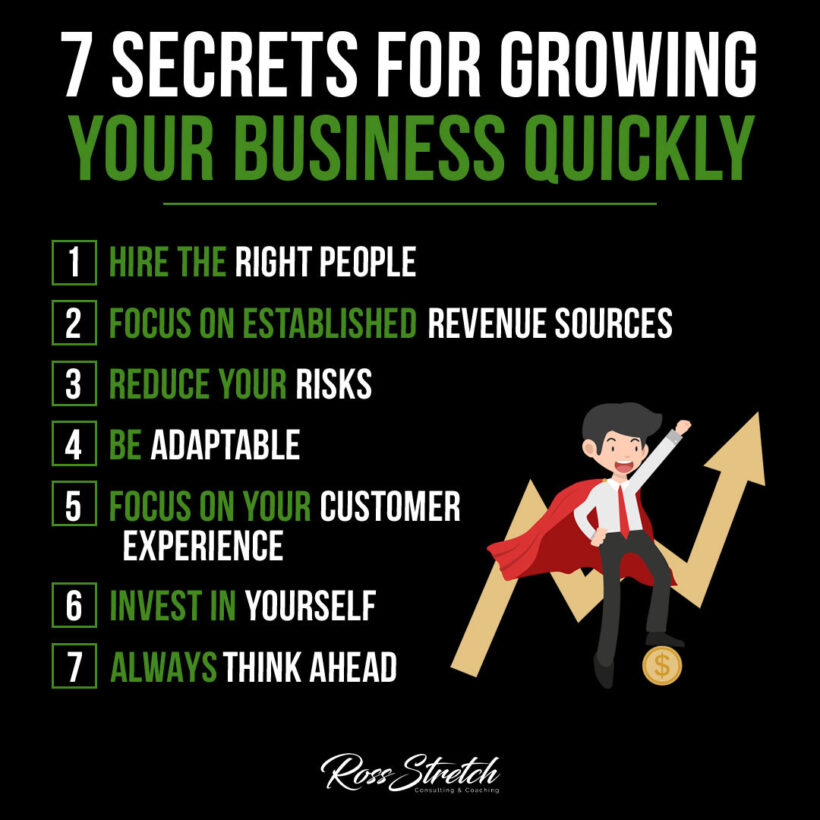

Most businesses don’t fail because of bad ideas — they stall because founders overlook the fundamentals that separate companies that thrive from those that barely survive. Rapid business growth requires more than hustle; it demands smart people decisions, relentless customer focus, and the discipline to plan beyond tomorrow. These 7 battle-tested secrets give you the specific strategies and immediate actions that high-growth companies use to scale faster and stay ahead of the competition.
1. Hire the Right People
Your Team Is Your Single Biggest Competitive Advantage
No strategy survives contact with the wrong team. The companies that grow fastest aren’t necessarily the ones with the best ideas — they’re the ones with the most capable, aligned people executing those ideas every day. A single wrong hire in a key role can cost you months of momentum and tens of thousands of dollars in lost productivity and rehiring costs.
- Actionable Tip: Before your next hire, write a “culture scorecard” listing 3-5 non-negotiable values your candidate must demonstrate. Use behavioral interview questions — “Tell me about a time you disagreed with your manager and how you handled it” — to assess alignment, not just capability. Run your current team through the same scorecard today to identify gaps.
- Why It Works: Skills can be trained; values cannot. Research from Harvard Business Review shows that poor cultural fit accounts for up to 89% of hiring failures. Hiring for alignment reduces turnover and accelerates team productivity far more than any onboarding or training program ever will.
Pro Tip:
Don’t hire to fill a seat — hire 12 months ahead. Think about where your business needs to be in a year and bring in people who can grow into that version of your company, not just serve today’s needs. The best hires make themselves indispensable before you realize how much you needed them.
2. Focus on Established Revenue Sources
Your Best Growth Opportunity Is Already Paying You
New customer acquisition costs 5 to 25 times more than retaining an existing one — yet most business owners obsess over new leads while their current customers quietly walk out the back door. Doubling down on your existing revenue base is one of the fastest and most capital-efficient paths to meaningful growth.
- Actionable Tip: Identify your top 20% of customers by revenue this week. Reach out personally — not with a newsletter blast, but a direct call or email — and ask what else they need. Offer them an upsell, a loyalty incentive, or early access to a new product or service you’re developing.
- Why It Works: Existing customers already trust you, which shortens the sales cycle dramatically. According to Bain and Company, increasing customer retention by just 5% can boost profits by 25% to 95%. Your best clients are also your most likely referrers — a free, high-converting sales channel you’re probably underusing.
Pro Tip:
Build a structured customer success process — onboarding calls, quarterly check-ins, review milestones — that converts one-time buyers into repeat clients and active referrers. A well-designed referral program can generate 20-30% of new revenue at zero advertising cost.
3. Reduce Your Risks
Fast Growth Without Risk Management Is a Ticking Clock
Ambitious growth without a safety net is how thriving businesses become cautionary tales. Financial risk, operational bottlenecks, legal exposure, and key-person dependency can all derail a company at the worst possible moment. The fastest-growing companies don’t avoid risk — they manage it systematically so it never becomes a crisis that consumes their momentum.
- Actionable Tip: Conduct a 30-minute risk audit today. Write down your top 5 business risks — cash flow gaps, client concentration, key-person dependency, legal gaps, data security. For each one, define one specific mitigation action you will take this quarter and assign it a deadline you’ll actually keep.
- Why It Works: Proactive risk management prevents the reactive firefighting that consumes founder bandwidth and derails growth plans. Businesses with documented contingency plans recover from disruptions significantly faster and with less financial damage than those operating without one.
Pro Tip:
Apply the 25% rule: no single client should ever represent more than 25% of your total revenue. This one discipline protects you from the most common catastrophic business failure — losing your anchor client with no financial runway to replace them. Diversified revenue is your strongest risk management tool and your most reliable growth foundation.
4. Be Adaptable
The Market Will Change — Your Job Is to Change First
The businesses that survive market shifts aren’t the strongest — they’re the most adaptable. What worked 12 months ago may be actively hurting your growth today. Building adaptability into your operating rhythm means you can pivot faster than competitors and capture emerging opportunities before they become obvious to everyone else.
- Actionable Tip: Schedule a monthly “market pulse” review. Spend 60 minutes analyzing competitor moves, customer feedback patterns, and industry news. At the end of every session, identify one strategy, process, or product element you will test or adjust as a direct result of what you observed.
- Why It Works: Decision-making speed is a genuine competitive moat. Companies that hold regular strategic reviews respond to market changes two to three times faster than those operating on annual planning cycles alone. Speed of adaptation — not size or budget — determines who captures emerging opportunities first.
Pro Tip:
Build a formal feedback loop with your five best customers. Quarterly calls asking “What’s changing in your world?” give you early signal on shifting needs before those changes show up in your revenue numbers. Your best clients are the best market research you’ll ever get — and they’re already paying you to listen.
5. Focus on Your Customer Experience
Revenue Follows the Experience You Deliver
In a crowded market, your customer experience is your true differentiator. Price can always be undercut. Features can be copied. But the feeling a customer has when they interact with your business — before, during, and after the sale — is nearly impossible to replicate at scale. Companies that lead in customer experience outperform laggards by up to 80% in revenue growth.
- Actionable Tip: Map your complete customer journey this week — from first touchpoint to post-purchase follow-up. Identify one specific friction point in that process and eliminate it by end of week. Even small, targeted improvements compound into significant loyalty and lifetime value gains over a 12-month period.
- Why It Works: According to PwC research, 73% of customers say experience is the top factor in their purchasing decisions — ranking above price and product quality. Every friction point you eliminate is a reason for a customer to stay, return, and actively refer others to you.
Pro Tip:
Implement a Net Promoter Score (NPS) survey immediately after purchase and again 30 days later. The gap between these two scores reveals whether your post-sale experience is reinforcing or undermining the initial buying decision — and pinpoints exactly where to focus your improvement effort to produce the greatest impact on retention.
6. Invest in Yourself
Your Business Grows at the Speed You Grow
The ceiling of your business is almost always the ceiling of your leadership. The skills, mindset, and knowledge you bring to the table today were sufficient to get you here — but they may not be sufficient to get you where you’re going. High-growth founders treat self-development as a non-negotiable business expense, not an optional luxury they’ll get to eventually.
- Actionable Tip: Block two hours per week for deliberate, structured learning — not passive podcast listening, but focused study with a specific application in mind. Read one industry-relevant book per month, review your company’s key metrics weekly, and join a peer mastermind of 3-5 entrepreneurs who are 6-12 months ahead of your current position.
- Why It Works: Leaders who invest in continuous learning measurably increase their problem-solving capacity and decision quality over time. The compounding effect of consistent weekly learning far outperforms the impact of a single annual conference or retreat, because application is immediate rather than theoretical.
Pro Tip:
Don’t consume knowledge passively — apply it immediately. After every book, course, or seminar, write down three specific actions you’ll take in the next 30 days as a direct result of what you learned. Knowledge without implementation is expensive entertainment. The return on self-investment is only realized at the point of application.
7. Always Think Ahead
Short-Term Thinking Builds Small Businesses. Long-Term Thinking Builds Legacies.
The decisions you make today are planting seeds that will either bear fruit or strangle your business in two to five years. Great business leaders operate on two simultaneous timelines: executing with discipline in the present while deliberately designing the future. Without a clear long-term vision anchoring your daily choices, you’ll spend your career reacting instead of building.
- Actionable Tip: Write a one-page “5-Year Vision Document” this week. Describe your ideal business in specific terms: annual revenue, team size, customer profile, core products, and your personal role. Then identify the three biggest gaps between where you are today and that vision — and make closing one of them your primary strategic focus for the next quarter.
- Why It Works: A documented long-term vision functions as a decision filter. When opportunities, distractions, and shiny objects arise — and they always do — you can evaluate them against your vision in seconds. This eliminates the reactive decision-making that scatters resources and kills the momentum you’ve worked hard to build.
Pro Tip:
Review your 5-Year Vision every quarter and update it intentionally. Markets shift, priorities evolve, and your vision should be a living document that reflects your current understanding — not a PDF you wrote once and forgot. The act of revisiting it regularly keeps your long-term strategy front of mind in every short-term decision you make.
Start Growing Faster Today
Growing a business quickly isn’t about working harder — it’s about making smarter decisions across every layer of your operation. Hire for alignment, protect your existing revenue, manage risk proactively, and never stop developing as a leader. Apply even three of these seven secrets with genuine consistency and you’ll build the kind of compounding momentum that most of your competitors will never unlock.
Resources
- U.S. Small Business Administration: Grow Your Business — Official government resource covering financing, hiring, and scaling strategies for small business owners at every stage.
- Harvard Business Review: Growth Strategy — Research-backed articles and real-world case studies on scaling, leadership, and competitive positioning from the world’s leading business publication.
- Entrepreneur Magazine: Growing a Business — Practical guides, founder interviews, and tactical advice on business growth across industries and business models.
- SCORE: How to Grow Your Small Business — Free mentorship resources and growth frameworks from experienced business executives, available at no cost to small business owners.


 Ross Stretch