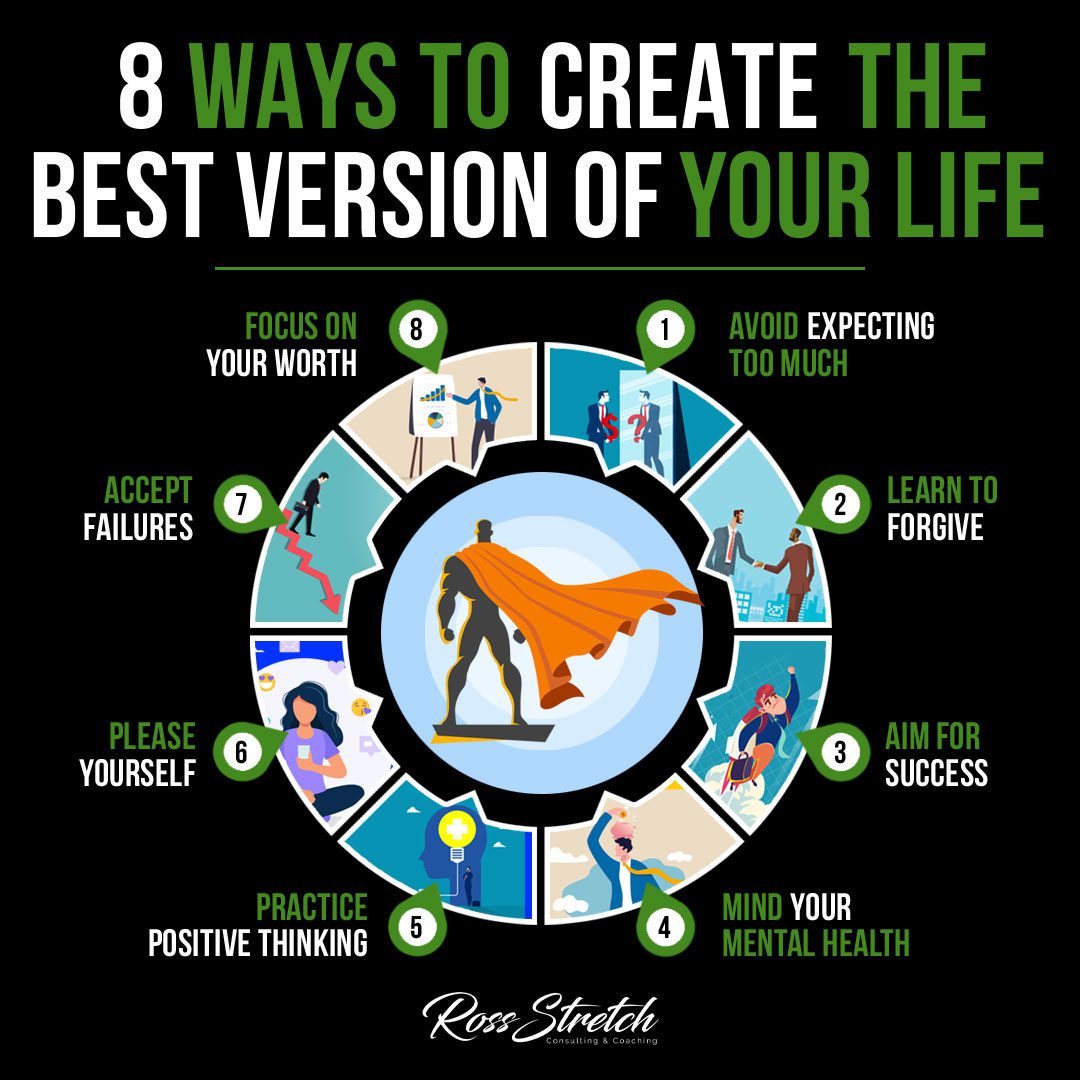
The best version of your life doesn’t arrive when everything is perfect. It’s built through deliberate choices made every day — about what you chase, what you release, who you choose to be, and how you treat yourself when things go wrong. This article gives you eight concrete, actionable strategies to build a life that feels both successful and meaningful — not by overhauling everything at once, but by shifting the foundational beliefs and daily practices that compound into extraordinary results over time.
1. Avoid Expecting Too Much
High Standards Are Healthy — Unrealistic Expectations Are Traps
There’s a crucial difference between ambitious goals and expectations that set you up for chronic disappointment. When your expectations consistently exceed what’s realistically achievable in a given timeframe, every outcome feels like failure — even genuine progress. Managing expectations isn’t lowering your standards; it’s ensuring your standards serve you instead of punishing you.
- Actionable Tip: For your next big goal, write down what you expect to achieve, then ask: “What would a realistic result look like at 30, 60, and 90 days?” Lock in those interim milestones as your actual benchmarks. Judge yourself by the milestones, not the destination.
- Why It Works: Research on goal-setting shows that proximal (near-term) goals produce higher motivation and self-efficacy than distal (long-term) goals alone. Celebrating progress at milestones releases dopamine — the same reward signal that keeps you moving forward.
Pro Tip:
Apply the “3 Good Things” practice at the end of each day. Write down three things that went well and why. This isn’t toxic positivity — it’s training your brain to notice and encode positive evidence. Over time, it recalibrates your baseline from “nothing is ever enough” to “I’m making real progress.”
2. Learn to Forgive
Resentment Is a Weight You Carry — Not the Person Who Hurt You
Holding onto grudges — against others or against yourself — is one of the most expensive habits you can maintain. It drains mental energy, perpetuates stress hormones, and locks a portion of your identity in the past. Forgiveness is not condoning what happened. It’s releasing your grip on it so you can redirect that energy toward building something better.
- Actionable Tip: Identify one person — or one past version of yourself — toward whom you’re still carrying resentment. Write a letter you don’t send: express everything you feel, then consciously choose to release the outcome. This is a process, not a one-time event; revisit it monthly.
- Why It Works: Research published in the Journal of Health Psychology links forgiveness to lower cortisol levels, reduced depression, and better cardiovascular health. Forgiveness is not just emotionally freeing — it delivers measurable physical benefits.
Pro Tip:
Distinguish between forgiveness and reconciliation. Forgiveness is an internal act — it doesn’t require the other person’s participation, apology, or even awareness. You can forgive someone and still choose not to have them in your life. The release is for you, not for them.
3. Aim for Success on Your Own Terms
Borrowed Goals Produce Empty Victories
Most people spend a decade chasing someone else’s definition of success — a title, an income level, a lifestyle they saw on social media — only to arrive and feel nothing. Sustainable ambition starts with clarity about what you personally value, not what you’ve been told to want. Your goals should feel like yours, not someone else’s projected expectations.
- Actionable Tip: Write your “life eulogy” — 200 words describing the life you would be remembered for living. Ignore what sounds impressive; write what would feel true. Then audit your current goals against that eulogy: are you building toward that life, or toward someone else’s version of it?
- Why It Works: Self-determination theory, developed by psychologists Ryan and Deci, identifies autonomy — the sense that your goals are genuinely your own — as one of the three core drivers of intrinsic motivation. Autonomously motivated goals are pursued with more energy, creativity, and persistence.
Pro Tip:
Review your goals quarterly and ask: “Is this still mine, or did I inherit it from an old version of myself or someone else’s expectations?” Goals are allowed to evolve. Letting go of a goal that no longer fits is not failure — it’s discernment. Save your energy for the pursuits that actually matter to who you’re becoming.
4. Mind Your Mental Health
Your Mind Is the Asset Everything Else Depends On
You can have the best business strategy, the clearest vision, and the strongest discipline — and a struggling mind will undercut all of it. Mental health is not a soft concern; it is the infrastructure on which every other area of your life runs. Proactive investment in your psychological wellbeing returns more than almost any other improvement you can make.
- Actionable Tip: Commit to one daily mental health practice — not as a crisis intervention, but as preventive maintenance. Ten minutes of mindfulness, a daily walk without your phone, five minutes of journaling, or a weekly session with a therapist or coach. Schedule it like any other non-negotiable appointment.
- Why It Works: Studies from the American Psychological Association show that consistent mindfulness practice reduces anxiety, improves emotional regulation, and increases working memory capacity — all of which directly improve performance, decision-making, and relationships.
Pro Tip:
Track your mental health the same way you track finances or fitness. Rate your mood, energy, and clarity each morning on a 1–10 scale. After 30 days, patterns emerge — which habits, people, and environments lift you up, and which ones drain you. Data beats guesswork, and self-awareness is the first step to self-management.
5. Practice Positive Thinking
Optimism Is a Skill, Not a Personality Trait
Optimism is not about denying reality or pretending problems don’t exist. It’s about training your brain to default to possibility over catastrophe when faced with uncertainty. Research consistently shows that optimistic people are more persistent, healthier, and more successful — not because life is kinder to them, but because they interpret setbacks differently.
- Actionable Tip: Practice cognitive reframing when you hit an obstacle. Ask yourself: “What’s another way to interpret this situation that serves me better?” Then ask: “What can I learn from this?” These two questions interrupt the catastrophizing loop and redirect your brain toward agency.
- Why It Works: Martin Seligman’s foundational research on learned optimism shows that the way you explain events to yourself — permanent vs. temporary, pervasive vs. specific — determines your resilience. Explanatory style can be trained, which means optimism can be learned at any age.
Pro Tip:
Start a gratitude practice, but go deeper than generic statements. Write one specific, detailed thing you’re grateful for and precisely why it matters. “I’m grateful for the difficult conversation today because it showed me where I need to grow.” Specific gratitude requires genuine reflection — and genuine reflection produces lasting mindset change.
6. Please Yourself First
Self-Neglect Is Not a Virtue — It’s a Sustainability Problem
The cultural narrative around ambition often glorifies self-sacrifice to the point of harm. But consistently deprioritizing your own needs doesn’t make you a better leader, parent, or partner — it makes you a depleted one. Tending to your own needs first isn’t selfishness; it’s the foundation of sustainable performance and genuine generosity toward others.
- Actionable Tip: Identify one area where you’re consistently giving more than you’re receiving — a relationship, a project, a role. Set one specific boundary this week: decline one draining request, restructure one obligation, or simply stop doing one thing that costs you without return.
- Why It Works: Research on emotional labor shows that people who fail to replenish their emotional and physical resources experience faster burnout, poorer decision quality, and diminished empathy. You cannot give from an empty reserve — this is not a platitude, it’s physiology.
Pro Tip:
Think of boundaries as saying yes to yourself, not no to others. When you decline something that doesn’t align with your priorities, you’re creating space for the things that do. Reframe every boundary you set as an act of intentional self-design — because that’s exactly what it is.
7. Accept Failures as Fuel
Every High Performer Has a Longer Failure List Than You Think
The people you admire most have failed more often, more visibly, and more expensively than you know. The difference between people who succeed long-term and those who quit is not the absence of failure — it’s the interpretation of it. When you treat failure as data rather than verdict, it becomes the most powerful accelerant in your arsenal.
- Actionable Tip: After every significant setback, run a “post-mortem” within 48 hours. Write down: what happened, what you contributed to the outcome, what you would do differently, and what the failure teaches you about your next attempt. Make this a ritual, not a punishment.
- Why It Works: Carol Dweck’s research on growth mindset demonstrates that people who believe abilities can be developed through effort — rather than being fixed traits — learn faster, recover more quickly from setbacks, and achieve more over time. Failure is only terminal if you treat it as evidence of fixed limitations.
Pro Tip:
Create a “failure résumé” — a private document listing your biggest failures and what each one taught you. Review it quarterly. You’ll quickly see that your greatest failures preceded your most important breakthroughs. Failure documented is failure transformed into intelligence.
8. Focus on Your Worth
Self-Worth Is the Foundation — Everything Else Is Built on It
Your relationship with yourself determines the quality of every decision you make, every opportunity you pursue, and every relationship you allow into your life. People with solid self-worth set higher standards, recover faster from setbacks, and make choices aligned with their values — not their fears. Self-worth isn’t arrogance; it’s the grounded belief that you deserve the life you’re building.
- Actionable Tip: Write down five specific things you’ve done — accomplished, overcome, created, or contributed — that you’re genuinely proud of. Read them aloud. Then ask: “Do my current goals and relationships reflect the person who did these things?” If not, identify one change to make this week.
- Why It Works: Self-efficacy — the belief in your own capacity to succeed — is one of the strongest predictors of actual performance across career, health, and relationship domains. Building an evidence-based case for your own competence directly increases the boldness of your goals and the persistence with which you pursue them.
Pro Tip:
Curate the voices you let in. Surround yourself with people who expect the best from you and hold you accountable to it — not those who are comfortable with you staying small. Your social environment is the single most powerful external influence on your self-concept. Choose it deliberately.
The Best Version of Your Life Is Built, Not Found
None of these eight strategies requires a dramatic overhaul or a perfect starting point. They require only the decision to take your own life seriously — to invest in your mindset, respect your limits, own your failures, and build relentlessly on your worth. Start with one strategy today. Let compound growth do the rest.
Resources

 Ross Stretch