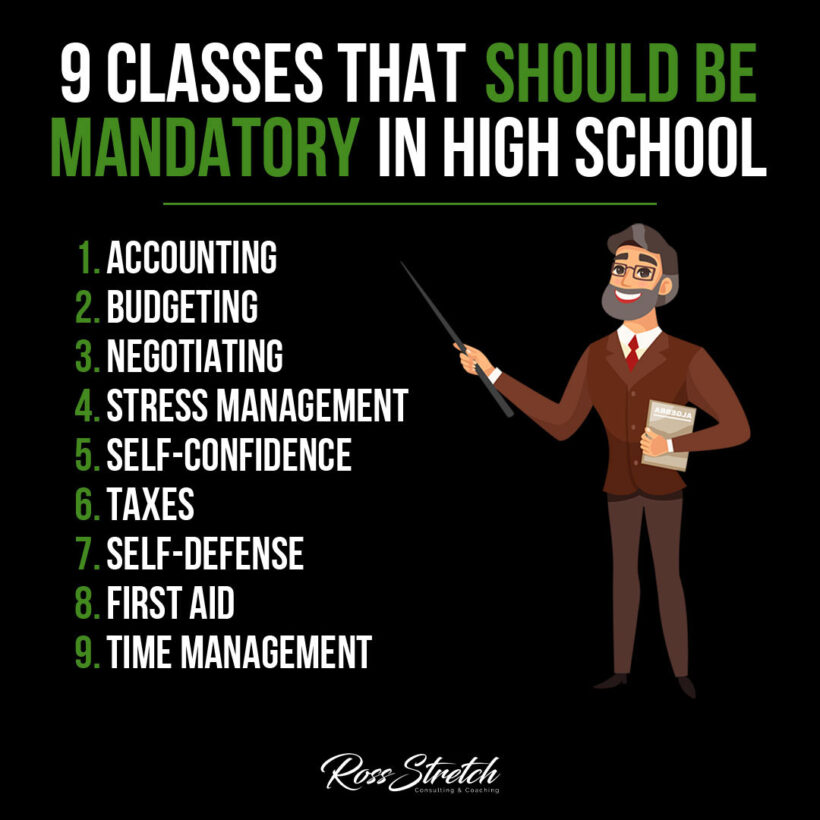

Most students spend thirteen years in school learning algebra, history, and literature — and graduate without knowing how to file their taxes, negotiate a raise, or manage their mental health under pressure. The gap between what schools teach and what life actually demands is staggering. Here are nine classes that should be mandatory in every high school curriculum, and why they would produce far more capable, confident adults.
1. Accounting
The Language of Money Everyone Should Speak
Understanding basic accounting isn’t just for future CPAs — it’s essential for anyone who wants to manage their finances intelligently. High school students who learn how money flows in and out of a household or small business are dramatically better prepared for financial independence. Accounting literacy translates directly into sharper decision-making about spending, saving, and investing at every stage of life.
- Actionable Tip: Start by learning to read a basic income statement and balance sheet — Khan Academy offers a free, beginner-friendly accounting course that covers exactly this.
- Why It Works: When you understand financial statements, you can see where money is being wasted, saved, or grown — in your personal life or any organization you work for.
Pro Tip:
Even a basic grasp of cash flow, depreciation, and profit margins makes you a significantly more valuable employee and a far more capable entrepreneur. Financially literate people at every level of an organization make better decisions — and companies know it.
2. Budgeting
The Skill That Separates the Financially Free from the Financially Stressed
A staggering 78% of Americans live paycheck to paycheck — not because they don’t earn enough, but because they never learned to manage what they have. A budgeting class would teach students how to allocate income intentionally, plan for irregular expenses, and build savings automatically. These habits, formed young, compound dramatically over a lifetime and prevent decades of financial stress.
- Actionable Tip: Start with the 50/30/20 framework — 50% of income to needs, 30% to wants, 20% to savings and debt repayment. Adjust the percentages over time as your income and goals evolve.
- Why It Works: Budgeting converts vague financial anxiety into a concrete, manageable plan. It transforms money from something that happens to you into something you actively direct.
Pro Tip:
The most effective budgets are reviewed weekly, not just created once and forgotten. Building a 15-minute weekly money check-in habit in high school could prevent decades of financial chaos in adulthood.
3. Negotiating
The Skill That Pays You for the Rest of Your Career
Research shows that failing to negotiate your starting salary costs the average professional over $500,000 in cumulative lost earnings over a career. Yet negotiation is almost never taught in school. Learning to negotiate confidently — for job offers, rental agreements, contractor rates, or everyday purchases — is one of the highest-leverage skills any adult can develop, and it costs nothing to learn.
- Actionable Tip: Practice anchoring — always state a number first, above your actual target, to set the psychological reference point for the negotiation. The first number stated disproportionately influences the final outcome.
- Why It Works: Anchoring exploits a cognitive bias where the initial figure shapes all subsequent offers. Used consistently, it shifts the center of every negotiation in your favor.
Pro Tip:
The single most powerful phrase in any negotiation is: “Is that the best you can do?” It’s non-confrontational, opens space for concessions, and works in nearly every scenario from car dealerships to job offers to vendor contracts.
4. Stress Management
The Foundation Everything Else Is Built On
Chronic stress is one of the leading drivers of poor decision-making, health problems, and burnout — yet schools almost never address it directly. A class on stress management would give students practical tools to regulate their nervous systems under pressure, which pays dividends in every area of life from academic performance to long-term career resilience. The earlier these tools are learned, the more deeply they become ingrained.
- Actionable Tip: Learn box breathing — inhale for 4 counts, hold for 4, exhale for 4, hold for 4. Used by Navy SEALs to manage acute stress, this technique measurably calms the nervous system within minutes.
- Why It Works: Slow, controlled breathing activates the parasympathetic nervous system, directly counteracting the fight-or-flight stress response at a physiological level — not just psychologically.
Pro Tip:
The best stress management is proactive, not reactive. Regular exercise, quality sleep, and reduced caffeine lower baseline cortisol levels and build inherent resilience — so that when pressure arrives, it hits a stronger system.
5. Self-Confidence
The Internal Edge That Changes Everything
Confidence isn’t a personality trait you’re born with — it’s a skill built through deliberate action and consistent self-awareness. Students who develop genuine self-confidence are more likely to take initiative, pursue stretch opportunities, and recover from setbacks without spiraling. Psychologist Albert Bandura’s decades of research show that self-efficacy — the belief in your ability to succeed in specific situations — is one of the strongest predictors of real-world achievement.
- Actionable Tip: Build confidence through daily micro-wins — set one small, specific goal each morning and complete it. Over time, your brain learns to associate effort with success, and confidence grows organically from that pattern.
- Why It Works: Each completed action — no matter how small — provides evidence that you are capable. Confidence is built on evidence, not affirmations.
Pro Tip:
Confidence is built at the edge of your comfort zone, not at the center of it. Speak in class when you’re unsure. Apply for the role you’re slightly underqualified for. Do the thing that feels slightly beyond you — repeatedly. That repetition is the class.
6. Taxes
The Annual Reality Nobody Prepares You For
Filing taxes is a non-negotiable fact of adult life, yet most people either pay someone else to handle it out of confusion or leave significant money on the table by not understanding the deductions they qualify for. A class on personal taxation would cover income brackets, registered account strategies (TFSA, RRSP, 401k), common deductions, and how to file accurately — turning what feels like a minefield into a manageable annual task.
- Actionable Tip: File your own return from the beginning using free software like Wealthsimple Tax (Canada) or FreeTaxUSA. Even if a professional reviews it, understanding the inputs builds financial literacy fast.
- Why It Works: People who understand their tax situation make better financial decisions year-round — they invest in registered accounts, time income strategically, and avoid costly surprises that blindside the uninformed.
Pro Tip:
Track deductible expenses throughout the year in a simple spreadsheet. Reconstructing them at tax time is painful and leads to missed claims. A system built early saves thousands over a career.
7. Self-Defense
Awareness and Agency in a Physical World
Self-defense training does more than teach physical protection — it builds body awareness, situational alertness, and the calm that comes from knowing you can handle yourself under pressure. These benefits transfer well beyond any confrontation scenario and into general resilience, presence of mind, and a more grounded way of moving through the world. Self-defense is ultimately a confidence class with physical skills attached.
- Actionable Tip: Begin with situational awareness — the habit of noting exits, scanning environments, and staying alert in unfamiliar places. Most threats are avoided long before any physical skill is ever needed.
- Why It Works: Feeling physically capable reduces background anxiety and allows you to engage more freely in social and professional environments without a constant undercurrent of vigilance.
Pro Tip:
Even a single semester of Krav Maga or Brazilian Jiu-Jitsu builds practical skills that remain useful for decades — far more durable knowledge than most content taught in a standard high school curriculum.
8. First Aid
The Knowledge That Can Literally Save a Life
Approximately 70% of Americans feel helpless during a medical emergency because they don’t know how to respond, according to the American Red Cross. Brain damage from cardiac arrest begins within 4 to 6 minutes without CPR. Bystander response in the minutes before paramedics arrive is often the single factor that determines whether someone lives or dies. Making first aid mandatory in high school would create a generation of people equipped to act when it counts most.
- Actionable Tip: Get certified in Standard First Aid and CPR through the Red Cross or St. John Ambulance — a one-day course covers wound care, choking response, CPR, and AED use. Recertify every two years to keep skills sharp.
- Why It Works: Trained bystanders dramatically improve cardiac arrest survival rates. Skills learned in a hands-on course are retained far longer than information simply read or heard.
Pro Tip:
Learn how to use an AED (Automated External Defibrillator). They are present in most public buildings and airports, but most people don’t know they can use them. The device talks you through every step — you just need the confidence to start.
9. Time Management
The Skill That Multiplies Every Other Skill You Have
Time is the one resource you cannot earn more of. Yet school trains students to work within schedules set by others, with no instruction on how to manage their own time when those external structures disappear at graduation. The result is millions of capable adults who struggle to execute on their own priorities consistently. A class on time management would teach prioritization, deep work, and the systems that turn good intentions into consistent results.
- Actionable Tip: Use time-blocking — assign specific tasks to specific time windows in your calendar. Reserve your highest-energy hours for your most demanding work, and batch low-cognitive tasks together to protect that focused time.
- Why It Works: Time-blocking eliminates the “what should I do now?” decision fatigue that bleeds hours from most people’s days. Structure creates productivity without sacrificing flexibility.
Pro Tip:
Apply the Pareto Principle: 80% of your results come from 20% of your activities. Identify your highest-value 20% each week and protect that time ruthlessly. The rest can be delegated, batched, or dropped entirely.
Conclusion
The skills on this list won’t appear on standardized tests, but they determine how well you actually function in adult life. Schools do a reasonable job preparing students for college — but a poor job preparing them for the world beyond it. Financial literacy, emotional resilience, practical health knowledge, and personal effectiveness are not soft skills. They are fundamental life skills, and their absence has real costs.
If these classes aren’t coming to your school, seek them out yourself. Books, online courses, certifications, and mentors can fill every gap your curriculum left behind. The students who acquire these skills early don’t just perform better in their careers — they live better, broader, more capable lives.
Resources

 Ross Stretch