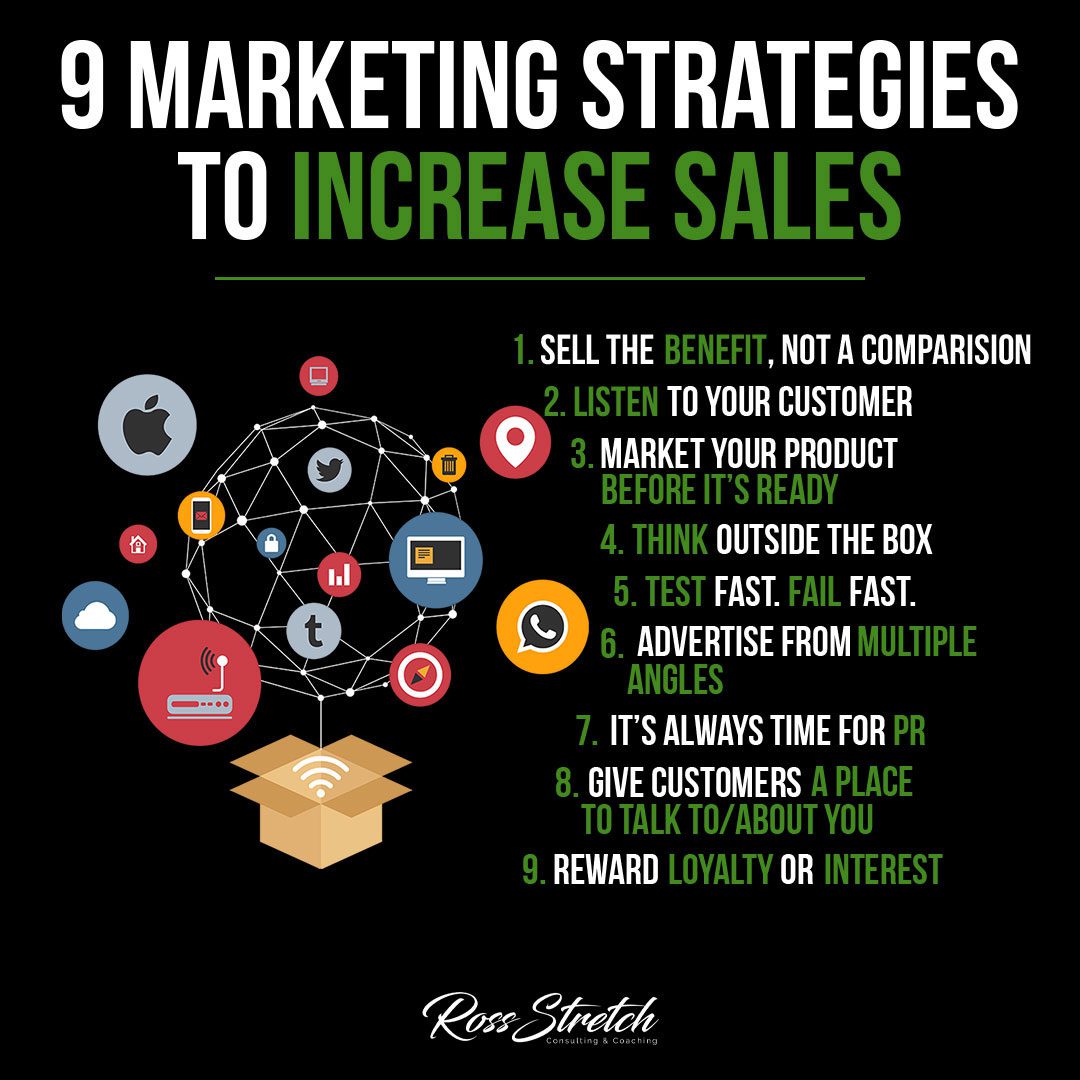
In today’s highly competitive business landscape, effective marketing strategies are the difference between businesses that thrive and those that merely survive. This article reveals 9 powerful strategies to increase your sales and achieve long-term success. From emphasizing value over comparison to building customer loyalty systems that drive repeat revenue, each tactic plays a critical role in attracting, converting, and retaining customers who become long-term advocates for your brand.
1. Sell the Benefit, Not the Comparison
Lead with Value to Win the Customer’s Decision
When marketing your product or service, highlighting the benefits it offers customers is far more effective than pointing to competitors’ weaknesses. Consumer psychology research consistently shows that purchasing decisions are made based on perceived personal value — how the product changes the customer’s life — not comparative feature lists. Instead of saying “we’re better than X,” communicate “here’s exactly what changes for you when you use this.” Frame everything through your customer’s transformation, not your competitive positioning.
- Actionable Tip: Rewrite your core marketing messages using this formula: “[Product feature] so that you can [specific outcome].” Instead of “We offer 24/7 support,” try “24/7 support, so you’re never stuck during a critical moment.” Test benefit-led copy against feature-led copy in your ads and let the data guide you.
- Why It Works: Benefits trigger emotional responses, while features trigger rational analysis. Purchasing decisions are primarily emotional and then rationalized logically. Benefit-led marketing speaks to both dimensions simultaneously, dramatically increasing conversion rates.
Pro Tip:
Survey your best existing customers and ask: “What was your situation before our product, and how has it changed?” Their exact language will reveal the benefits that resonate most authentically — and using those precise words in your marketing creates an almost eerie sense that your brand understands your prospects better than they understand themselves.
2. Listen to Your Customers
Your Customers Are Telling You Exactly How to Sell to Them
Understanding your customers’ needs, preferences, and pain points is essential for crafting targeted marketing campaigns that convert at high rates. Actively listening to customer feedback, engaging in real conversations, and conducting surveys or interviews provides invaluable data that no agency or marketing consultant can manufacture. According to Salesforce research, 66% of customers expect companies to understand their unique needs — yet most businesses treat all customers identically, missing enormous personalization opportunities.
- Actionable Tip: Implement a post-purchase survey of three questions maximum, asking what problem the customer was trying to solve, what almost stopped them from buying, and how they would describe your product to a colleague. Use tools like Typeform or SurveyMonkey to automate this and collect responses at scale.
- Why It Works: Customer insights eliminate guesswork from your marketing. When you know the exact language customers use to describe their problems, you can mirror it back in your copy — creating the feeling that your brand reads their mind, which is one of the most powerful drivers of trust and conversion.
Pro Tip:
Monitor review platforms like G2, Trustpilot, and Amazon reviews — both yours and your competitors’ — for patterns in customer language. Competitor reviews are especially valuable: customers explicitly describe what they wish the product did better, handing you a roadmap for both product development and positioning your alternative.
3. Market Your Product Before It’s Ready
Build the Audience First, Then Launch to Eager Buyers
The biggest mistake new businesses make is waiting until launch day to start marketing. By the time your product is ready, you should already have an engaged audience that has been anticipating it for weeks or months. Building pre-launch buzz creates a sense of inevitability around your product — waitlists, beta programs, and behind-the-scenes content build social proof and goodwill before you’ve made a single sale.
- Actionable Tip: Launch a “coming soon” landing page with an email capture form 60-90 days before your product is ready. Offer early subscribers an exclusive benefit — first access, founder pricing, or a free bonus. Build content around the problem your product solves while you develop the solution itself.
- Why It Works: Pre-launch marketing validates demand before you finalize the product, builds an initial customer base, and creates launch-day momentum that platforms like Product Hunt, social media algorithms, and press coverage amplify significantly.
Pro Tip:
Document your product-building journey publicly on social media. Founder-led transparency — sharing challenges, pivots, and behind-the-scenes progress — builds authentic brand loyalty that no paid advertising budget can replicate. Audiences who feel they have co-created something with you have dramatically higher conversion and retention rates at launch.
4. Think Outside the Box
Unconventional Marketing Cuts Through the Noise
In a marketplace where every customer is exposed to thousands of marketing messages daily, conventional advertising increasingly fails to register. The most memorable campaigns are those that surprise people, challenge expectations, or create genuine shareability. Guerrilla marketing, unexpected partnerships, and bold creative concepts can generate awareness that a standard ad budget cannot buy — especially in markets where competitors are all saying the same things in the same ways.
- Actionable Tip: Brainstorm three “what if we actually dared to” marketing ideas that your competitors would never attempt. Pick the most viable one and pilot it at small scale — measure engagement, shares, and sentiment before committing significant resources. Examples include surprise pop-up experiences, cause-based campaigns, or social media challenges tied authentically to your brand’s values.
- Why It Works: Novelty triggers dopamine in the brain, making unexpected experiences inherently memorable and shareable. People share things that make them feel smart, entertained, or part of something distinctive — and your marketing earns organic distribution when it achieves any of these.
Pro Tip:
Study breakthrough campaigns from adjacent industries, not just your direct competitors. The most disruptive creative ideas come from transplanting approaches that work brilliantly in retail, entertainment, or hospitality into your category — where they feel fresh and surprising rather than derivative.
5. Test Fast, Fail Fast
Data Beats Opinion Every Time
In today’s fast-paced digital environment, marketing agility is a genuine competitive advantage. Rather than spending months planning the theoretically perfect campaign, successful marketers run rapid experiments, gather real data, and iterate based on what the market actually responds to. A/B testing, multivariate testing, and small-scale pilots allow you to validate assumptions before committing significant budget — and consistently reveal counterintuitive insights that no amount of planning could predict.
- Actionable Tip: Run structured A/B tests on your highest-traffic pages and most-active ad sets. Change ONE variable at a time — headline, call-to-action, image, or price point — collect statistically significant data (minimum 1,000 impressions per variant), then scale the winner and test the next variable.
- Why It Works: Marketing decisions based on empirical data consistently outperform those based on intuition, opinion, or internal debate. Testing removes ego from the equation entirely — you let the market tell you what works rather than arguing internally about what should work.
Pro Tip:
Document every test and its results in a shared “marketing learnings” log accessible to your entire team. Over time, this becomes an invaluable institutional database of what works for your specific audience — a compounding competitive advantage that grows more valuable as you accumulate more data points.
6. Advertise from Multiple Angles
Omnichannel Presence Multiplies Your Reach and Impact
Customers rarely convert on first exposure. Marketing research consistently shows it takes between 7 and 13 touchpoints before a prospect makes a purchase decision. Reaching your target audience through multiple channels — social media, search ads, email, content marketing, video, and offline channels — increases the cumulative exposure needed to drive conversion, while also reinforcing your brand message across multiple formats and contexts.
- Actionable Tip: Map out your customer journey and identify which channels your prospects use at each stage — awareness, consideration, and decision. Allocate budget and content resources to cover each stage deliberately, not just the bottom-funnel conversion stage where your competitors are competing most aggressively.
- Why It Works: Multichannel marketing creates the “everywhere effect” — the impression that your brand is omnipresent in your category. This dominance of mental real estate is a primary driver of both first purchases and the brand loyalty that sustains long-term revenue growth.
Pro Tip:
Retargeting is one of the highest-ROI digital marketing tools available. Install the Facebook Pixel and Google Tag Manager on your website to serve tailored messages to visitors based on which specific pages they viewed — speaking directly to where they are in their buying journey rather than showing generic awareness ads to people who are already past that stage.
7. Leverage Public Relations
Earned Media Delivers Credibility That Paid Advertising Cannot Buy
Public relations plays a vital role in building brand credibility and reaching audiences who actively avoid advertising. A single feature in a respected publication can generate awareness equivalent to tens of thousands of dollars in paid media — while carrying far greater trust because it comes from a third-party journalist rather than your own brand. PR is especially powerful for establishing authority in a new market, launching a new product category, or repositioning an existing brand.
- Actionable Tip: Build a curated list of 20-30 journalists, podcasters, and industry bloggers who cover your space. Follow them on social media, engage authentically with their content, and when you have a genuinely newsworthy story — original data, a contrarian perspective, a significant milestone, or a timely industry angle — pitch them with a concise, personalized email that connects your story to what their audience cares about.
- Why It Works: Editorial credibility is borrowed credibility. Readers trust publications they subscribe to, and when your brand appears in Forbes, industry newsletters, or respected podcasts, that trust transfers to your business in a way that a paid ad simply cannot replicate.
Pro Tip:
Create your own PR opportunities by publishing original research or survey findings. Data is highly shareable and regularly cited by journalists seeking statistics to anchor their stories. A simple 100-person survey on a topic relevant to your industry can generate multiple media placements, inbound backlinks, and significant credibility — at a fraction of the cost of paid advertising.
8. Give Customers a Place to Talk About You
Community and Social Proof Are Your Best Salespeople
Word-of-mouth has always been the most powerful form of marketing — and digital platforms have amplified it exponentially. Creating a community or platform where customers can engage with your brand and each other transforms buyers into brand advocates who actively recruit new customers on your behalf. User-generated content, reviews, and community engagement provide authentic social proof that influences prospects far more effectively than any claim your own marketing makes.
- Actionable Tip: Create a branded Facebook Group, Slack community, or Discord server for your customers. Seed it with valuable content, Q&A sessions with your team, and peer-to-peer conversations. Actively celebrate customer wins and feature member success stories to create a culture of achievement associated with your brand.
- Why It Works: Nielsen research consistently shows that 92% of consumers trust recommendations from people they know, while fewer than 33% trust branded advertising. A community channels this natural trust-in-peers dynamic directly in favor of your business, creating a self-sustaining referral engine.
Pro Tip:
Feature customer success stories with specific, measurable outcomes — not just generic five-star quotes. A testimonial that says “I grew my revenue by 40% in three months using this service” dramatically outperforms “Great product, highly recommend.” Specificity creates credibility, and credibility converts skeptical prospects into buyers.
9. Reward Loyalty
Retention Is More Profitable Than Acquisition
Acquiring a new customer costs 5 to 25 times more than retaining an existing one, according to Harvard Business Review research. Implementing customer loyalty programs, referral incentives, and exclusive rewards not only encourages repeat purchases but transforms your satisfied customers into your most cost-effective acquisition channel. Loyalty programs work across virtually every industry — from coffee shops to enterprise SaaS platforms — because the underlying psychology of reciprocity and belonging is universal.
- Actionable Tip: Design a three-tier loyalty structure that rewards customers for repeat purchases, referrals, and social sharing. Use platforms like Smile.io or LoyaltyLion to automate points tracking and rewards fulfillment. Even a simple “refer a friend for $50 off” program can meaningfully reduce your customer acquisition cost over time.
- Why It Works: Existing customers have already demonstrated trust in your brand. They are significantly easier to sell to, have higher average order values, and provide more authentic referrals than any paid channel can generate. Loyalty programs create switching costs that protect you from competitive threats while deepening the relationship.
Pro Tip:
Personalize your loyalty rewards based on individual customer purchase behavior — not one-size-fits-all discounts applied equally to every account. A customer who primarily purchases in one category should receive rewards and early access relevant to that category. Personalization dramatically increases redemption rates and the perceived value of your loyalty program without increasing its cost.
Conclusion
By implementing these 9 effective marketing strategies, you can transform your approach to customer acquisition and build a sustainable competitive advantage. The most effective marketing isn’t any single tactic — it’s a coherent, customer-centric system that attracts the right prospects, converts them through genuine demonstrated value, and retains them through extraordinary ongoing experience.
Start with two or three strategies that address your biggest current gap — whether that’s awareness, conversion rate, or customer retention. Measure results rigorously, double down on what the data confirms, and continue layering in additional strategies as your capacity grows. Consistent, intelligent marketing effort compounds over time into category leadership.
Resources

 Ross Stretch