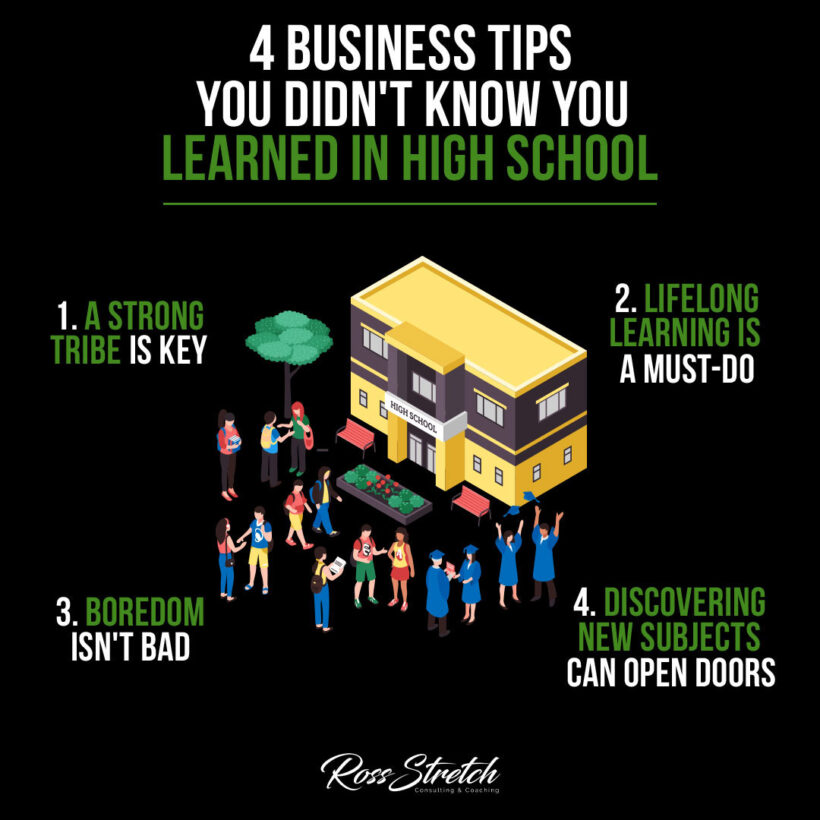

High school gets a bad reputation as a relic of mandatory academia — a place to endure before real life begins. But look closely and you’ll find that some of the most important business lessons were embedded in your daily high school experience. The social dynamics, the curriculum structure, and even the tedium all taught you things that translate directly into entrepreneurial success. Here are four business principles you already learned in high school — and why they still matter for building a thriving career or company.
1. A Strong Tribe Is Key
Your Network in Business Works Exactly Like Your Crew in High School
In high school, finding your group — the people who understood you, supported you, and pushed you to be better — made everything easier. The same dynamic applies in business. Your professional network is your tribe, and its quality directly shapes your trajectory. A strong network provides access to opportunities you’d never find on your own: introductions to potential clients, referrals, honest feedback, mentorship during difficult stretches, and partnerships that multiply your capabilities. The entrepreneurs who build remarkable businesses almost always point to a handful of key relationships as the turning point. Those relationships didn’t happen by accident — they were cultivated intentionally over time.
- Actionable Tip: Identify five people in your industry or adjacent field whose judgment you respect. Invest in those relationships intentionally — schedule regular check-ins, offer value before you ask for anything, and show up for them when it costs you something.
- Why It Works: Relationships built on genuine mutual investment are the ones that generate meaningful opportunities. Transactional networking produces weak ties. Real relationships produce strong ones.
Pro Tip: Curate Your Inner Circle Carefully
Research consistently shows that your income, attitudes, and ambitions tend to converge with those of the five people you spend the most time with. In high school, peer pressure was a liability. In business, the right peer group is a serious asset. Seek out people who challenge your thinking, hold high standards, and have achieved what you’re working toward.
2. Lifelong Learning Is a Must-Do
The Habit of Continuous Learning Is Your Strongest Competitive Advantage
High school exposed you to an enormous breadth of subjects — not because you’d use calculus and chemistry every day, but because the act of learning across disciplines builds cognitive flexibility and intellectual curiosity. Those qualities are enormously valuable in business. Industries shift, technologies emerge, and the strategies that worked three years ago may be obsolete today. The entrepreneurs and executives who thrive long-term are learners. They read constantly, seek feedback actively, take courses when skill gaps appear, and stay curious about how other fields solve problems they can apply in their own context.
- Actionable Tip: Dedicate 30 minutes per day to deliberate learning — a book on business strategy, an industry podcast, an online course in an adjacent skill, or a deep-dive article on a topic you don’t know well yet.
- Why It Works: Compounded over time, consistent learning creates an expertise gap between you and less intentional competitors. The person who reads 24 business books a year has a significant advantage over the person who reads none.
Pro Tip: Learn Outside Your Industry
Some of the best business innovations come from applying ideas from one field to another. Studying psychology, history, military strategy, or design will give you mental models that most people in your industry simply don’t have access to. Cross-domain thinking is where breakthrough ideas tend to originate.
3. Boredom Isn’t Bad
Unstructured Time Is Where Strategic Thinking Happens
Sitting through a slow class, staring out a window, letting your mind wander — these moments felt unproductive. But neuroscience research now confirms what many creative people have long known: boredom and mental downtime are when the brain’s default mode network activates, producing the kind of associative, creative thinking that generates new ideas and unexpected connections. In business, the pressure to stay constantly busy is intense. But the most strategic thinkers — the ones who spot market opportunities before competitors, who solve problems in non-obvious ways — are typically people who protect time for reflection. Boredom isn’t a bug. It’s a feature of creative, strategic thinking.
- Actionable Tip: Schedule at least one 30-minute block per week with no agenda, no phone, and no tasks. Walk, sit quietly, or simply let your mind wander. Treat this as a legitimate business activity, not wasted time.
- Why It Works: Strategic insight rarely arrives on command. It emerges during quiet, unscheduled moments. Protecting that space is one of the most effective things a business leader can do for innovation and problem-solving.
Pro Tip: Keep a Capture System Nearby
Ideas that emerge during downtime often evaporate within minutes. Keep a small notebook or use a voice memo app to capture thoughts immediately when they appear. Review these captures weekly — you’ll be surprised how often a passing thought becomes a meaningful solution or new direction for your business.
4. Discovering New Subjects Can Open Doors
Curiosity and Versatility Are Invaluable Business Assets
High school’s broad curriculum — art, science, literature, history, physical education — was frustrating for students who just wanted to specialize. But that breadth was training you to be versatile. In business, the ability to move comfortably across domains is enormously valuable. A founder who understands both product development and marketing writes better briefs and catches gaps before they become problems. A manager who has studied both psychology and finance makes better people decisions and budget decisions simultaneously. The most effective business leaders are what researchers call T-shaped — deep expertise in one area combined with genuine working knowledge across multiple disciplines.
- Actionable Tip: Identify one skill area adjacent to your core expertise and invest three to four months developing it. If you’re a marketer, study sales psychology. If you’re in operations, study financial modeling. Cross-functional knowledge makes you significantly more strategic and more valuable.
- Why It Works: Adjacent skill development reveals opportunities invisible to pure specialists. It also makes you a better collaborator — when you understand what your colleagues do and why, friction drops dramatically.
Pro Tip: Follow Your Curiosity Before You Follow the Market
Some of the most successful businesses were built by people who followed genuine curiosity into a niche others dismissed. Don’t only learn what your current job requires — follow what genuinely interests you. Curiosity-driven learning produces deeper mastery and often reveals opportunities that purely career-focused learning misses entirely.
Conclusion
High school taught you more than you realized. The relationships you built, the learning habits you formed, the patience you developed sitting through slow afternoons, and the exposure to unfamiliar subjects all planted seeds that can directly serve your business life. The question isn’t whether you learned these lessons — it’s whether you’re applying them intentionally right now.
Resources
- Harvard Business Review — Learn to Love Networking
- Coursera — Business and Entrepreneurship Courses
- Psychology Today — The Psychology of Boredom and Creativity
- TED Talks — TED Talks on Curiosity and Learning


 Ross Stretch