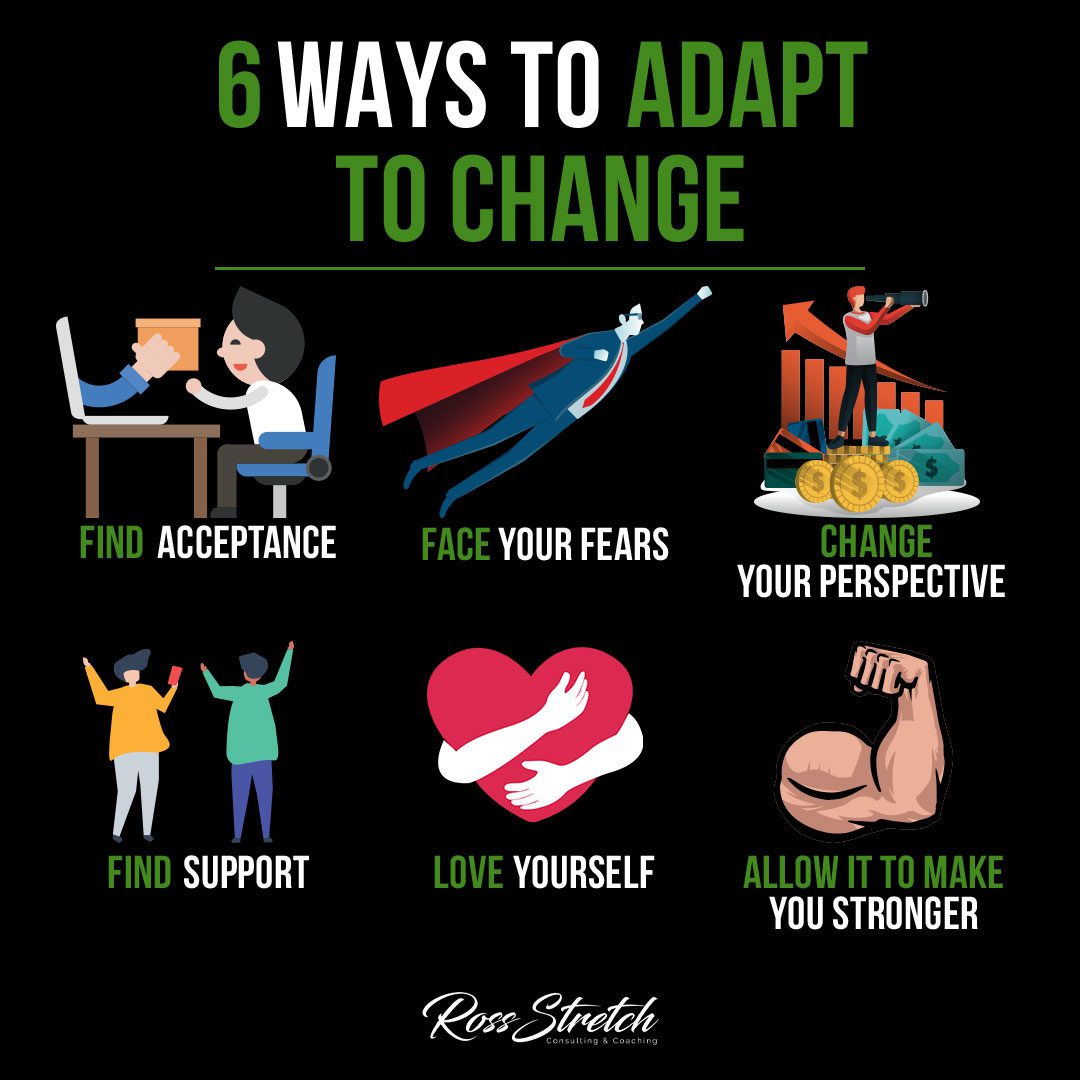
Adapting to change is one of the most critical skills you can develop — in business, in relationships, and in life. Yet most people resist change instinctively, treating it as a threat rather than an opportunity. Research in behavioral psychology consistently shows that individuals who embrace change rather than fight it recover faster, perform better under pressure, and report higher levels of long-term satisfaction. The six strategies below are grounded in both science and practical experience. They won’t make change painless, but they will make you significantly more capable of handling it without losing your footing or your momentum.
1. Find Acceptance
Stop Fighting What Has Already Happened
Acceptance is not resignation — it’s the realistic acknowledgment that something has changed and that your energy is better spent adapting than resisting. When you fight against change that has already occurred, you burn cognitive and emotional resources that could otherwise fuel your response. Acceptance clears the path for forward movement. It’s the difference between being stuck in the mud and choosing which direction to walk.
- Actionable Tip: Write down precisely what has changed and clearly identify what is now outside your control. This simple act externalizes the situation and shifts your attention toward what you can actually influence.
- Why It Works: Research on psychological flexibility consistently shows that acceptance — not suppression or avoidance — is the foundation of effective coping. It reduces emotional reactivity and opens the door to the creative problem-solving that adaptation requires.
Pro Tip: Name Your Emotions Without Judging Them
Rather than telling yourself you shouldn’t feel anxious or frustrated about a change, name what you’re feeling precisely. Studies show that labeling emotions with specificity reduces their intensity and gives you greater capacity to act rationally in the midst of them. Acceptance doesn’t mean liking the change — it means refusing to let your resistance to it make the situation worse than it already is.
2. Face Your Fears
What You Avoid Has Power Over You
Fear is the most common barrier to embracing change, and it’s almost always disproportionate to the actual risk involved. The human brain is wired to perceive uncertainty as danger, which means your fear response will often fire even when the realistic downside is minimal. Facing your fears directly — rather than avoiding them — is the fastest way to reduce their influence on your decisions and your quality of life.
- Actionable Tip: Write out your specific fear in concrete terms: “I’m afraid that if I take this new role, I’ll fail and be fired within six months.” Then work through the realistic probability of that outcome and map out what you would actually do if it happened.
- Why It Works: Avoidance maintains fear; exposure reduces it. By engaging with the fear directly and rationally, you interrupt the anxiety loop that keeps you paralyzed and build confidence in your ability to handle adverse outcomes — which is exactly what change demands.
Pro Tip: Break the Change Into Micro-Steps
One of the most effective techniques for managing fear of change is to shrink the scale of the next required action. If a major career change feels overwhelming, the next step isn’t “change careers” — it’s “research three companies in the field I’m curious about.” Small, concrete actions accumulate into large transformations while keeping fear at a manageable level throughout the process.
3. Change Your Perspective
The Framing of an Event Determines How You Experience It
Two people can experience the same change and have radically different responses based entirely on how they interpret it. A job loss can be experienced as a catastrophe or as an unexpected opportunity to build something better — and the difference is not the event itself, but the story you tell yourself about what it means. Learning to deliberately shift that narrative is a learnable, practiceable skill with measurable impact on outcomes.
- Actionable Tip: Ask yourself: “What would someone who was genuinely excited about this change notice or focus on?” Use that thought experiment to generate a list of potential positives — even if they feel forced at first. The brain follows the direction you give it.
- Why It Works: Cognitive reframing is one of the most empirically validated techniques in cognitive-behavioral therapy. It doesn’t require pretending a situation is better than it is — it requires being honest about the full range of possibilities, including the ones your threat-focused brain is systematically overlooking.
Pro Tip: Audit Your Own History of Change
Think back to the last three major changes you experienced that felt threatening at the time. How many of them led to outcomes that were ultimately neutral or positive? Most people, when they audit their own history honestly, discover that the majority of changes they feared turned out to be pivotal improvements to their lives. Your past is evidence that you’re more capable of navigating change than your current anxiety suggests.
4. Find Support
You Were Not Designed to Navigate Uncertainty Alone
One of the most consistent findings in psychology is that social support is a powerful buffer against the negative effects of stress and uncertainty. Having people around you who understand what you’re going through — who can offer perspective, accountability, and genuine encouragement — makes navigating change significantly more manageable. Connection itself reduces cortisol and sharpens thinking, both of which you need during a transition.
- Actionable Tip: Identify two or three people you trust — a mentor, a close friend, or a coach — and proactively share what you’re going through. Be specific about the kind of support you need: a sounding board, accountability, or practical advice. People want to help but often don’t know how unless you tell them.
- Why It Works: Social support activates the brain’s reward system and measurably reduces cortisol levels. People with strong support networks make better decisions during periods of transition because their nervous systems are less overwhelmed, freeing cognitive resources for clear and strategic thinking.
Pro Tip: Find Someone Who Has Already Been Through It
Generic encouragement is nice, but specific experience is invaluable. If you’re navigating a career transition, find someone who has made a similar move. If you’re restructuring a business, seek out an entrepreneur who has gone through that process and come out the other side. Their hard-won perspective will compress your learning curve and remind you that people do get through what you’re currently facing.
5. Love Yourself Through the Process
Self-Compassion Is a Performance Strategy, Not Just a Wellness Concept
Self-criticism during periods of change is counterproductive. When you respond to uncertainty and difficulty with harsh internal judgment — “I should be handling this better,” “I can’t believe I made that mistake” — you create additional psychological stress on top of the external pressure you’re already managing. Self-compassion, by contrast, stabilizes your emotional state and preserves your capacity to function effectively when it matters most.
- Actionable Tip: When you notice self-critical thoughts arising, apply a three-step practice: acknowledge that you’re struggling (mindfulness), remind yourself that struggle during transitions is a universal human experience (common humanity), and speak to yourself with the same kindness you’d offer a close friend facing the same situation (self-kindness).
- Why It Works: Researcher Kristin Neff’s work demonstrates that self-compassion — not self-esteem — is the most reliable predictor of psychological resilience. Self-compassionate people bounce back faster, take more responsibility for mistakes, and perform better under pressure than those who rely on self-criticism as a motivation strategy.
Pro Tip: Protect Your Physical Foundations During Transitions
Change is demanding, and the instinct is often to sacrifice sleep, exercise, and downtime to manage it. This is the opposite of what your nervous system needs. Protect the basics — consistent sleep, regular movement, and adequate nutrition — as non-negotiables during periods of disruption. Your capacity to adapt is directly dependent on the physical and mental resources you bring to each day.
6. Allow Change to Make You Stronger
Adversity Is the Raw Material of Resilience
Resilience is not a fixed trait you either have or don’t — it’s a capacity that grows through exposure to difficulty. Every significant change you navigate successfully increases your confidence in your ability to handle the next one. Psychologists refer to this as post-traumatic growth: the documented phenomenon in which people emerge from difficult experiences with greater psychological strength, deeper relationships, and a more purposeful sense of direction.
- Actionable Tip: After navigating a significant change, take time to document what you specifically learned: about yourself, about others, and about the situation. Create a personal record of your resilience that you can reference when future challenges arise, so you’re meeting them with evidence rather than doubt.
- Why It Works: Deliberate reflection activates explicit memory systems that make the lessons from an experience more accessible in future situations. It also gradually shifts your identity — you begin to think of yourself as someone who handles change well, which becomes a self-reinforcing pattern.
Pro Tip: Seek Voluntary Challenges Between Major Transitions
The best way to build resilience before you need it is to deliberately seek out smaller challenges in low-stakes environments. Take on a project outside your comfort zone, learn a skill that doesn’t come easily, or voluntarily enter situations where you might fail without serious consequences. These voluntary exposures train your nervous system to remain regulated under pressure and give you a continuously expanding body of evidence that you can handle uncertainty.
Conclusion
Change is not the exception in life — it is the constant. The people who thrive are not those who experience less of it, but those who have developed reliable strategies for processing and responding to it effectively. By practicing acceptance, facing your fears directly, reframing your perspective, seeking meaningful support, treating yourself with compassion, and viewing each transition as evidence of your growing resilience, you build a relationship with change defined by competence rather than anxiety. Start applying these strategies now — before the next major transition arrives.
Resources

 Ross Stretch