The differences between an average mindset and an entrepreneurial mindset are not about IQ, privilege, or luck. They are about how you frame problems, generate income, and think about risk and opportunity. Most people are never taught to think like an entrepreneur — they’re taught to fit into systems that already exist. Understanding the core distinctions between these two mindsets is the first step toward choosing which one you want to operate from, and toward developing the financial independence and creative agency that entrepreneurial thinking makes possible.
Searching for Jobs vs. Creating Opportunities
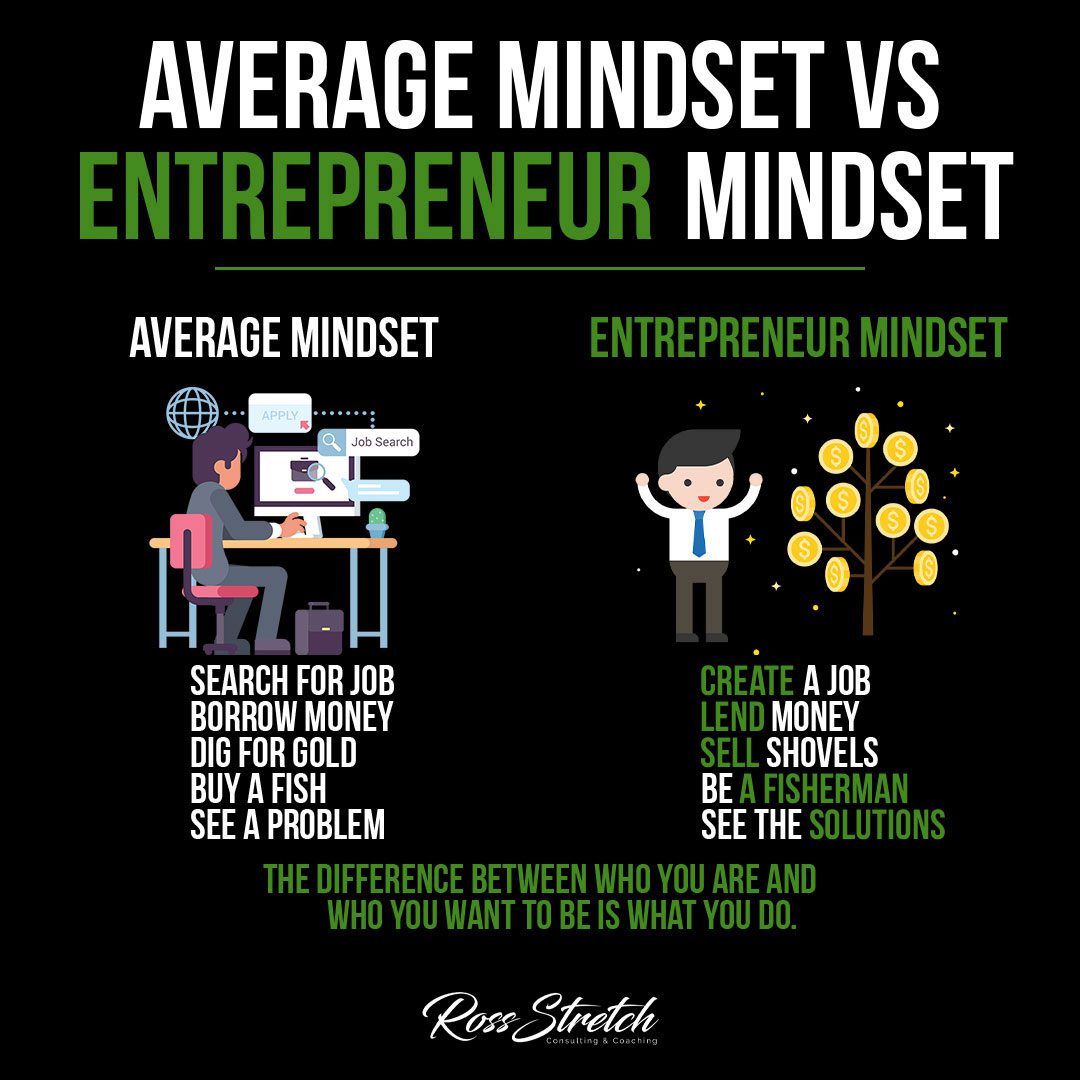
The average mindset revolves around finding a stable position within an existing structure. This is entirely understandable — it’s what education systems, family expectations, and decades of social norms reinforce. Job security, steady income, and clear hierarchy feel safe and predictable. And for many people, a traditional career is genuinely fulfilling. The limitation arises when the average mindset confuses employment security with financial security — treating a job as both an income source and a wealth-building strategy, when it is really only the former.
The entrepreneurial mindset asks a fundamentally different question: not “where is the job?” but “where is the unmet need, and how can I solve it better than anyone else?” Entrepreneurs create value by identifying gaps and building systems to fill them. This mindset doesn’t require starting a company from scratch — it can be applied within an organization through intrapreneurship, in freelancing, in investing, or in any context where initiative and creative problem-solving are rewarded. The shift from job-seeker to opportunity-creator is, at its core, a change in how you see your role in the economic ecosystem.
Borrowing Money vs. Deploying Capital
In the average mindset, borrowing is primarily a tool for consumption — credit cards for lifestyle expenses, car loans for depreciating assets, mortgages approached without considering return on investment. There is nothing inherently wrong with any of these instruments, but the average mindset rarely distinguishes between debt that builds wealth and debt that erodes it. The result is a financial life organized around servicing obligations incurred for things already consumed, with little capital available for genuine wealth-building.
The entrepreneurial mindset views capital — both earned and borrowed — as a resource to be deployed strategically for returns. Entrepreneurs think in terms of return on invested capital: will this dollar generate more than a dollar in the future? They are willing to take on strategic debt that funds appreciating assets or revenue-generating ventures. But they are equally disciplined about avoiding consumer debt that simply front-loads consumption at the cost of future wealth. The question an entrepreneur asks is never “can I afford the monthly payment?” — it is “does this create more value than it costs?”
Digging for Gold vs. Selling Shovels
The average mindset is often driven by the hope of a windfall — a lucky investment, a market run-up, a single breakthrough that changes everything. This is the “digging for gold” mentality: high effort, high hope, and fundamentally passive dependence on external circumstances delivering the desired outcome. Speculative investments, lottery tickets, and get-rich-quick schemes are the natural expressions of this mindset. The vast majority of gold-diggers in any market find nothing — or worse, lose the capital they brought to the search.
The entrepreneurial insight — selling shovels — is one of the most enduring wealth-building principles in business history. During the California Gold Rush of 1849, the people who consistently made money were not the prospectors but the merchants selling them tools, food, clothing, and supplies. Levi Strauss built a global company selling denim pants to miners. The same pattern repeats in every modern rush: when everyone chases Bitcoin, the entrepreneur builds the exchange platform. When everyone wants to be an influencer, the entrepreneur sells the tools they need to produce and distribute content. Identify who is running toward an opportunity, determine what they need to get there, and build the business that provides it.
Buying the Fish vs. Mastering the Craft
The average mindset tends to seek ready-made solutions — pre-packaged answers that require minimal skill development on the part of the buyer. In a world where consumption has been made incredibly frictionless, this tendency is understandable. But it comes at a compounding cost: when you rely on buying solutions rather than developing capabilities, you remain permanently dependent on those solutions and never build the leverage that comes from genuine mastery of a skill.
Entrepreneurs think differently. They invest in learning the craft — developing skills that can be applied repeatedly across contexts and scaled through systems and teams. A person who masters sales, financial analysis, software development, or marketing doesn’t just solve today’s problem; they create a compounding capability that increases in value across an entire career. The entrepreneurial question is not “who can I hire to handle this?” before you understand the domain — it is “what skill, if I mastered it, would dramatically expand my income and options?” Then it commits to developing that skill relentlessly, even when the payoff isn’t immediate.
Seeing Problems vs. Creating Solutions
The average mindset experiences problems primarily as obstacles — things that block progress, cause frustration, and need to be escaped or endured. This is a natural human response. But it leaves significant value on the table every time. Every meaningful problem is simultaneously a market opportunity, waiting for someone with the entrepreneurial perspective to recognize it and build a solution that others will pay for. Airbnb saw the problem of expensive, impersonal hotel stays and solved it. Uber saw unreliable, opaque taxi services and replaced them. Every transformative company started with someone who looked at a widespread frustration and thought: “I can fix this — and people will pay me to do it.”
Developing this solution-oriented perspective is a practiced skill, not an innate personality trait. Start by auditing the frustrations in your daily life and cataloguing the complaints you consistently hear from others. Ask: why does this problem still exist? What would need to be true for it to be solved elegantly? Is there a product, service, or system that would address it — and would people pay enough for that solution to build a sustainable business? Not every frustration is a viable business opportunity, but the habit of asking these questions builds the pattern-recognition skills that eventually surface genuinely valuable ideas.
Conclusion
The average mindset and the entrepreneurial mindset are not fixed identities — they are operating systems that can be deliberately updated. The distinctions explored here are not meant to glorify entrepreneurship as the only worthy path; a traditional career pursued with entrepreneurial thinking — proactively creating value, investing in skills, solving problems before being asked, thinking in terms of return on effort — can be deeply fulfilling and financially rewarding. What matters is the underlying orientation: passive or proactive, consumer or creator, problem-focused or solution-focused.
Begin where you are. Choose one dimension from this article — the shovel principle, the skill-mastery approach, the problem-to-opportunity reframe — and apply it deliberately for the next 30 days. You do not need to overhaul your entire life to start thinking like an entrepreneur. You need to make one different decision, consistently, until it becomes a new default. That is how mindsets change — and how financial trajectories follow.
Resources
- Harvard Business Review — What Makes an Entrepreneur
- Forbes — The Entrepreneurial Mindset: How to Think Like an Entrepreneur
- Inc. — How Entrepreneurs Think Differently, According to Science
- Investopedia — What Is an Entrepreneur? Characteristics and How to Get Started

 Ross Stretch