Workplace stress has become one of the defining challenges of modern professional life. Whether you are managing a team, building a business, or navigating a demanding corporate environment, chronic stress erodes your performance, your health, and your quality of life over time. The good news is that stress management is a learnable skill — not a personality trait you either have or don’t. With the right strategies in place, you can build a calmer, more productive relationship with your work without sacrificing ambition or results.
Why Workplace Stress Is So Persistent
Stress at work is not simply a matter of having too much to do. Research from the American Institute of Stress consistently identifies the primary drivers as lack of control, unclear expectations, interpersonal conflict, and poor work-life balance. These are structural and relational issues, not just workload problems — and that is why simply working harder or faster rarely makes them better. The source of the stress is not your effort; it is the environment and the habits you bring to it.
The body’s stress response was designed for short-term threats. When it is activated repeatedly over months or years — as it often is in demanding work environments — it leads to burnout, weakened immune function, impaired decision-making, and a range of other serious consequences. Managing stress is not a luxury; it is a professional requirement for anyone who wants to perform at a high level consistently over the long term.
Start Your Day with Intention
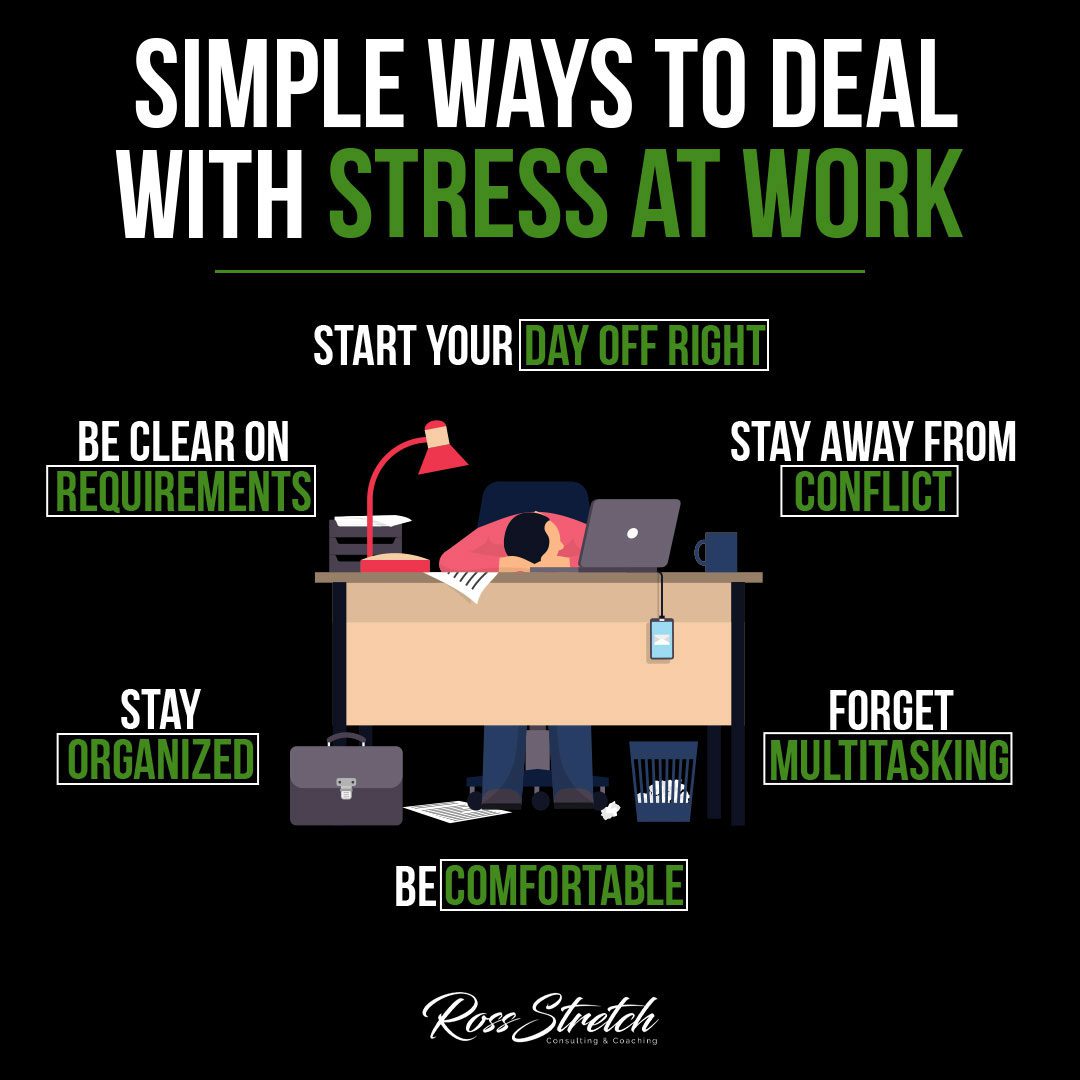
How you begin your morning shapes the entire arc of your day. Jumping straight from bed to email to meetings without any deliberate transition time puts you in reactive mode before your first coffee is finished. Reactive mode is stress mode — your attention is pulled by whatever is loudest rather than directed toward what is most important.
A consistent morning routine — even a brief one — can act as a buffer between the rest of the world and your best thinking. This does not have to be elaborate. Ten minutes of quiet, a short walk, or a few minutes of journaling can be enough to arrive at your desk feeling oriented rather than overwhelmed. The point is to choose how your day begins rather than letting it happen to you by default.
Physical movement in the morning is particularly effective. Exercise reduces cortisol, increases dopamine and serotonin, and has been shown in multiple studies to reduce anxiety and improve emotional regulation throughout the day. Even a 15-minute walk before work can shift your baseline stress level meaningfully — and that shift compounds over weeks and months of consistency.
Eliminate Ambiguity Through Clear Communication
One of the most underappreciated sources of workplace stress is ambiguity — not knowing exactly what is expected, what success looks like, or how your work fits into the larger picture. When expectations are unclear, people fill the gaps with anxiety. They overwork to compensate for uncertainty, or they freeze up entirely, unsure how to prioritize when everything feels equally urgent.
The remedy is direct communication. If your role, deliverables, or priorities are not crystal clear, ask for clarification. This is not a sign of weakness — it is a sign of professionalism. A five-minute conversation to align on expectations can save hours of misguided effort and the stress that comes with it. Document agreements in writing so that both parties have a shared reference point they can return to.
If you manage a team, making expectations explicit is one of the highest-leverage things you can do for group performance and morale. Clearly documented goals, regular check-ins, and open feedback loops eliminate the guesswork that generates so much unnecessary anxiety — and they signal to your team that you respect their time and effort.
Organize Your Environment and Your Schedule
A disorganized environment creates cognitive friction. When your desk is cluttered, your inbox is unmanaged, and your task list has no order, your brain is constantly trying to track everything at once — which is exhausting and leaves little capacity for actual deep work. Creating physical and digital order reduces that mental load and makes it significantly easier to focus on the work that actually moves things forward.
Use a trusted task management system — whether that is a simple notepad, a tool like Todoist or Notion, or a structured daily planner — to capture and prioritize your work. The goal is to get your responsibilities out of your head and into a reliable external system so that your attention can be fully present on what you are doing right now. A clear task list also makes it easier to push back on new requests in a grounded way, since you can show clearly what is already committed.
Time blocking — scheduling specific windows for specific types of work — is another powerful strategy for reducing the overwhelm that fuels stress. When every hour has a defined purpose, you feel less reactive and more in control of your day. Block time for deep focus work, administrative tasks, meetings, and genuine recovery. Protect those blocks the same way you would protect any important external commitment.
Protect Your Focus: Single-Tasking and Boundaries
Multitasking is a myth. Cognitive science research consistently shows that the human brain does not truly perform two cognitive tasks simultaneously — it switches rapidly between them, and each switch comes with a measurable cost in time, attention, and accuracy. Attempting to manage multiple demanding tasks at once increases stress and degrades the quality of everything involved.
Choosing one task and giving it your complete attention for a defined period — even 25 to 50 minutes — produces better results with less mental fatigue. The core principle is protecting that focus time from interruption, which means setting deliberate boundaries around your availability. Letting colleagues know you are in a deep work block and will respond to messages at a set time, turning off notifications during focus periods, and declining meetings that do not genuinely require your presence are all legitimate and professional strategies.
Setting boundaries at work is not selfish — it is professional. The people who are most effective over the long term are rarely the ones who respond to everything instantly. They are the ones who protect the conditions that allow their best thinking to happen and deliver high-quality results as a result.
Build a Workspace That Supports You
Physical discomfort is a slow but steady drain on your capacity to handle stress. A poorly designed setup — a chair that hurts your back, a screen at the wrong height, a noisy environment with no private space for focused work — adds unnecessary friction to every hour you spend working. These are solvable problems, and addressing them is worth the investment in time and money.
Beyond ergonomics, personalizing your workspace — adding plants, meaningful objects, or simply maintaining order — can reduce ambient stress and create a sense of ownership over your environment. Natural light has documented benefits for mood and alertness. If you work remotely, creating a defined workspace that you associate specifically with work helps your brain understand when it is time to focus and when it is time to genuinely rest — a distinction that many remote workers struggle to maintain.
Conclusion
Becoming more zen at work is not about eliminating pressure — it is about changing your relationship to it. By starting your day with intention, communicating clearly, staying organized, protecting your focus, and building a supportive environment, you create conditions that make high performance sustainable over years rather than just sprints. Stress will never disappear entirely, but with the right practices in place, it stops running the show.
Resources

 Ross Stretch