Speed and output are not just about talent or effort — they are the result of deliberate systems and environmental design. High performers do not simply work harder; they engineer their conditions for peak performance. Small changes to how you structure your time, organize your space, and manage your attention can produce dramatic gains in how much you accomplish in a given day. These productivity strategies are backed by behavioral science and practical experience, and every one of them can be implemented today without spending money or overhauling your entire schedule.
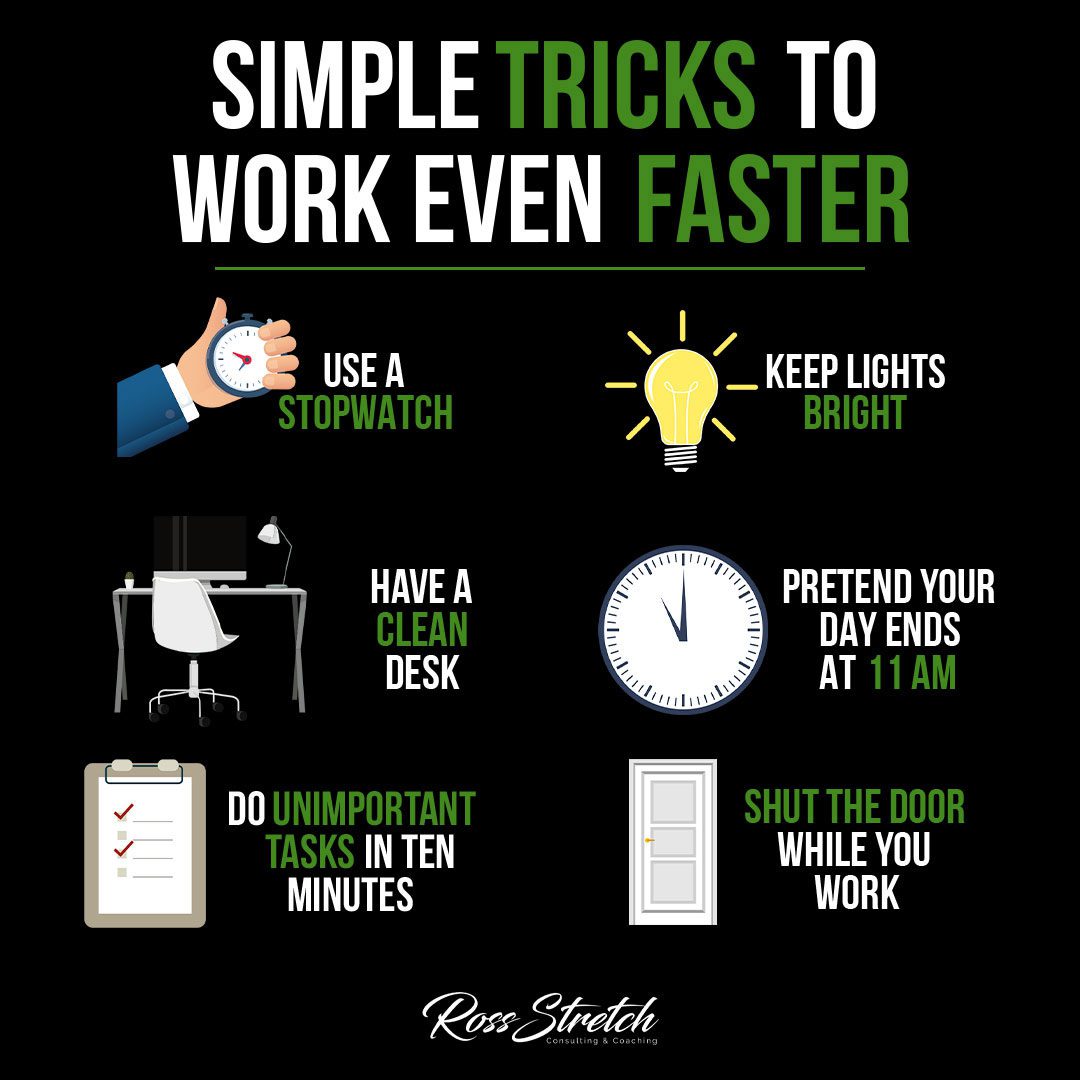
Use a Timer to Track Time and Build Focused Work Sessions
Time is the one resource you cannot replenish, yet most people have almost no accurate sense of where it goes. Using a stopwatch or countdown timer to measure how long specific tasks take is one of the most revealing productivity experiments you can run. Many people are shocked to discover that tasks they believed took 30 minutes consistently take over an hour — and tasks they dreaded often take far less time than anticipated.
The act of starting a timer creates a subtle psychological shift. When time is being measured, your brain treats the task as bounded and concrete rather than open-ended, which reduces procrastination and sustains focus. Techniques like the Pomodoro Method — 25 minutes of focused work followed by a 5-minute break — formalize this principle. Whether you follow a strict protocol or simply keep a running stopwatch, the habit of measuring your time transforms vague intentions into accountable action and reveals exactly where your hours are actually going.
Optimize Your Lighting for Alertness and Energy
Lighting is one of the most overlooked variables in workspace design. Research published in Applied Ergonomics and related fields has shown that exposure to bright, cool-spectrum light — particularly light that mimics daylight — significantly increases alertness, cognitive performance, and mood compared to dim or warm lighting. This is because light regulates your circadian rhythm and directly influences cortisol levels, which govern your energy cycle throughout the day.
If your workspace relies on dim overhead bulbs or warm-toned lamps, you are likely working at a fraction of your alertness potential. Upgrading to full-spectrum LED lighting or positioning your desk to receive natural daylight is a low-cost, high-return investment. During afternoon slumps, increasing light exposure can be more effective than a second cup of coffee — without the crash that follows. Bright light tells your brain it is time to be awake and engaged, and your work output will reflect that signal.
Keep a Clean and Organized Workspace
Physical clutter creates cognitive clutter. A Princeton University Neuroscience Institute study found that visual chaos in your environment competes for your attention and impairs focus, making even simple tasks feel harder than they are. The inverse is also true — a clean, organized desk reduces the mental load of your environment and frees up cognitive resources for the work itself rather than the chaos surrounding it.
The practical solution is not a perfectly minimalist aesthetic — it is having a clear system. At the end of each workday, spend five minutes returning your desk to a defined baseline: clear surfaces, files in their place, supplies organized. This creates a clean slate for the next morning and eliminates the low-grade anxiety of starting the day surrounded by yesterday’s unfinished chaos. The return on those five minutes, compounded over a year of workdays, is substantial.
Set Artificial Deadlines to Create Urgency
Parkinson’s Law states that work expands to fill the time available for its completion. When you have three hours for a task that actually requires 90 minutes, you will use all three hours. Artificial deadlines directly counteract this dynamic by compressing the available time and triggering the motivating pressure that most people only feel when a real deadline looms.
The key is to make artificial deadlines specific and tied to a consequence. Saying you will finish a report by 2pm is more effective than saying you will finish it today. Pair the deadline with a reward — leave for lunch only after the task is complete, or schedule something you enjoy immediately after the work session. This reward structure reinforces the habit of working with urgency and makes self-imposed deadlines feel more real over time. High performers consistently finish work faster than their peers not because they are more talented, but because they impose structure on open-ended tasks.
Handle Small Tasks in Ten Minutes or Less
Low-priority tasks — short emails, minor administrative items, quick decisions — are productivity killers when they accumulate. They do not require significant mental energy individually, but they take up space in your attention and create a persistent background sense of unfinished business. A practical rule drawn from David Allen’s Getting Things Done methodology: if a task can be completed in roughly 10 minutes or less, do it immediately rather than scheduling it for later, provided you are not in the middle of deep focused work.
The key is to batch these small tasks rather than letting them interrupt your most productive hours. Designate a 20-minute window in the morning and afternoon specifically for clearing minor items. This contains the disruption while still keeping the inbox clear. By removing small tasks quickly and systematically, you prevent them from cluttering your to-do list and stealing time from the deep, high-value work that actually moves your goals forward.
Eliminate Distractions by Engineering Your Environment
Willpower is a limited resource, and relying on it alone to resist distractions is a losing strategy. The most effective approach is to remove distractions from your environment entirely, so they require effort to access rather than effort to resist. Close unnecessary browser tabs. Put your phone in another room or use a focus app that blocks social media during work sessions. Close your door — literally or metaphorically — when you need uninterrupted concentration.
Research from the University of California Irvine found that it takes an average of 23 minutes to fully regain concentration after an interruption. With that data in mind, even a single distraction in a two-hour work block can effectively eliminate nearly a quarter of your focused output. Protecting your attention is not about being antisocial or unreachable — it is about respecting the value of deep work and ensuring that your best cognitive hours are spent on your most important tasks rather than on reactive, low-value interruptions.
Start Implementing One Change Today
The gap between knowing productivity strategies and actually using them is where most people get stuck. The best approach is to pick one change from this list — not all six — and implement it consistently for two weeks before adding another. Building one strong habit is worth more than vaguely attempting six at once. Start with whatever feels most relevant to your current challenge, build the routine until it requires no decision-making, and then layer in the next. Over time, these habits compound into a fundamentally different relationship with your work — one where output is consistent, focus is deep, and the end of the workday actually means something.
Resources

 Ross Stretch