It sounds almost too simple to matter — pack your own lunch instead of buying it. But when you run the actual numbers, the financial difference between buying and making your lunch is anything but trivial. The principle of compound growth means that small, consistent choices made today can result in dramatically different financial outcomes decades from now. Daily spending habits are among the most powerful — and most overlooked — determinants of long-term wealth. This is the math behind one of the most actionable personal finance decisions you can make starting this week.
The Real Numbers Behind the Lunch Decision
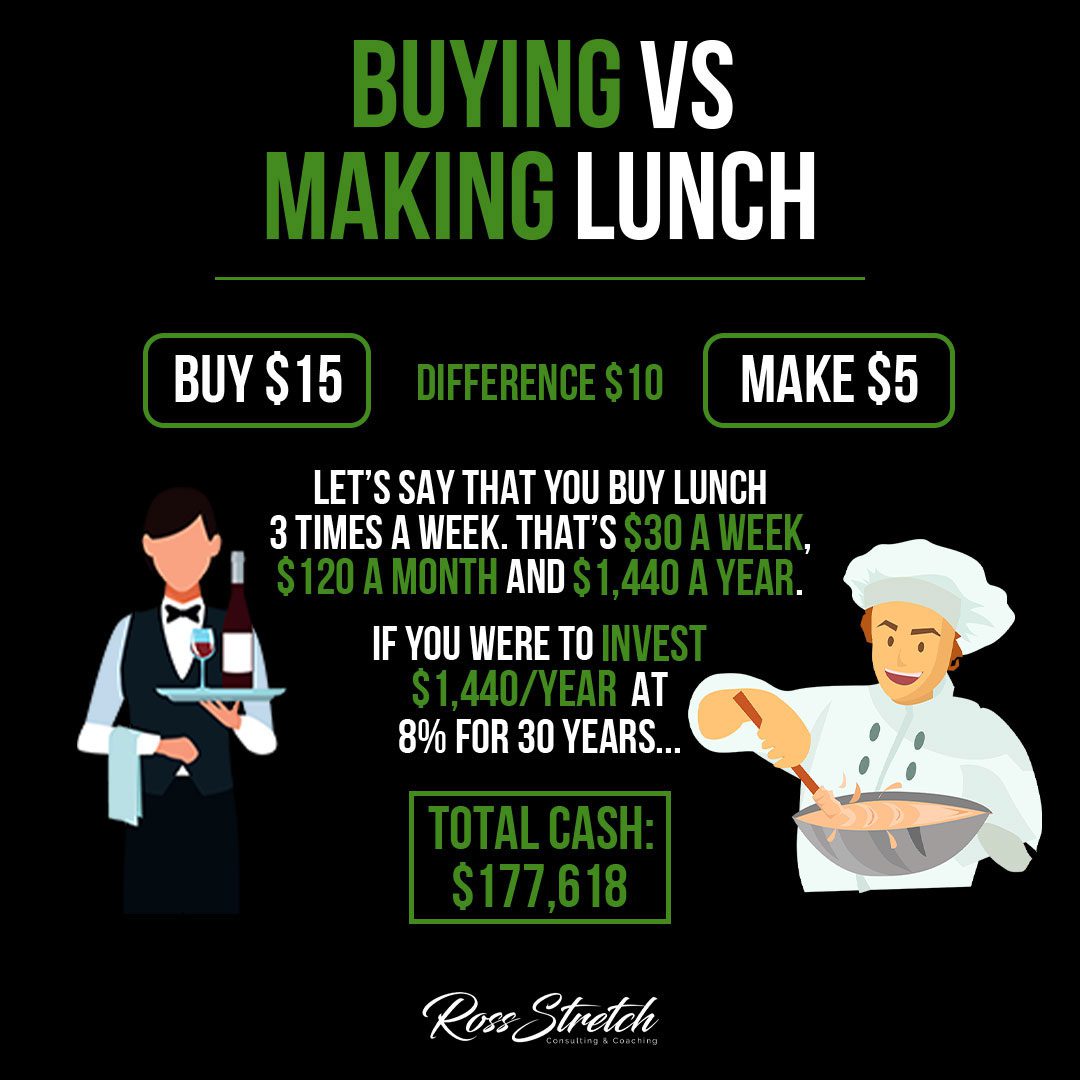
Let us look at a realistic scenario. Buying lunch at a restaurant, deli, or food court typically runs between $12 and $18 depending on your city and choices. A reasonable average is $15. Making lunch at home — a sandwich, leftovers from dinner, or a simple salad — costs roughly $3 to $5 in ingredients. Call it $5 on the high end.
That is a $10 daily difference. Three days a week, that adds up to $30 in weekly savings. Multiply that across a full calendar year and you are looking at $1,560 in annual savings — just from packing your own lunch three times a week instead of buying it. That figure alone should get your attention, but the more interesting number comes when you factor in time and investment growth.
For many people, this feels abstract. It is only $10. But behavioral finance research consistently shows that small recurring expenses are the most underestimated drain on household wealth. The $10 does not feel significant in the moment. Over years and decades, compounded, the story changes entirely.
What Happens When You Invest the Difference
Here is where the math gets genuinely compelling. Instead of spending $1,560 on bought lunches each year, imagine redirecting that money into a diversified index fund generating an average annual return of 8 percent. That is not an extraordinary return — it is roughly what the broad stock market has historically delivered over long time periods before inflation adjustments.
After 10 years of investing $1,560 annually at 8 percent, you would have approximately $24,500. After 20 years, roughly $77,000. After 30 years — the time horizon from your late twenties to your late fifties — your accumulated total would approach $177,000. That is the power of compound interest applied to a simple behavioral change.
You are not inheriting money, winning a lottery, or making risky bets. You are redirecting spending on a daily habit into an investment that grows steadily for decades. The $10 you save on Tuesday’s lunch is still working for you thirty years later, growing silently alongside everything else you have invested. That is the mechanism that makes small habits matter at scale.
The Broader Principle: Small Habits, Large Outcomes
The lunch example is illustrative of a much broader personal finance principle. Lifestyle inflation and small habitual expenses are where most people’s wealth quietly disappears. It is rarely one catastrophic financial decision that derails wealth building — it is the accumulation of a hundred small choices made without intention or awareness.
This is why personal finance experts consistently emphasize tracking everyday spending before trying to optimize it. When you see, in black and white, that you spend $200 per month on lunches, $150 on coffee, and another $300 on convenience meals, the picture changes. Each individual expense seems reasonable in isolation. Taken together, they represent over $7,800 per year — money that could be funding retirement accounts, paying down high-interest debt, or building an investment portfolio.
The goal is not to live an ascetic, joyless financial life where every pleasure is rationed. It is to be intentional about where your money goes rather than spending on autopilot. Some bought lunches are worth it — a business meeting, a celebration, or a deliberate break from routine. The key is choosing consciously rather than defaulting to convenience every time.
Practical Steps to Make the Shift Sustainable
Changing a habitual spending pattern requires more than awareness — it requires systems that remove the friction from the better choice. Here are the steps that make meal prep sustainable over the long term:
- Plan meals weekly before grocery shopping. Deciding in advance what you will eat eliminates the “nothing to pack” problem that sends people to the nearest restaurant by default.
- Cook in batches on the weekend. Preparing larger quantities means you have ready-to-pack lunches for multiple weekdays with no additional effort during the busy work week.
- Invest in quality food containers. Leaky, inconvenient containers are one of the most common reasons people abandon meal prep. Good gear removes friction from a habit you want to keep.
- Calculate your personal savings number. Run the math based on your specific buying versus making costs and use that figure as weekly motivation when the habit feels tedious.
- Automate the investment transfer. Set up an automatic monthly transfer to move your lunch savings directly into an investment account before you can spend it elsewhere.
The automation step is critical. Willpower is unreliable over weeks and months. Automation turns a good intention into a reliable system that works even on the days you do not feel like it — and those are exactly the days that determine your long-term financial trajectory.
How This Fits Into a Broader Financial Strategy
The lunch example is a starting point, not a complete financial plan. But the mindset it represents — every dollar spent today is a dollar that could have been compounding for decades — is foundational to building long-term wealth at any income level. Apply this same thinking to other recurring expenses: subscriptions you rarely use, daily coffee runs, convenience food deliveries, and unused gym memberships.
Audit your monthly spending once, identify the habits that do not bring proportionate value to your daily life, and redirect that money toward assets that grow. Personal finance is not primarily about income — it is about the gap between what you earn and what you spend. Widening that gap, even by $30 per week, is one of the most direct and accessible actions available to anyone building toward financial independence.
Conclusion
The decision to pack your own lunch three times a week instead of buying is a $1,560 annual savings with a thirty-year compounded value of approximately $177,000. That number is accurate, achievable, and accessible to anyone regardless of income level. The math is not magic — it is consistency applied over time. Start with one packed lunch per week if that is where you are today. Track the savings. Invest the difference automatically. Small behavioral shifts, compounded over decades, build the financial future that feels impossibly out of reach right now.
Resources


 Ross Stretch