Financial freedom — the point at which your assets generate enough income to cover your living expenses without trading time for money — is one of the most achievable yet consistently underestimated goals in personal finance. It doesn’t require a six-figure salary or a lucky break. It requires a clear strategy, consistent execution, and a willingness to confront some uncomfortable financial realities head-on. These nine steps, taken in sequence, form a proven roadmap from financial stress to financial independence.
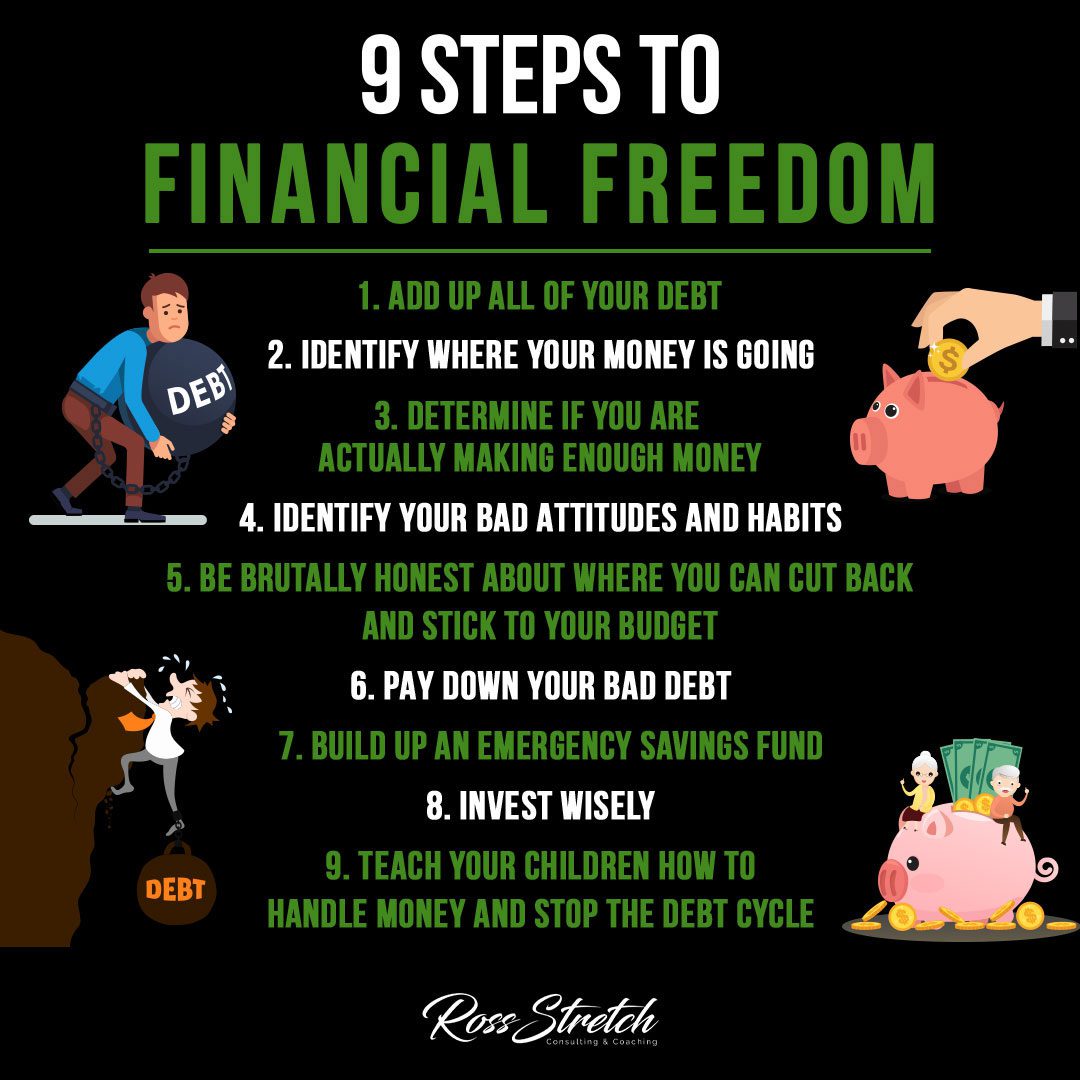
Step 1: Face Your Financial Reality
List Every Dollar You Owe
You cannot solve a problem you won’t look at. The first step is sitting down with every account statement, every loan balance, and every credit card bill to create a complete, honest picture of your debt. This exercise is uncomfortable — but it’s the most important one in the process. Most people carry a vague, inflated sense of what they owe rather than a precise one, which actually makes anxiety worse and action harder.
- Actionable Tip: Open a spreadsheet and list every debt: lender, current balance, interest rate, and minimum payment. Sort by interest rate from highest to lowest.
- Why It Works: A clear, complete picture removes the psychological weight of the unknown and gives you something concrete to work with rather than a shapeless dread.
Pro Tip:
Pull your full credit report for free at AnnualCreditReport.com to make sure you haven’t missed any accounts. Review all three bureaus — Equifax, Experian, and TransUnion — since each may report different information.
Step 2: Track Every Dollar You Spend
See Where Your Money Is Actually Going
Most people are surprised when they actually track their spending. The daily coffee, the unused subscriptions, the takeout meals that replaced grocery runs — these small leaks are often the difference between building savings and living paycheck to paycheck. Tracking isn’t about judgment; it’s about visibility. You can’t redirect money you don’t know you’re losing.
- Actionable Tip: Use a free tool like Mint, YNAB (You Need A Budget), or a simple spreadsheet to categorize every purchase for one full month before making any changes.
- Why It Works: Tracking creates awareness, and awareness drives behavior change — often without requiring willpower, just information and honest accounting.
Pro Tip:
Review your bank and credit card statements rather than trying to log transactions manually in real time. A monthly 20-minute review session is often more sustainable and accurate than daily micro-tracking for most people.
Step 3: Evaluate and Grow Your Income
Close the Gap Between What You Earn and What You Need
Budgeting only gets you so far if the income side of the equation is too small. Once you understand your expenses, honestly assess whether your current income can realistically support your financial goals. If you’re cutting to the bone and still not making meaningful progress, the problem may not be your spending — it may be your income. This is the moment to explore raises, career moves, freelance work, or a side business.
- Actionable Tip: Research salary benchmarks for your role on Glassdoor or LinkedIn Salary. If you’re underpaid, build a case for a raise with documented results. Simultaneously, brainstorm one or two realistic income streams you could add.
- Why It Works: There’s a floor to how much you can cut expenses; there’s no ceiling on how much you can earn. Increasing income has asymmetric upside that budgeting alone can’t match.
Pro Tip:
Side income doesn’t need to replace your job to be transformative. An extra $500–$1,000 per month directed entirely at debt repayment or savings can cut years off your timeline to financial freedom.
Step 4: Shift Your Relationship With Money
Identify and Replace Limiting Financial Beliefs
Money is as much a psychology game as it is a math game. Many people carry beliefs about money — “I’m just not good with finances,” “rich people are greedy,” “wealth is for other people” — that actively undermine their financial behavior. These beliefs, often absorbed in childhood, cause self-sabotage: overspending to relieve stress, avoiding account statements out of shame, or unconsciously rejecting opportunities for growth.
- Actionable Tip: Write down three beliefs you hold about money and examine where each came from. Ask whether each is objectively true or simply a story you inherited from your environment.
- Why It Works: Behavioral change is sustainable when it’s rooted in identity. When you begin to see yourself as someone who is capable with money and deserving of financial stability, your choices begin to reflect that self-image.
Pro Tip:
Books like “The Psychology of Money” by Morgan Housel and “I Will Teach You to Be Rich” by Ramit Sethi are excellent starting points for rewiring financial thinking without the guilt-trip approach common in traditional personal finance advice.
Step 5: Build a Realistic Budget You’ll Actually Follow
Create a Spending Plan That Works With Your Real Life
A budget only works if you actually use it. Many people fail not because they lack discipline, but because they create unrealistic plans that leave no room for real life. A sustainable budget accounts for irregular expenses, allows some discretionary spending, and is built around your actual income and goals — not an idealized version of them. Perfection is the enemy of consistency in budgeting.
- Actionable Tip: Use the 50/30/20 rule as a starting framework: 50% of take-home pay to needs, 30% to wants, 20% to savings and debt repayment. Adjust the percentages based on your actual situation and goals.
- Why It Works: A framework prevents decision fatigue in the moment and gives you clear permission to spend in some areas while prioritizing others — eliminating the all-or-nothing thinking that kills most budgets.
Pro Tip:
Automate your savings and debt payments so they happen the moment your paycheck lands. What you don’t see, you don’t spend. This single automation habit eliminates more financial friction than almost any other change you can make.
Step 6: Eliminate Debt Strategically
Choose a Method and Attack With Focus
There are two proven debt repayment strategies, and both work — the key is choosing one and committing to it fully. The debt avalanche method prioritizes highest-interest debt first, minimizing the total interest you pay over time. The debt snowball method prioritizes the smallest balances first, generating psychological wins that build momentum. Mathematically, avalanche wins. Behaviorally, snowball often wins because the early victories keep you motivated.
- Actionable Tip: If you’re motivated by numbers and long-term optimization, use the avalanche method. If you’ve struggled with debt repayment before and need early wins to stay the course, use the snowball method.
- Why It Works: A strategy you follow through on is infinitely better than an optimal one you abandon. The best method is whichever one you’ll actually execute consistently over months and years.
Pro Tip:
Look into balance transfer offers for high-interest credit card debt. Moving balances to a 0% introductory APR card can save hundreds or thousands in interest — provided you commit to paying the balance before the promotional period ends.
Step 7: Build an Emergency Fund
Create the Buffer That Keeps You Out of Debt
An emergency fund is not a luxury — it’s the financial immune system that prevents a single unexpected event (a car repair, a medical bill, a job loss) from derailing your entire progress. Without one, every setback sends you back to debt. With one, setbacks are manageable inconveniences rather than financial crises. The standard target is three to six months of living expenses, kept liquid in a savings account separate from your day-to-day money.
- Actionable Tip: If you’re in heavy debt repayment mode, start with a $1,000 emergency fund as a first milestone. Once your high-interest debt is cleared, build it up to three to six months of expenses.
- Why It Works: Even a small buffer fundamentally changes your financial decision-making by removing the desperation that leads to costly short-term choices like payday loans or credit card cash advances.
Pro Tip:
Keep your emergency fund in a high-yield savings account (HYSA). Online banks like Marcus by Goldman Sachs, Ally, and Wealthfront typically offer significantly higher interest rates than traditional savings accounts. Your safety net should be earning interest while it waits.
Step 8: Invest for the Long Term
Put Your Money to Work Before You Need It
Once your emergency fund is established and high-interest debt is eliminated, investing becomes the most powerful wealth-building tool available to you. The S&P 500 has returned an average of approximately 10% annually over the long term before inflation. At that rate, invested money doubles roughly every seven years. The single biggest factor in investment outcomes isn’t stock selection — it’s time in the market. Starting early matters enormously.
- Actionable Tip: Start with your employer’s 401(k) if they offer a match — that match is an immediate 50–100% return on your contribution. Then open a Roth IRA and invest in low-cost index funds through Vanguard, Fidelity, or Schwab.
- Why It Works: Index funds capture broad market returns with minimal fees and dramatically outperform most actively managed funds over ten-plus-year periods, with no stock-picking expertise required.
Pro Tip:
Automate your investment contributions and commit to increasing them by 1% each year — or every time you get a raise. This “set it and forget it” approach eliminates the temptation to time the market and removes the emotional component from investing decisions.
Step 9: Build Financial Literacy as a Family Value
Break the Cycle by Teaching the Next Generation
Financial habits are learned, not inherited genetically. Children who grow up in households where money is discussed openly, where saving is modeled, and where basic financial concepts are introduced early develop the foundational literacy that serves them for life. If you grew up without this education, you learned the hard way — which is exactly the reason to make sure the next generation doesn’t have to.
- Actionable Tip: Give children a small allowance tied to household responsibilities and teach them to divide it into three categories: spend, save, and give. For teenagers, open a custodial investment account and walk them through buying their first index fund share.
- Why It Works: Early financial education creates habits and mental models that compound over a lifetime. A teenager who understands compound interest and starts investing at 18 has a multi-decade head start over someone who figures it out at 40.
Pro Tip:
The Next Gen Personal Finance curriculum at ngpf.org is free and makes financial education engaging for teenagers. Ron Lieber’s book “The Opposite of Spoiled” is an excellent guide for parents who want to raise financially literate kids without having all the answers themselves.
Conclusion: Financial Freedom Is a Decision, Made Daily
No single step on this list will transform your finances overnight — but all nine, executed consistently over time, absolutely will. Financial freedom isn’t a destination you reach once and maintain passively; it’s a set of behaviors you practice until they become your default. Start where you are, with what you have. Confront the numbers honestly, build the systems deliberately, and trust the process. The math is in your favor — it just requires you to begin.
Resources
- The Total Money Makeover by Dave Ramsey — Step-by-step debt elimination and wealth building framework
- I Will Teach You to Be Rich by Ramit Sethi — Modern personal finance built around automation and behavior
- AnnualCreditReport.com — Free credit reports from all three major bureaus
- Investopedia: What Is Financial Freedom? — Clear explanation with actionable benchmarks and definitions


 Ross Stretch