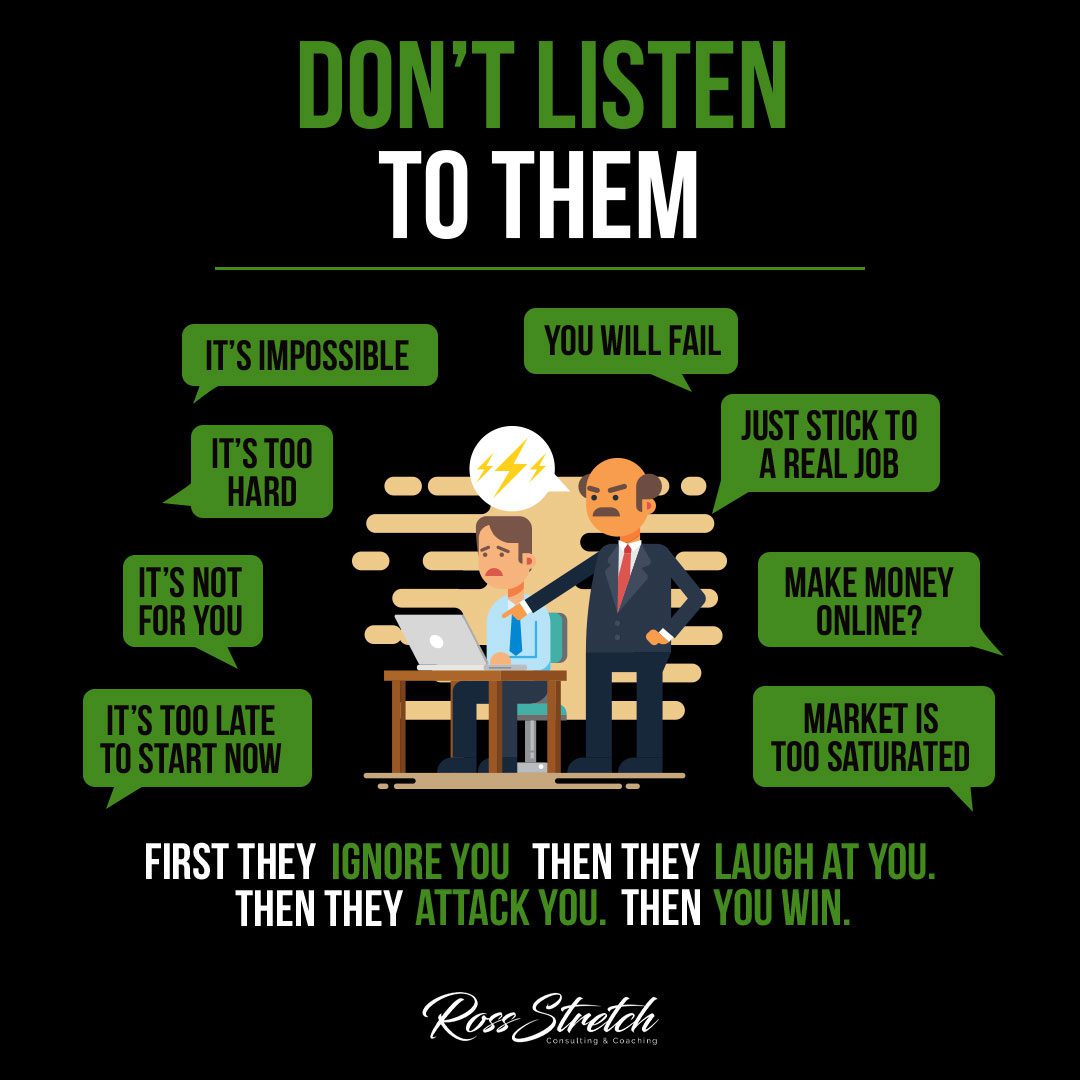
Every entrepreneur, creator, and ambitious professional has encountered the same invisible wall: the voices — both external and internal — saying it cannot be done. “The market is too crowded.” “You don’t have the right background.” “It’s too late to start now.” These are not just discouraging words. They are tests. And how you respond to them determines whether you become one of the rare individuals who actually builds something worth building.
History is filled with people who were told their ideas were impossible and answered with results. The question is not whether doubt will appear on your journey — it will, reliably and often — but whether you have developed the tools to move through it rather than be stopped by it. Those tools are learnable, and this guide walks you through the most important ones.
Understanding Where Doubt Comes From
Negativity rarely comes from nowhere. When someone tells you your idea will not work, that reaction typically stems from one of three sources: fear (their own unresolved anxiety about risk), misunderstanding (a lack of information about what you are actually building), or projection (they have abandoned a similar dream and struggle to watch someone else pursue theirs).
Recognizing the origin of criticism changes how you receive it. Not all skepticism is destructive — a trusted mentor highlighting a real gap in your model is genuinely valuable. But generalized doubt from people who have never done what you are attempting deserves the weight it has earned: very little.
The discipline is learning to tell the difference. Ask yourself: Does this person have relevant experience? Are they offering specific, actionable concerns or vague negativity? Do they have a stake in my success or failure? Those answers quickly separate signal from noise and allow you to direct your energy accordingly.
The Psychology of Resilience
Resilience is often mischaracterized as toughness — as though the goal is to feel nothing when things go wrong. In reality, resilience is about maintaining forward motion in the presence of setbacks, not in their absence. You are allowed to feel the difficulty of failure. What matters is that you do not let it become your final address.
Psychologist Martin Seligman and his colleagues at the University of Pennsylvania have studied resilience extensively and found that the most persistent performers share a key attribution pattern: they explain setbacks as specific, temporary, and situational rather than as global, permanent, and personal. In other words, they do not conclude “I am a failure.” They conclude “that specific approach did not work in that context, at that time.”
That reframe keeps the door open for the next attempt. And in entrepreneurship, the willingness to attempt again — sometimes dozens of times — is the actual competitive advantage. The market does not reward the most talented. It rewards those who stay in the game long enough to develop real skill and recognize opportunity when it arrives.
Entrepreneurship and the Skepticism Tax
Entrepreneurship attracts more than its share of doubt because it asks people to believe in something before there is proof. That is uncomfortable for most people. Society rewards certainty — stable employment, predictable income, familiar paths. Choosing a road with inherent uncertainty puts you outside the norm, and people often respond to what is outside the norm with suspicion.
Understanding this dynamic is not about feeling aggrieved — it is about planning around it. In the early stages of building, you may not be able to count on the people closest to you for genuine encouragement. The solution is to build that support deliberately: through communities of other entrepreneurs, through mentors who have taken similar risks, and through a personal practice of tracking your own progress rather than waiting for external validation that may never arrive on your timeline.
The entrepreneurs who break through are rarely those with the most cheerleaders at the start. They are the ones who built conviction internally, stayed consistent, and attracted believers as the evidence accumulated. The proof came first. The recognition followed.
Breaking the Market Saturation Myth
“The market is too saturated” is among the most repeated and least examined objections in business. On the surface it sounds logical. In practice, it almost never holds up to scrutiny.
Consider: there are thousands of coffee shops, yet exceptional ones open and thrive constantly. There are tens of thousands of fitness coaches, yet those with a specific point of view and a clearly defined audience continue to build loyal businesses. Saturation describes the average, not the excellent. If you are building something with a genuine value proposition — a real answer to a real problem for a defined group of people — there is always room.
What market saturation actually signals is that demand exists. It confirms people are willing to spend money in this space. The job is not to avoid crowded markets but to enter them with something meaningfully better, more specific, or differently positioned. That differentiation could be your niche focus, your service quality, your brand voice, your delivery model, or the exact customer segment you choose to serve.
Emotional Intelligence as a Strategic Skill
The ability to manage your emotional state under criticism and pressure is not a soft skill — it is a strategic one. Entrepreneurs who lack emotional regulation tend to make reactive decisions: abandoning strategies too early after one difficult week, chasing validation from the wrong sources, or swinging between overconfidence and paralysis based on the last conversation they had.
Emotional intelligence — specifically the capacity to recognize what you are feeling, understand why you are feeling it, and choose how to respond — creates stability in volatile conditions. That stability compounds over time. It allows you to think clearly during crises, communicate effectively with collaborators and clients, and maintain the long-term perspective that most people surrender under sustained pressure.
Building emotional intelligence is a practice, not a fixed personality trait. It includes regular reflection on what triggers your reactive patterns, building relationships where honest feedback is normalized, and creating personal rituals — exercise, journaling, structured downtime — that help you return to a grounded state after difficult days.
The Advantage of Starting Later
One of the most persistent myths in entrepreneurship is that it favors the young. This narrative exists partly because of a small number of celebrated early-stage founders — but the data tells a different story. Research published in the Harvard Business Review found that the average age of a successful startup founder is 45, and that founders in their late thirties and forties show significantly higher success rates than those in their twenties.
The reasons are straightforward once examined: life experience builds judgment. Industry relationships create genuine structural advantages. Having seen how things go wrong in corporate or earlier entrepreneurial environments gives you specific insight into what to build differently. Starting later often means starting wiser, with more patience, more financial stability, and more realistic expectations about what sustained success actually requires.
If you have been sitting on an idea because you believe you have missed your window — you have not. The window is open. The time you spent in roles, relationships, and experiences you did not initially choose may be precisely the asset that makes the difference when you finally do start building.
Conclusion
Conquering doubt is not a single moment of resolve. It is a daily practice. It means filtering feedback through discernment rather than reacting to all criticism equally. It means building resilience as a renewable resource. It means understanding that the market has room for what is genuinely excellent, that starting later carries real advantages, and that the resistance you feel is often a reliable signal you are moving toward something meaningful.
The voices that say it cannot be done are not oracles. They are echoes of someone else’s limitations. The only real question is whether you will allow them to set the ceiling on yours — or whether you will build anyway.
Resources

 Ross Stretch